


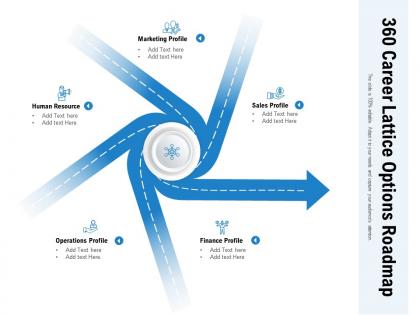
360 career lattice options roadmap




Try Before you Buy Download Free Sample Product
 Impress Your
 Audience
 100%
100% Editable
 Save Hours
 of Time


Our 360 Career Lattice Options Roadmap are topically designed to provide an attractive backdrop to any subject. Use them to look like a presentation pro.
People who downloaded this PowerPoint presentation also viewed the following :
360 career lattice options roadmap with all 2 slides:
Use our 360 Career Lattice Options Roadmap to effectively help you save your valuable time. They are readymade to fit into any presentation structure.
FAQs for 360 career
A career lattice emphasizes lateral movement, cross-functional opportunities, skill diversification, and flexible pathways, while traditional career ladders focus on vertical advancement, hierarchical progression, and upward mobility within specific departments. This lateral approach enables employees to develop broader competencies, explore diverse roles, and build strategic networks across organizations, ultimately delivering enhanced adaptability and expanded career possibilities in increasingly dynamic business environments.
Professionals can identify relevant skills for lateral moves through systematic market research, conducting informational interviews with target role incumbents, analyzing job descriptions across desired functions, and leveraging internal mentorship networks. Through strategic skills gap analysis and cross-functional project participation, professionals enhance their adaptability while building competencies that translate across departments, ultimately positioning themselves for seamless transitions and expanded career opportunities.
A career lattice enhances employee engagement by offering diverse development paths, skill-building opportunities, cross-functional mobility, mentorship programs, and personalized growth trajectories. Through lateral moves and specialized advancement tracks, employees experience greater autonomy, continuous learning, and career ownership, with organizations finding that this flexibility significantly reduces turnover while fostering innovation and internal talent retention.
Mentorship and networking provide essential guidance, opportunities, and strategic connections for navigating lateral moves, skill development, and cross-functional transitions within career lattices. Through mentors and professional networks, employees gain insights into different departments, identify emerging opportunities, and build relationships that facilitate seamless movement across organizational pathways, ultimately accelerating career growth.
Organizations can support employee career lattice development through mentorship programs, cross-functional project assignments, internal job shadowing opportunities, skills assessment tools, and regular career planning discussions. By providing learning and development budgets, creating transparent role requirements across departments, and facilitating networking connections, companies enable employees to map diverse career paths while building capabilities that enhance organizational agility and retention.
**INPUT**: What strategies should individuals adopt to effectively assess their skill sets for lateral opportunities? **OUTPUT**: Individuals should conduct comprehensive skills audits through self-assessment tools, peer feedback, performance reviews, and competency mapping against target roles. These strategies enable professionals to identify transferable skills, knowledge gaps, and growth opportunities across departments like marketing, operations, or project management, ultimately delivering clearer career pathways and enhanced internal mobility within their organizations. [Word count: 54 words]
Career lattice frameworks enable professionals to balance specialization and versatility by creating lateral movement opportunities, cross-functional project assignments, and skill-building rotations across departments. This strategic approach allows employees to deepen expertise in core areas while gaining broader organizational knowledge, with many companies finding that this combination enhances innovation, leadership capabilities, and ultimately delivers more adaptable talent pipelines.
Career lattice mapping tools include skills assessment platforms, internal mobility software, mentorship programs, career development workshops, and competency frameworks that identify lateral and vertical opportunities. These resources enable employees to visualize cross-functional pathways, assess skill gaps, and explore diverse advancement routes, with many organizations finding that structured mapping tools enhance retention and strategic talent development.
Diverse work experience enhances career lattice advancement by developing transferable skills, cross-functional knowledge, and broader organizational perspective that enables lateral moves and upward progression. Through exposure to different departments, projects, and challenges, professionals build versatile competencies and internal networks, ultimately creating multiple pathways for growth while delivering enhanced value to organizations seeking adaptable, well-rounded talent.
Ongoing education and training enhance career lattice mobility by developing transferable skills, expanding industry knowledge, building cross-functional competencies, and creating networking opportunities across different departments and sectors. These investments enable professionals to demonstrate value in diverse roles, with many organizations finding that continuous learners adapt more successfully to lateral moves, ultimately delivering greater versatility and strategic advantage in an increasingly dynamic workplace environment.
Common misconceptions about career lattice pathways include believing they lack clear progression, require constant lateral movement, delay promotions, eliminate specialization opportunities, and create confusion in traditional hierarchies. However, organizations implementing these frameworks find they actually enhance skill diversification, accelerate leadership development, and provide multiple advancement routes, ultimately delivering greater employee engagement and retention while building more versatile, adaptable teams.
Performance evaluations can be adapted by assessing cross-functional competencies, lateral skill development, collaboration across departments, and contribution to diverse projects rather than traditional hierarchical advancement metrics. These comprehensive assessments enable employees to demonstrate value through multiple pathways, with many organizations finding that lattice-focused evaluations enhance talent retention, internal mobility, and strategic workforce flexibility.
Company culture significantly impacts career lattice flexibility by determining whether organizations embrace cross-functional movement, knowledge sharing, collaboration across departments, and internal mobility over external hiring. Companies with growth-oriented cultures actively encourage lateral moves, skill diversification, and department rotations, while traditional hierarchical cultures may resist such flexibility, with many progressive organizations finding that cultural openness ultimately delivers enhanced employee engagement and competitive talent retention.
Professionals should leverage accomplishments by clearly articulating transferable skills, quantifiable results, and cross-functional impact that demonstrates value beyond their current role. When pursuing lateral transitions, highlighting collaborative projects, process improvements, and strategic contributions helps employers recognize versatility, while showcasing adaptability and diverse expertise ultimately positions candidates as strategic assets capable of driving organizational success across multiple business functions.
Employers face challenges including restructuring traditional hierarchies, managing increased lateral movement complexity, ensuring equitable advancement opportunities, and maintaining clear progression metrics within flexible pathways. While implementation requires significant cultural shifts and resource allocation, organizations in sectors like healthcare, technology, and financial services find that career lattices ultimately enhance employee retention and organizational agility.
No Reviews