

360 Degree Leadership Performance Appraisal




Try Before you Buy Download Free Sample Product
 Impress Your
 Audience
 100%
100% Editable
 Save Hours
 of Time


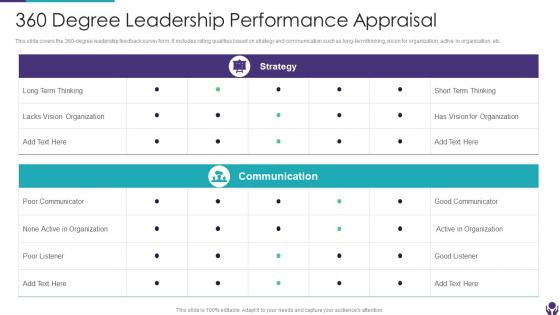
This slide covers the 360 degree leadership feedback survey form. It includes rating qualities based on strategy and communication such as long term thinking, vision for organization, active in organization, etc.
People who downloaded this PowerPoint presentation also viewed the following :
360 Degree Leadership Performance Appraisal with all 6 slides:
Use our 360 Degree Leadership Performance Appraisal to effectively help you save your valuable time. They are readymade to fit into any presentation structure.





FAQs for 360 Degree
Key benefits include enhanced self-awareness, improved leadership development, stronger communication skills, increased employee engagement, and comprehensive performance insights from multiple perspectives. These feedback systems streamline talent development by identifying skill gaps, fostering accountability, and creating targeted improvement plans, with many organizations finding that 360-degree assessments ultimately deliver better team dynamics and accelerated professional growth.
360-degree feedback contributes to employee development by providing comprehensive insights from supervisors, peers, subordinates, and customers, creating a holistic view of performance strengths and improvement areas. This multi-source approach enables targeted skill development, enhances self-awareness, and identifies blind spots, with many organizations finding that employees receiving regular 360-degree feedback demonstrate improved communication, leadership capabilities, and overall performance.
Common challenges include employee resistance to feedback transparency, lack of proper training for participants, inconsistent implementation across departments, and difficulty ensuring anonymous, honest responses. Many organizations find that without clear communication about the process's developmental purpose and strong leadership support, initiatives can create anxiety rather than growth, ultimately requiring careful change management and ongoing coaching to deliver meaningful performance improvements.
Anonymity in 360-degree feedback is ensured through secure online platforms, coded responses that separate identities from feedback, and third-party administrators who manage data collection and reporting. Organizations typically require minimum response thresholds, aggregate similar feedback sources, and present results in summarized formats, ultimately delivering honest insights while protecting participant confidentiality and encouraging candid developmental input.
Training plays a crucial role by educating participants on giving constructive feedback, interpreting results objectively, and creating development plans from insights gathered. Comprehensive training programs help managers, employees, and HR teams navigate the feedback process effectively, minimize defensive reactions, and maximize developmental outcomes, with many organizations finding that well-trained participants achieve significantly better engagement and performance improvements.
Organizations can effectively communicate 360-degree feedback's purpose by emphasizing its developmental nature, highlighting career growth opportunities, and demonstrating leadership commitment through transparent messaging. Through town halls, training sessions, and clear documentation, companies like Microsoft and General Electric have successfully positioned these programs as strategic investments in employee advancement, ultimately building trust and encouraging participation while reducing anxiety around the feedback process.
Success metrics for 360-degree feedback initiatives include participation rates, response quality scores, goal completion percentages, behavioral change indicators, and employee engagement improvements. Organizations typically measure ROI through enhanced performance ratings, reduced turnover, increased leadership effectiveness, and improved team collaboration, with many companies finding that sustained feedback cycles deliver measurable productivity gains and stronger organizational culture.
360-degree feedback can be tailored by adjusting communication styles, feedback frequency, anonymity levels, and cultural frameworks to match organizational values and hierarchical structures. While collaborative cultures benefit from open, frequent exchanges, traditional hierarchical organizations often require structured, formal processes with clear protocols, ultimately delivering enhanced employee development and organizational alignment across diverse cultural contexts.
Best practices for constructive feedback in 360-degree frameworks include focusing on specific behaviors rather than personality traits, providing balanced perspectives with both strengths and development areas, using clear examples, maintaining confidentiality, and delivering feedback with empathy and respect. These approaches enhance trust and receptivity by creating psychologically safe environments, encouraging honest dialogue, and ultimately delivering more meaningful professional development outcomes, with many organizations finding that structured feedback processes significantly improve employee engagement and performance.
Technology facilitates 360-degree feedback collection through automated survey distribution, real-time data aggregation, anonymous response systems, and integrated analytics platforms. These digital tools streamline the process by eliminating manual coordination, providing instant dashboard visualizations, and delivering comprehensive reports with actionable insights, ultimately enabling organizations to conduct more frequent, efficient, and meaningful performance evaluations.
360-degree feedback significantly enhances team dynamics by fostering transparency, accountability, and mutual understanding among colleagues through comprehensive peer evaluations. This multi-source approach enables teams to identify collaboration gaps, improve communication patterns, and build stronger working relationships, with many organizations finding that regular 360-feedback cycles ultimately deliver increased trust, reduced conflicts, and more cohesive team performance across departments.
Address employee skepticism through transparent communication about assessment goals, emphasizing professional development over performance evaluation, and ensuring anonymity to encourage honest feedback. Organizations like Microsoft and Google have successfully overcome resistance by involving employees in designing the process, providing comprehensive training on giving constructive feedback, and demonstrating how insights lead to meaningful career growth opportunities rather than punitive measures.
360-degree feedback should be conducted annually or bi-annually to maintain effectiveness, with timing depending on organizational goals, role complexity, and development cycles. Many organizations find that annual reviews provide sufficient time for meaningful behavioral changes while maintaining engagement, though leadership roles may benefit from more frequent assessments, ultimately delivering sustained performance improvement and strategic development outcomes.
**INPUT**: What strategies can be implemented to follow up on the feedback received through 360-degree evaluations? **OUTPUT**: Effective follow-up strategies include creating personalized development plans, scheduling regular coaching sessions, setting measurable improvement goals, and establishing accountability partnerships with mentors or supervisors. Organizations increasingly implement quarterly progress reviews, peer check-ins, and skill-building workshops, with many companies finding that structured follow-through ultimately delivers enhanced leadership capabilities and stronger team performance.
360-degree feedback differs from traditional appraisals by gathering input from multiple sources including peers, subordinates, customers, and supervisors, rather than relying solely on manager evaluations. This comprehensive approach delivers more balanced perspectives, reduces bias, and enhances employee development through diverse insights, with many organizations finding it creates stronger self-awareness and targeted improvement strategies.
-
The ease of modifying templates is just superb! Also, the vast collection offers plenty of options to choose from.
-
I discovered some really original and instructive business slides here. I found that they suited me well.