


4 pillars of safety management system




Try Before you Buy Download Free Sample Product
 Impress Your
 Audience
 100%
100% Editable
 Save Hours
 of Time


Our 4 Pillars Of Safety Management System are topically designed to provide an attractive backdrop to any subject. Use them to look like a presentation pro.
People who downloaded this PowerPoint presentation also viewed the following :
Content of this Powerpoint Presentation
Description:
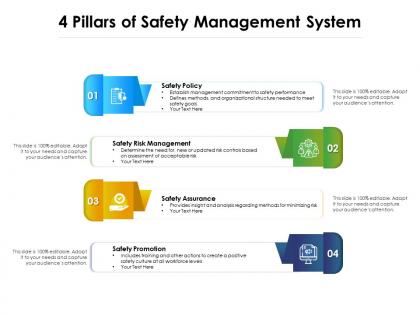
The image presents a structured breakdown of what it labels as the "4 Pillars of Safety Management System." This PowerPoint slide is designed for a presentation that aims to inform about the key components necessary for a comprehensive safety management system within an organization.
Pillar 1:
"Safety Policy," suggests establishing management commitment to safety performance, defining methods, goals, and the organizational structure necessary to meet safety goals, leaving a placeholder for additional personalized text.
Pillar 2:
"Safety Risk Management," focuses on determining the need for and the implementation of new or updated risk controls based on an assessment of acceptable risk. It again provides a space for tailored text.
Pillar 3:
"Safety Assurance," offers insight and analysis regarding methods for minimizing risk, and similar to the previous pillars, it has a customizable text area.
Pillar 4:
"Safety Promotion," includes guidelines for training and other actions that foster a positive safety culture at all workforce levels, accompanied by a placeholder for further details.
Use Cases:
These principles of safety management could be widely applicable across various industries where safety is a priority:
1. Construction:
Use: To establish and maintain safety standards on construction sites.
Presenter: Safety Officer
Audience: Construction Workers and Site Managers
2. Aviation:
Use: To outline the safety protocols required by flight and ground staff.
Presenter: Aviation Safety Manager
Audience: Pilots, Cabin Crew, and Airport Staff
3. Healthcare:
Use: To discuss risk management and assurance in clinical settings.
Presenter: Hospital Administrator
Audience: Medical Professionals and Hospital Staff
4. Manufacturing:
Use: To communicate the safety procedures around machinery and working environments.
Presenter: Plant Safety Coordinator
Audience: Factory Workers and Supervisors
5. Energy:
Use: To introduce safety frameworks for handling hazardous materials and operations.
Presenter: Safety Engineer
Audience: Energy Sector Employees and Contractors
6. Transportation:
Use: To focus on safety strategies for public and private transport services.
Presenter: Transport Safety Specialist
Audience: Drivers, Maintenance Crew, and Transport Managers
7. Education:
Use: To share safety practices within educational institutions.
Presenter: School Administrator or Campus Safety Officer
Audience: Teachers, Support Staff, and Facility Management Teams
4 pillars of safety management system with all 2 slides:
Use our 4 Pillars Of Safety Management System to effectively help you save your valuable time. They are readymade to fit into any presentation structure.
FAQs for 4 pillars of
Effective Safety Management Systems include safety policy development, risk assessment protocols, hazard identification procedures, incident reporting mechanisms, and continuous monitoring frameworks. These components work together by establishing clear accountability structures, enabling proactive risk mitigation, and facilitating regulatory compliance, with organizations in aviation, manufacturing, and healthcare finding that integrated SMS approaches ultimately deliver reduced incident rates and enhanced operational safety.
Risk assessment integrates into a Safety Management System through systematic hazard identification, probability analysis, impact evaluation, and control measure implementation across all operational levels. Organizations embed these assessments into daily workflows, incident reporting systems, and compliance auditing processes, with manufacturing and aviation sectors finding that continuous risk evaluation ultimately enhances operational safety and regulatory compliance.
Employee training serves as the foundation of SMS success by ensuring staff understand safety protocols, recognize hazards, report incidents effectively, and maintain compliance standards across operations. Through comprehensive training programs, organizations develop a safety-conscious workforce that proactively identifies risks, responds appropriately to emergencies, and continuously improves safety practices, ultimately delivering reduced incidents and enhanced operational reliability.
Organizations measure Safety Management System effectiveness through leading indicators like training completion rates, safety audits, and near-miss reporting, alongside lagging indicators such as incident rates, compliance scores, and cost analyses. These metrics enable companies across manufacturing, construction, and healthcare to identify trends, benchmark performance, and demonstrate ROI, ultimately delivering improved safety outcomes and reduced operational risks.
Common challenges include resistance to cultural change, inadequate resource allocation, insufficient training programs, poor communication across departments, and lack of leadership commitment. Organizations often struggle with integrating new safety protocols into existing workflows, maintaining consistent documentation, and ensuring employee buy-in, with many companies finding that sustained leadership engagement and comprehensive training ultimately overcome initial implementation barriers.
Technology enhances Safety Management Systems through real-time monitoring sensors, predictive analytics, automated incident reporting, IoT-connected equipment, and AI-powered risk assessment tools. These technologies streamline safety protocols by identifying hazards before incidents occur, accelerating emergency response times, and delivering comprehensive safety data analysis, with manufacturing and construction industries finding significantly improved workplace safety outcomes.
Company culture significantly influences SMS effectiveness by shaping employee attitudes toward safety reporting, risk communication, and compliance behaviors across all organizational levels. A culture that encourages transparency and accountability enables proactive hazard identification, streamlined incident reporting, and continuous improvement initiatives, with many organizations finding that strong safety cultures ultimately deliver reduced incidents, enhanced operational efficiency, and sustained regulatory compliance.
Key SMS performance metrics include incident rates, near-miss reporting frequency, safety training completion rates, audit compliance scores, and corrective action closure times. These indicators work together to provide comprehensive safety oversight, with many organizations finding that tracking leading indicators like safety observations and employee engagement alongside traditional lagging metrics delivers better predictive insights and ultimately enhances overall safety culture.
Organizations ensure regulatory compliance through their SMS by establishing systematic documentation processes, conducting regular audits and inspections, implementing corrective action protocols, and maintaining detailed incident reporting systems. Through automated compliance tracking and real-time monitoring, companies in manufacturing, aviation, and chemical industries streamline regulatory adherence while reducing violation risks, ultimately delivering enhanced operational transparency and competitive advantage in increasingly regulated environments.
Best practices for conducting safety audits include establishing clear audit criteria, using trained auditors, implementing systematic documentation processes, ensuring regular scheduling intervals, and maintaining independence from audited areas. These practices enhance organizational safety by identifying hazards proactively, verifying compliance with safety protocols, and creating accountability frameworks, with many aviation, manufacturing, and healthcare organizations finding that comprehensive audits ultimately deliver improved safety performance and regulatory compliance.
Communication can be improved through regular safety briefings, standardized reporting protocols, open feedback channels, digital communication platforms, and cross-departmental collaboration initiatives. These approaches streamline information flow by ensuring consistent messaging, facilitating real-time incident reporting, and creating transparent dialogue between management and frontline workers, ultimately delivering enhanced safety awareness and faster response times across organizations.
Incident reporting and investigation form the backbone of SMS effectiveness by identifying hazards, analyzing root causes, and preventing recurrence through systematic data collection and corrective actions. These processes enable organizations across aviation, manufacturing, and healthcare to enhance operational safety, reduce liability exposure, and maintain regulatory compliance, ultimately delivering improved safety performance and competitive advantage in increasingly regulated industries.
Strategies include regular safety training programs, creating safety committees with employee representatives, implementing recognition systems for safe behaviors, conducting participatory safety audits, and establishing open communication channels for reporting concerns. These approaches enhance engagement by empowering workers as safety partners, fostering ownership through direct involvement, and demonstrating organizational commitment, with many companies finding that employee-driven initiatives significantly reduce workplace incidents while improving overall safety culture.
Safety Management Systems adapt to remote and hybrid environments through digital incident reporting platforms, virtual safety training modules, online risk assessments, and cloud-based compliance tracking tools. These systems enable organizations to maintain safety oversight across distributed workforces by monitoring home office ergonomics, tracking mental health metrics, and conducting virtual safety audits, ultimately ensuring consistent safety standards while supporting flexible work arrangements.
Continuous improvement drives Safety Management System evolution by enabling regular assessment of safety protocols, incorporating lessons learned from incidents, and adapting to emerging risks and regulatory changes. Through systematic feedback loops, organizations enhance their safety culture, streamline reporting processes, and implement more effective risk mitigation strategies, ultimately delivering reduced incidents and improved operational resilience across all business functions.
No Reviews