


4 stage lean agile transformation




Try Before you Buy Download Free Sample Product
 Impress Your
 Audience
 100%
100% Editable
 Save Hours
 of Time


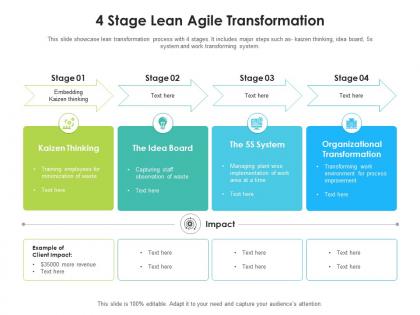
This slide showcase lean transformation process with 4 stages. It includes major steps such as- kaizen thinking, idea board, 5s system and work transforming system.
People who downloaded this PowerPoint presentation also viewed the following :
4 stage lean agile transformation with all 2 slides:
Use our 4 Stage Lean Agile Transformation to effectively help you save your valuable time. They are readymade to fit into any presentation structure.
FAQs for 4 stage
Key principles include customer-centricity, continuous improvement, value stream optimization, cross-functional collaboration, and rapid feedback cycles. These approaches streamline operations by eliminating waste, accelerating delivery timelines, and enhancing team autonomy, with many organizations finding that strategic implementation delivers improved product quality, reduced time-to-market, and sustained competitive advantage.
Organizations can effectively measure Lean Agile transformation success through key performance indicators like cycle time reduction, customer satisfaction scores, employee engagement metrics, delivery frequency improvements, and defect rates. These measurements enable companies across sectors, from financial services to manufacturing, to track operational efficiency gains, enhanced team collaboration, and faster time-to-market capabilities, ultimately delivering competitive advantage and sustainable business growth.
Leadership plays a pivotal role by championing cultural change, removing organizational barriers, providing necessary resources, and modeling agile behaviors throughout the transformation process. Effective leaders facilitate cross-functional collaboration, empower teams with decision-making authority, and maintain transparent communication, with many organizations finding that leadership commitment directly correlates with transformation success and sustainable competitive advantage.
Teams can overcome resistance by implementing transparent communication, providing comprehensive training, involving skeptical members in decision-making processes, and demonstrating quick wins through pilot projects. Through gradual implementation and continuous feedback loops, organizations like manufacturing companies and financial services find that early adopters become change champions, ultimately creating momentum that reduces resistance while enhancing team collaboration and operational efficiency.
Common pitfalls in Lean Agile transformation include insufficient leadership commitment, resistance to cultural change, inadequate training, rushing implementation without proper foundation, and maintaining rigid hierarchical structures. Organizations can avoid these by securing executive sponsorship, investing in comprehensive change management, providing continuous coaching and training, adopting gradual phased approaches, and restructuring teams around cross-functional collaboration, ultimately delivering improved responsiveness and competitive advantage.
Organizations tailor Lean Agile transformation by conducting industry-specific assessments, adapting methodologies to regulatory requirements, customizing metrics for sector goals, and aligning practices with operational constraints. Financial services emphasize compliance frameworks, healthcare focuses on patient safety protocols, and manufacturing integrates production workflows, with many finding that sector-specific customization accelerates adoption and delivers sustainable competitive advantage.
Lean Agile transformation tools include SAFe (Scaled Agile Framework), Kanban boards, value stream mapping, retrospective templates, and digital collaboration platforms like Jira or Azure DevOps. These frameworks streamline workflow visibility, enhance cross-functional communication, and accelerate delivery cycles, with many organizations finding that strategic tool combination ultimately delivers faster time-to-market and improved operational efficiency.
Lean Agile transformation enhances team dynamics by promoting cross-functional collaboration, eliminating silos, establishing regular feedback loops, and encouraging shared accountability for outcomes. Through daily standups, retrospectives, and continuous improvement practices, organizations streamline communication, reduce decision-making delays, and foster transparent problem-solving, with many teams finding that this approach ultimately delivers faster innovation and stronger employee engagement.
Best practices for training and coaching teams during Lean Agile transformation include hands-on workshops, embedded coaching, cross-functional collaboration sessions, continuous feedback loops, and leadership alignment programs. These approaches streamline adoption by combining theoretical knowledge with practical application, fostering psychological safety, and enabling iterative learning, with many organizations finding that sustained coaching ultimately delivers faster time-to-market and enhanced team autonomy.
Organizations ensure continuous improvement through regular retrospectives, feedback loops, value stream mapping, and iterative process refinement based on data-driven insights. By establishing metrics for cycle time, quality, and customer satisfaction, teams can identify bottlenecks and optimization opportunities, with many companies finding that cross-functional collaboration and leadership commitment ultimately deliver sustained operational excellence and competitive advantage.
Effective Lean Agile transformation metrics include cycle time, lead time, team velocity, defect rates, customer satisfaction scores, and employee engagement levels. These measurements enable organizations to track operational efficiency, quality improvements, and cultural adoption across departments, with many companies finding that combining quantitative performance data with qualitative feedback delivers comprehensive insights into transformation success.
Customer feedback integration enhances Lean Agile transformation by enabling continuous product refinement, accelerating iteration cycles, and ensuring market alignment throughout development processes. Through direct customer insights, organizations streamline decision-making, reduce development waste, and deliver more targeted solutions, with many companies finding that regular feedback loops ultimately improve product-market fit and competitive responsiveness.
Sustaining Lean Agile transformation requires cultural shifts toward psychological safety, continuous learning, customer-centricity, cross-functional collaboration, and embracing failure as learning opportunities. These changes enable organizations to move from hierarchical decision-making to empowered teams, with many companies finding that fostering transparency and adaptive leadership ultimately delivers faster innovation and enhanced competitive advantage.
Lean Agile transformation scales across large enterprises through strategic portfolio alignment, cross-functional team coordination, standardized frameworks like SAFe or LeSS, and executive sponsorship at every organizational level. This approach enables consistent methodology implementation while preserving team autonomy, with many Fortune 500 companies finding that gradual rollouts combined with continuous coaching ultimately deliver faster innovation cycles and improved market responsiveness.
Lean Agile transformation fundamentally shifts project management from traditional waterfall approaches to iterative, customer-centric methodologies that emphasize continuous delivery, cross-functional collaboration, and adaptive planning. This transformation enables organizations across industries like software development, manufacturing, and financial services to reduce project cycle times, enhance stakeholder engagement, and respond more rapidly to market changes, ultimately delivering improved product quality and competitive advantage.
-
I discovered this website through a google search, the services matched my needs perfectly and the pricing was very reasonable. I was thrilled with the product and the customer service. I will definitely use their slides again for my presentations and recommend them to other colleagues.
-
Excellent products for quick understanding.
-
Unique research projects to present in meeting.
-
Design layout is very impressive.
-
Unique and attractive product design.