

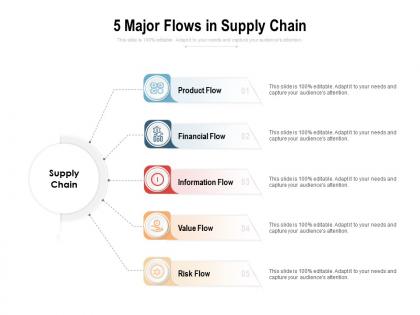
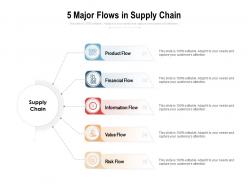
5 major flows in supply chain




Try Before you Buy Download Free Sample Product
 Impress Your
 Audience
 100%
100% Editable
 Save Hours
 of Time


Our 5 Major Flows In Supply Chain are topically designed to provide an attractive backdrop to any subject. Use them to look like a presentation pro.
People who downloaded this PowerPoint presentation also viewed the following :
5 major flows in supply chain with all 2 slides:
Use our 5 Major Flows In Supply Chain to effectively help you save your valuable time. They are readymade to fit into any presentation structure.
FAQs for 5 major flows
Supply chain flows include information flows, material flows, financial flows, service flows, and reverse flows. These interconnected streams enhance operational efficiency by enabling real-time visibility, coordinating inventory movement, and streamlining payment processes, with many manufacturing and retail organizations finding that integrated flow management ultimately delivers faster response times and competitive advantage.
Information flow enhances collaboration by enabling real-time data sharing, synchronized planning, transparent communication, and coordinated decision-making across all supply chain partners. Through integrated systems and shared platforms, manufacturers, suppliers, and distributors achieve better demand forecasting, reduced inventory costs, and faster response times, ultimately delivering improved customer satisfaction and competitive advantage.
Technology revolutionizes supply chain flows through automation, real-time tracking, predictive analytics, AI-driven demand forecasting, and integrated management systems. These solutions enhance operational efficiency by minimizing delays, reducing costs, and improving inventory management, with manufacturing and retail companies finding that streamlined digital processes ultimately deliver faster delivery times and enhanced customer satisfaction.
Companies face challenges including demand forecasting accuracy, inventory optimization, transportation bottlenecks, supplier reliability issues, and warehouse capacity constraints in managing physical flows. These operational hurdles can significantly impact delivery timelines, increase storage costs, and reduce customer satisfaction, with many organizations finding that inefficient physical flow management ultimately undermines their competitive advantage in increasingly demanding markets.
Businesses can optimize cash flow by extending payment terms with suppliers, accelerating customer collections, implementing dynamic discounting programs, and leveraging supply chain financing solutions. Through strategic payment timing and digital invoicing platforms, companies streamline cash conversion cycles, reduce working capital requirements, and enhance liquidity management, with many organizations finding that these approaches deliver improved financial flexibility and stronger supplier relationships.
Demand forecasts influence supply chain flow dynamics by determining production schedules, inventory levels, resource allocation, and logistics planning across all network stages. These predictions enable manufacturers to optimize capacity utilization, distributors to position stock strategically, and retailers to minimize stockouts, ultimately delivering improved service levels and reduced costs while enhancing responsiveness to market fluctuations.
Reverse logistics significantly enhance overall supply chain efficiency by recovering value from returned products, reducing waste disposal costs, and enabling resource reuse through refurbishment and recycling processes. Companies in electronics, automotive, and retail sectors streamline operations by integrating reverse flows with forward logistics, ultimately delivering cost savings, improved sustainability metrics, and stronger customer loyalty through efficient return handling.
Best practices for implementing seamless information flow include establishing standardized data formats, deploying cloud-based integration platforms, implementing real-time tracking systems, creating automated communication protocols, and maintaining centralized dashboards for visibility. These technologies streamline operations by enabling instant coordination between suppliers, manufacturers, and distributors across continents, ultimately delivering faster response times and reduced operational costs, with many global enterprises finding significant competitive advantages through enhanced transparency.
Regulatory changes significantly impact supply chain flows by altering compliance requirements, trade documentation, and cross-border procedures across different regions. These modifications force companies to restructure logistics networks, update supplier relationships, and invest in new tracking systems, with many multinational organizations finding that proactive regulatory monitoring ultimately delivers operational resilience and competitive advantage.
Lead time is crucial for supply chain flows because it determines inventory requirements, production scheduling, and customer service levels, directly impacting cash flow and operational efficiency. Shorter lead times enable companies to reduce safety stock, respond faster to demand changes, and improve customer satisfaction, with many manufacturers and retailers finding that optimized lead times deliver significant competitive advantages and cost reductions.
Companies measure supply chain flow effectiveness through key performance indicators like inventory turnover, order fulfillment rates, lead times, cost per unit, and on-time delivery percentages. These metrics enable organizations to identify bottlenecks, optimize resource allocation, and enhance operational efficiency, with many manufacturing and retail companies finding that integrated analytics platforms deliver significant cost reductions and improved customer satisfaction.
Sustainability significantly transforms supply chain flow strategies by driving circular economy practices, renewable energy adoption, waste reduction initiatives, and ethical sourcing requirements. These environmental considerations reshape traditional logistics models, with companies like Unilever and Patagonia finding that sustainable flows reduce operational costs, enhance brand reputation, and deliver competitive advantages in increasingly environmentally-conscious markets.
Risk management integrates into supply chain flow planning through scenario modeling, supplier diversification strategies, buffer stock optimization, and real-time monitoring systems. These approaches enable organizations to identify vulnerabilities early, develop contingency protocols, and maintain operational continuity, with many manufacturers finding that proactive risk integration reduces disruption costs while enhancing supply chain resilience.
Essential technologies for real-time supply chain tracking include IoT sensors, RFID tags, GPS systems, blockchain platforms, and AI-powered analytics tools. These technologies enhance visibility by monitoring shipments continuously, automating data collection, and predicting potential disruptions, with many logistics companies finding that this combination ultimately delivers faster response times, reduced costs, and improved customer satisfaction.
Businesses leverage data analytics to improve supply chain visibility through real-time tracking systems, predictive modeling, demand forecasting algorithms, and integrated dashboard platforms that consolidate multi-source information. These technologies enable companies to identify bottlenecks, optimize inventory levels, and anticipate disruptions proactively, with manufacturing and retail organizations finding significantly enhanced operational efficiency and reduced costs.
No Reviews