


5 piece circle puzzle layout powerpoint guide




Try Before you Buy Download Free Sample Product
 Impress Your
 Audience
 100%
100% Editable
 Save Hours
 of Time


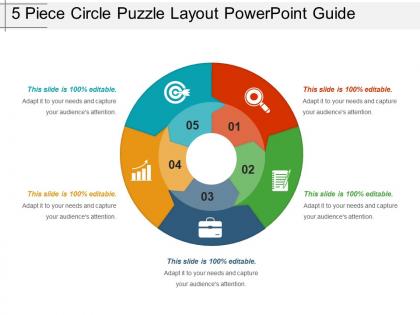
Use our 5 piece circle puzzle layout PowerPoint guide and be able to illustrate your data in the best possible manner. This 5 pieces circle puzzle uses a round shape divided into five parts along with text holders which are edited. Our business experts have designed this 5 segment circular puzzle for business professionals like you who do not have time to sit and design the slides themselves. Due to the use of high resolution and premium quality slides while designing this donut shaped business slides the quality of your work will be uplifted. We assure you that by downloading and using this 5 part circle puzzle PPT slideshow you will be able to save a lot of your precious time s the slides used in it are predesigned and ready to use. The use of this business slides will allow you to reduce all your stress and workload that you used to face. So if you are hungry to get successful andand want to get famous simply hit the download button and make most of this opportunity. Use our 5 Piece Circle Puzzle Layout Powerpoint Guide as a looking glass. Train them on the magnificent future you have in mind.
People who downloaded this PowerPoint presentation also viewed the following :
5 piece circle puzzle layout powerpoint guide with all 5 slides:
Eliminate factors that can be harmful with our 5 Piece Circle Puzzle Layout Powerpoint Guide. Identify causes of insecurity.
FAQs for 5 piece circle puzzle
A 5-piece circle puzzle layout enhances presentations by creating visual unity, simplifying complex interconnected concepts, improving audience comprehension through segmented information, and facilitating step-by-step explanations of processes or frameworks. This strategic design enables presenters to demonstrate how individual components work together seamlessly, particularly effective for business strategies, team structures, and systematic workflows, ultimately delivering clearer communication and stronger audience engagement.
A 5-piece circle puzzle layout enhances audience engagement by creating visual intrigue, encouraging active participation through revelation of interconnected elements, and facilitating better information retention through sequential storytelling. This approach transforms static presentations into dynamic experiences, with many presenters finding that audiences remain more focused and invested when content unfolds progressively, ultimately delivering stronger message comprehension and memorable business communications.
**INPUT**: What types of content or data are best suited for a 5-piece circle puzzle layout? **OUTPUT**: Five-piece circle puzzle layouts excel with cyclical processes, strategic frameworks, interconnected business components, departmental relationships, and balanced scorecards. These visual structures streamline complex organizational data by demonstrating interdependencies, enhancing stakeholder understanding, and creating memorable presentations, with many executives finding that circular formats deliver stronger audience engagement and clearer strategic communication.
Industries requiring clear process visualization particularly benefit from 5 piece circle puzzle layouts, including healthcare for patient care pathways, manufacturing for quality control stages, financial services for compliance workflows, and education for curriculum development. These sectors leverage the circular design to demonstrate interconnected processes, stakeholder relationships, and systematic approaches, ultimately enhancing operational clarity and strategic communication across complex organizational frameworks.
A 5-piece circle puzzle layout facilitates better comprehension by breaking complex information into interconnected segments, creating visual hierarchy, and showing relationships between components through circular flow patterns. This segmented approach enables audiences to process information sequentially while understanding the complete picture, with many organizations in consulting, education, and strategic planning finding that circular layouts enhance retention and comprehension significantly.
5-piece circle puzzle templates should follow principles of proportional balance, clear visual hierarchy, consistent spacing between segments, complementary color schemes, and readable typography that maintains legibility across all pieces. These design elements work together by ensuring each segment commands equal visual weight, creating intuitive information flow, and delivering professional presentations that enhance audience comprehension, with many organizations finding that well-designed circular layouts significantly improve stakeholder engagement.
Color theory enhances 5-piece circle puzzle layouts through strategic contrast, complementary pairings, visual hierarchy, temperature variations, and saturation balance to guide audience attention and improve comprehension. These principles streamline information processing by creating distinct segment boundaries, emphasizing key data points, and establishing intuitive flow patterns, with many organizations finding that thoughtful color application significantly increases presentation engagement and message retention.
PowerPoint, Google Slides, Canva, Prezi, and specialized template providers like SlideTeam offer excellent tools for creating 5-piece circle puzzle presentations. These platforms enable professionals to build visually compelling circular diagrams through drag-and-drop functionality, customizable templates, and seamless integration capabilities, with many organizations finding that pre-designed templates significantly accelerate presentation development while maintaining professional design standards.
**INPUT**: Can you provide examples of effective presentations that utilized a 5-piece circle puzzle layout? **OUTPUT**: Effective presentations using 5-piece circle puzzle layouts include strategic planning workshops showing market analysis, competitive positioning, resource allocation, risk assessment, and growth opportunities as interconnected elements. Corporate training sessions, consulting proposals, and business transformation presentations leverage this format to demonstrate how customer experience, operational efficiency, technology integration, workforce development, and financial performance work together, ultimately delivering comprehensive solutions that stakeholders can easily understand and act upon. [Word count: 60 words]
A 5-piece circle puzzle layout enhances visual engagement and information retention compared to traditional linear slide formats by creating interconnected segments, demonstrating relationships between concepts, and encouraging audience participation through discovery-based learning. This circular approach streamlines complex processes into digestible components while maintaining logical flow, with many organizations finding that puzzle layouts deliver improved comprehension and stronger stakeholder buy-in during presentations.
Common mistakes include overcrowding segments with text, using inconsistent colors or fonts, placing unrelated information together, making segments disproportionate to their importance, and failing to establish clear logical flow. These design flaws confuse audiences and dilute key messages, with many presenters finding that balanced visual hierarchy, coherent color schemes, and strategic content placement ultimately deliver clearer communication and stronger audience engagement.
Interactivity can be incorporated through clickable segments that reveal detailed information, hover effects highlighting connections between pieces, animated transitions showing process flows, and drag-and-drop functionality for audience engagement. These interactive elements enhance presentations by enabling deeper exploration of complex concepts, facilitating audience participation during meetings, and creating memorable experiences that improve information retention and comprehension.
Storytelling can be integrated by assigning each puzzle piece a chapter of your narrative, with the central circle representing the main theme or resolution. Each piece becomes a story element—characters, conflict, setting, climax, and outcome—that connects seamlessly to create a compelling flow, with many presenters finding that this circular approach reinforces narrative continuity and audience engagement.
Visual layouts like 5-piece circle puzzles resonate strongly with analytical professionals, strategic planners, C-suite executives, and educational audiences who process complex information systematically. These demographics, particularly in consulting, finance, healthcare, and technology sectors, find that circular visualizations enhance comprehension of interconnected processes, strategic frameworks, and cyclical workflows, ultimately delivering clearer communication and faster decision-making in presentations.
The layout supports thematic storytelling by creating visual continuity between presentation sections, with each puzzle piece representing distinct themes while maintaining connection to the central narrative. This approach enables presenters to build comprehensive stories across multiple slides, seamlessly transitioning between related concepts, ultimately delivering cohesive messaging that enhances audience understanding and retention.
-
Best way of representation of the topic.
-
Designs have enough space to add content.