


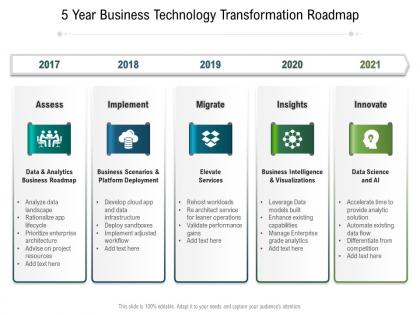
5 year business technology transformation roadmap




Try Before you Buy Download Free Sample Product
 Impress Your
 Audience
 100%
100% Editable
 Save Hours
 of Time


Utilize our pre build 5 Year Business Technology Transformation Roadmap to present your plan of action in the most effective way. Reduce the paperwork and showcase how different activities are linked to each other by incorporating this attention grabbing PowerPoint theme. This completely editable roadmap PPT layout is suitable to fit all your needs and to have a structured outline of the entire process flow using color coding. Provide guidelines to your teammates about the progression process by employing our PPT theme. Team members can easily be designated into teams by accessing the work milestones to be accomplished within the timeframe. You can easily modify the PowerPoint slide according to real time situations. Download our stunning 5 Year Business Technology Transformation Roadmap, and you are good to go to prove your expertise in strategic planning.
People who downloaded this PowerPoint presentation also viewed the following :
5 year business technology transformation roadmap with all 2 slides:
Give your audience a fulfilling experience. They will find our 5 Year Business Technology Transformation Roadmap elevating.
FAQs for 5 year business
Key components include strategic assessment and goal alignment, technology infrastructure evaluation, stakeholder engagement planning, phased implementation timelines, and risk mitigation strategies. These elements work together by establishing clear priorities, ensuring resource allocation matches business objectives, and creating measurable milestones, with many organizations finding that comprehensive roadmaps reduce implementation costs while accelerating digital transformation outcomes.
Organizations assess their current technology landscape through comprehensive audits, system inventory analysis, performance benchmarking, security evaluations, and stakeholder feedback collection. This strategic assessment enables identifying integration gaps, operational inefficiencies, and modernization priorities, with many enterprises finding that thorough landscape analysis accelerates transformation timelines and delivers better ROI outcomes.
Stakeholder engagement drives technology transformation success by ensuring alignment with business objectives, identifying critical requirements, securing necessary resources, and building organizational buy-in across departments. Through collaborative workshops and feedback sessions, companies gather diverse perspectives that shape realistic timelines and implementation priorities, ultimately delivering solutions that enhance operational efficiency while minimizing resistance to change.
Businesses can prioritize technology investments by conducting thorough cost-benefit analyses, focusing on solutions that streamline core operations, and implementing phased approaches that deliver quick wins alongside long-term strategic goals. This strategic combination enables organizations to maximize ROI by targeting high-impact areas first, while many companies find that starting with customer-facing technologies and operational automation delivers measurable returns faster.
Key metrics for technology transformation success include operational efficiency improvements, cost reduction percentages, user adoption rates, system uptime reliability, and customer satisfaction scores. These measurements enable organizations to track ROI across departments, with many financial services and healthcare institutions finding that combining quantitative performance data with qualitative user feedback delivers comprehensive insights into transformation effectiveness and competitive advantage.
Organizations effectively manage change resistance by establishing transparent communication channels, providing comprehensive training programs, involving employees in decision-making processes, and creating feedback mechanisms that address concerns proactively. Through strategic change management approaches, companies like financial institutions and healthcare organizations streamline adoption rates, enhance employee buy-in, and ultimately deliver smoother transitions, with many finding that early engagement significantly reduces implementation timelines.
Best practices for aligning technology transformation goals with business objectives include establishing cross-functional steering committees, conducting comprehensive business-technology gap analyses, creating measurable KPIs tied to revenue outcomes, implementing phased rollout strategies, and maintaining regular stakeholder communication protocols. These approaches enable organizations to streamline resource allocation, minimize implementation risks, and accelerate competitive advantage, with many enterprises finding that strategic alignment ultimately delivers faster ROI and enhanced operational efficiency.
AI and IoT integration requires strategic phasing through pilot programs, infrastructure assessment, data platform development, and cross-functional team alignment with existing systems. Organizations typically begin with specific use cases like predictive maintenance in manufacturing or customer analytics in retail, gradually scaling these technologies across departments while ensuring robust cybersecurity frameworks, ultimately delivering enhanced operational efficiency and competitive advantage.
Common pitfalls include inadequate stakeholder engagement, unrealistic timelines, insufficient change management planning, lack of clear success metrics, and underestimating integration complexities. Organizations often find success by conducting thorough current-state assessments, establishing cross-functional governance structures, and prioritizing user training alongside technical implementation, ultimately delivering smoother transitions and higher adoption rates.
Businesses ensure adaptable technology transformation roadmaps by implementing modular architectures, establishing regular review cycles, prioritizing cloud-native solutions, and maintaining flexible integration capabilities. Through strategic planning that emphasizes scalability and interoperability, organizations can pivot quickly when new technologies emerge, while continuous monitoring and stakeholder feedback loops enable seamless updates, ultimately delivering sustained competitive advantage in an increasingly dynamic digital landscape.
Data governance provides the foundation for successful technology transformation by establishing data quality standards, access controls, privacy protocols, and compliance frameworks throughout the modernization process. Through robust governance structures, organizations streamline migration activities, enhance security measures, and ensure regulatory adherence, with many enterprises finding that strong data stewardship ultimately delivers faster implementation timelines and sustainable competitive advantages.
Organizations leverage customer insights to inform technology transformation through feedback analysis, behavioral data mining, journey mapping, preference surveys, and satisfaction metrics. These insights enable companies to prioritize user-centric features, streamline digital experiences, and automate pain points, with many retail and financial services firms finding that customer-driven transformation strategies ultimately deliver higher adoption rates and competitive advantage.
Essential collaborative tools include project management platforms like Asana or Monday.com, real-time communication systems such as Slack or Microsoft Teams, document sharing solutions like SharePoint, video conferencing tools, and workflow automation platforms. These technologies streamline coordination by centralizing updates, enabling instant feedback, and maintaining transparency across departments, with many organizations finding that integrated collaboration suites significantly accelerate transformation timelines while reducing miscommunication.
A phased approach minimizes disruption by implementing changes incrementally, allowing teams to adapt gradually, maintaining operational continuity, and enabling iterative testing and refinement. Through strategic sequencing, organizations can preserve critical functions while upgrading systems, with many financial services and healthcare institutions finding that staggered rollouts reduce risk while delivering measurable improvements in efficiency and performance.
Organizations should develop data literacy, change management capabilities, digital collaboration skills, systems thinking, and continuous learning mindsets within their workforce. These competencies enable teams to navigate evolving technologies, adapt workflows seamlessly, and drive innovation across departments, with many companies finding that cross-functional training and upskilling programs ultimately deliver greater operational agility and competitive advantage.
No Reviews