


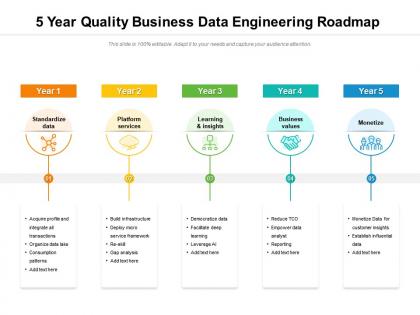
5 year quality business data engineering roadmap




Try Before you Buy Download Free Sample Product
 Impress Your
 Audience
 100%
100% Editable
 Save Hours
 of Time


A well thought out action plan makes execution easier and increases the possibility of success significantly. Ensure hitting all the milestones within the deadlines by introducing our fully customizable 5 Year Quality Business Data Engineering Roadmap. Streamline the work related information, budget, timeframe, key deliverable, landmarks, and major steps involved, all in one place to give an organized overview of the project by utilizing our PowerPoint theme. Minimize time lag and increase work efficiency by providing insight into the process with our comprehensively researched roadmap PowerPoint layout. Color coding helps in highlighting the process and grabs the attention of the audience. Download our handy 5 Year Quality Business Data Engineering Roadmap to identify the possible problem areas in a much shorter time and propose solutions. Have a productive brainstorming session with your workforce by utilizing our action plan visualization tool.
People who downloaded this PowerPoint presentation also viewed the following :
5 year quality business data engineering roadmap with all 2 slides:
Give your audience a fulfilling experience. They will find our 5 Year Quality Business Data Engineering Roadmap elevating.
FAQs for 5 year quality business
Key skills for successful data engineering include programming languages like Python and SQL, database management, ETL pipeline development, cloud platforms, and data modeling expertise. These technical competencies enable engineers to streamline data workflows, automate processing systems, and optimize storage solutions, with many organizations finding that skilled data engineers ultimately deliver faster analytics, enhanced decision-making capabilities, and significant competitive advantages.
Data engineers focus on building, maintaining, and optimizing data infrastructure, pipelines, and storage systems, while data scientists analyze processed data to extract insights, build predictive models, and drive strategic decisions. Engineers ensure reliable data flow and accessibility across organizations, enabling scientists to perform advanced analytics, with many companies finding that this strategic combination streamlines operations and enhances competitive advantage.
Essential tools for data pipeline construction include Apache Kafka, Apache Airflow, Apache Spark, cloud platforms like AWS Data Pipeline, and database technologies such as PostgreSQL and MongoDB. These technologies streamline data ingestion, transformation, and orchestration by automating workflows, enabling real-time processing, and ensuring scalable data management, with many organizations finding that strategic tool combinations ultimately deliver faster analytics and competitive advantage.
Data modeling is the foundational process of structuring, organizing, and defining relationships between data elements to ensure consistency, accuracy, and accessibility across systems. It enables data engineers to design scalable architectures, optimize query performance, and maintain data integrity, with organizations in finance, healthcare, and retail finding that well-designed models significantly reduce processing times and enhance analytical capabilities.
Cloud platforms enhance data engineering workflows by providing scalable infrastructure, managed services like data warehouses and ETL tools, and seamless integration capabilities. These platforms enable organizations to process vast datasets more efficiently, reduce infrastructure costs, and accelerate deployment cycles, with many enterprises finding that cloud-native solutions deliver greater flexibility and faster time-to-market for data initiatives.
Data architecture best practices include establishing clear data governance frameworks, implementing robust security protocols, ensuring scalability through modular design, maintaining comprehensive documentation, and creating standardized data integration processes. These approaches streamline operations by reducing redundancy, enhancing data quality, and enabling seamless cross-platform integration, with many organizations finding that well-designed architectures ultimately deliver faster analytics and competitive advantage.
Data governance plays a critical role in data engineering by establishing policies, standards, and procedures that ensure data quality, security, and compliance throughout the entire data pipeline. It provides the framework for data lineage tracking, access controls, and metadata management, while ensuring regulatory adherence and cross-team collaboration, ultimately delivering trusted, reliable data assets that support strategic business decisions.
Common challenges data engineers face include data quality issues, scalability bottlenecks, integration complexities, pipeline failures, and managing diverse data sources across legacy and modern systems. These obstacles can be overcome through automated testing frameworks, cloud-native architectures, robust monitoring systems, and standardized ETL processes, with many organizations finding that investing in modern data infrastructure and cross-functional training ultimately delivers improved reliability and operational efficiency.
Big data technologies like Hadoop and Spark integrate into data engineering solutions by providing distributed storage through HDFS, parallel processing capabilities, real-time analytics, and seamless data pipeline orchestration. These platforms enable organizations to handle massive datasets efficiently, streamline ETL processes, and deliver faster insights across industries like finance and healthcare, ultimately enhancing scalability and competitive advantage.
ETL serves as the backbone of data engineering by extracting data from various sources, transforming it into consistent formats, and loading it into target systems like data warehouses. This process enables organizations to consolidate disparate information from databases, APIs, and files, ultimately delivering clean, analytics-ready datasets that drive business intelligence and informed decision-making.
Essential database and data warehouse management skills include SQL proficiency, data modeling, ETL development, performance optimization, and cloud platform expertise like AWS or Azure. These competencies enable professionals to design scalable architectures, streamline data pipelines, and ensure reliable access to information, with many organizations finding that skilled managers deliver faster analytics, reduced costs, and enhanced decision-making capabilities.
Data engineers ensure data quality through comprehensive validation frameworks, automated testing protocols, data profiling mechanisms, anomaly detection systems, and robust monitoring dashboards. These approaches streamline operations by implementing real-time quality checks, establishing clear data lineage, and creating automated alerts for inconsistencies, with many organizations finding that proactive quality measures significantly reduce downstream errors while enhancing analytical accuracy.
Data engineers should monitor real-time streaming analytics, serverless data architectures, automated data quality management, edge computing integration, and enhanced data privacy frameworks. These trends are revolutionizing data processing across industries like financial services, healthcare, and retail, enabling faster insights, reduced infrastructure costs, and improved compliance, ultimately delivering competitive advantages in an increasingly data-driven business landscape.
Data engineers collaborate with other teams by building robust data pipelines, ensuring data quality and accessibility, and translating business requirements into scalable technical solutions. Through regular communication and shared platforms, engineers work closely with data scientists to prepare datasets for analysis, support business analysts with reliable reporting infrastructure, and partner with stakeholders across departments, ultimately delivering seamless data flows that enable faster insights and strategic decision-making.
Key data engineering certifications include AWS Certified Data Analytics, Google Professional Data Engineer, Microsoft Azure Data Engineer, Databricks Certified Data Engineer, and Snowflake SnowPro certifications. These credentials enhance career prospects by validating technical expertise, demonstrating proficiency with industry-standard platforms, and showcasing specialized skills in cloud architectures, ultimately delivering competitive advantage and higher compensation potential across organizations.
No Reviews