

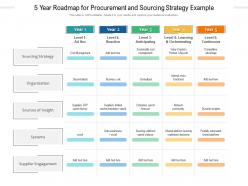
5 year roadmap for procurement and sourcing strategy example





Try Before you Buy Download Free Sample Product
 Impress Your
 Audience
 100%
100% Editable
 Save Hours
 of Time


A well thought out action plan makes execution easier and increases the possibility of success significantly. Ensure hitting all the milestones within the deadlines by introducing our fully customizable 5 Year Roadmap For Procurement And Sourcing Strategy Example. Streamline the work related information, budget, timeframe, key deliverable, landmarks, and major steps involved, all in one place to give an organized overview of the project by utilizing our PowerPoint theme. Minimize time lag and increase work efficiency by providing insight into the process with our comprehensively researched roadmap PowerPoint layout. Color coding helps in highlighting the process and grabs the attention of the audience. Download our handy 5 Year Roadmap For Procurement And Sourcing Strategy Example to identify the possible problem areas in a much shorter time and propose solutions. Have a productive brainstorming session with your workforce by utilizing our action plan visualization tool.
People who downloaded this PowerPoint presentation also viewed the following :
5 year roadmap for procurement and sourcing strategy example with all 2 slides:
Use our 5 Year Roadmap For Procurement And Sourcing Strategy Example to effectively help you save your valuable time. They are readymade to fit into any presentation structure.

FAQs for 5 year roadmap for procurement and
Honestly, you'll want to nail down five things first. Map out where your procurement is right now - all the messy details like spend, suppliers, processes. Then figure out your 12-24 month goal. Gap analysis comes next (sounds fancy but it's just "what's missing?"). After that, build a timeline with actual deadlines people can hit. Oh, and don't skip the metrics part - you need ways to prove it's working. I'd definitely start with assessing where you are now. Hard to get somewhere when you don't even know your starting point, you know?
Start with figuring out what your company actually wants to accomplish - growth plans, where they're cutting costs, that whole picture. Then align your procurement stuff to match those goals. Expanding into new markets? You'll need flexible suppliers and local connections. Cost cutting mode? Focus on spend data and consolidating vendors. If they're big on sustainability, you're stuck vetting everyone's ESG credentials (which honestly takes forever). The trick is staying in regular contact with the business leaders since priorities change constantly. Just make sure your metrics actually track what the company cares about, not just procurement vanity numbers.
Look, tech is what makes or breaks procurement these days. AI handles supplier risk checks, e-procurement platforms streamline your buying process, and analytics spot savings you'd miss otherwise. Real-time spend visibility beats guessing every time. It's like - why would you manually track everything when software does it better? The trick is finding tools that actually play nice with whatever systems you're already stuck with. Don't just buy fancy software because it looks impressive though. Focus on stuff that fixes your actual headaches first.
Honestly, stop thinking of suppliers as just vendors you haggle with over price. That's where most people screw up. You want actual partnerships here. Set up quarterly reviews with your top 5-10 suppliers - talk about goals, roadblocks, share your forecasts so they can plan ahead too. Regular check-ins make a huge difference. Track stuff beyond just cost savings... like how quickly they respond or what new ideas they bring. Oh and definitely do collaborative planning sessions. Sounds corporate-y but it works. The whole relationship changes once they feel like they're part of your team instead of just another transaction.
Honestly, you need both cost and performance data - can't just look at one side. Start with cost savings, spend management, and how your suppliers are actually performing. Contract compliance is huge too because rogue spending will torpedo everything you're working toward. Cycle times are pretty telling about efficiency. Also track supplier diversity and whether people are happy with the process - if stakeholders hate dealing with procurement, something's broken. I'd pick maybe 3-5 metrics that match what your company cares about most, then add more later. Don't overcomplicate it right out the gate.
Look, don't just slap risk assessment on at the end - weave it into your procurement planning right away. Map out what could go wrong in each category: supplier crashes, market chaos, compliance headaches. Build your fixes straight into sourcing - spread suppliers around, add penalty clauses, have backup plans ready. I do this simple risk matrix thing scoring likelihood vs impact, then tackle the worst stuff first. Honestly, most people treat this like paperwork but it should drive every buying decision you make. Set up quarterly reviews so you're not scrambling when things blow up.
First thing - figure out where all your money's actually going by mapping spend across categories and suppliers. Talk to the key people to understand what's broken in current processes, then see how you stack up against industry benchmarks. Your team's skills and tech setup will probably surprise you (never fails). Go through existing contracts, compliance stuff, and supplier relationships too. Honestly, the hardest part is being real about what sucks - but that's how you build something that'll actually work. Just document it all so you can see if you're making progress down the road.
Start with your biggest spending categories - that's where you'll make the most impact anyway. Set actual green requirements for vendors, like environmental certs or carbon targets. Don't just make it a feel-good checkbox though, create scorecards that balance environmental stuff with cost and quality. Map out which areas hit the environment hardest (spoiler: it's usually your high-spend ones). Honestly, I'd test this on just one or two categories first before going crazy company-wide. Build in milestones for switching to sustainable options. The whole thing needs to be measurable or you're just wasting time.
Honestly? Getting everyone on the same page is brutal - finance wants cost cuts, operations needs reliability, and everyone's got their favorite vendors. Most companies have zero clue what they're actually spending money on too, which makes it hard to build any real strategy. People hate changing their processes (can't blame them really). Plus you probably don't have enough time or people to do this right. My take? Pick one small area first, show some wins, then slowly expand. Don't try to boil the ocean from day one.
Honestly, data analytics is a game-changer for procurement - no more guessing what's working. You'll spot spending patterns and see which suppliers actually show up on time with decent quality. The forecasting part helps you avoid those panic buys when demand suddenly spikes (we've all been there). I'd start with something simple like tracking supplier performance first, then build from there. Having real numbers when you're negotiating with vendors is so much better than just winging it. Plus you'll catch cost-saving opportunities that would totally slip by otherwise.
Honestly, global sourcing is a mixed bag. Those 30-40% cost savings look amazing on paper, but there's always a catch. Lead times get crazy long, and don't get me started on quality control issues. Currency swings can mess with your budget too. I've watched teams lose weeks just because specs got lost in translation - communication gaps are real. Import duties and shipping costs will chip away at your savings, plus you're dealing with compliance headaches. My advice? Test it out with some non-essential parts first. Get your processes down before you move critical stuff offshore.
Honestly, stakeholder management can make or break your whole project. Figure out who matters first - who's got influence, who gets impacted, what keeps them up at night (usually budget or deadlines). Don't wait for them to come to you with problems. Some folks want constant updates, others just need the cliff notes version. I've seen too many projects crash because someone felt left out of the loop. Set up regular touchpoints and actually ask for their input on drafts - then circle back so they know you heard them. Way better than scrambling when everything hits the fan later.
Look, compliance will basically run your whole procurement strategy whether you like it or not. Map out your regulatory requirements first - don't try to figure it out later when you're already locked into contracts. Each supplier needs vetting against whatever rules apply to your industry. Healthcare and finance are nightmare territory for this stuff. Your bid processes, contract terms, everything gets shaped by compliance checkpoints. I know it sounds boring but seriously, audit your current suppliers now. Way cheaper than scrambling when regulators come knocking.
Honestly? I'd say quarterly reviews minimum, then do a big annual overhaul. But don't be super rigid about it - if the market goes crazy or your company changes direction, jump on it early. Those quarterly check-ins are clutch for spotting trends before they bite you. The yearly deep dive is when you really dig into long-term goals and supplier relationships. It's basically like car maintenance - stay on top of the small stuff so you don't get blindsided later. Oh, and actually put those quarterly reviews in your calendar right now or they'll never happen.
Market trends basically control your whole procurement game. Supply chain chaos, inflation, sustainability pressure, new tech - all that stuff directly impacts how you plan. You can't just ignore what's happening around you, right? Build flexibility into your strategy so you can actually pivot when things go sideways. Material shortages hit different than they used to. Pick maybe 3-5 major trends hitting your industry and create backup plans for each one. Trust me, having contingencies ready beats scrambling when everything changes overnight.
-
I discovered this website through a google search, the services matched my needs perfectly and the pricing was very reasonable. I was thrilled with the product and the customer service. I will definitely use their slides again for my presentations and recommend them to other colleagues.
-
Easily Understandable slides.