


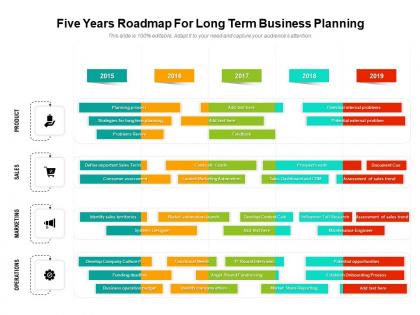
Five years roadmap for long term business planning




Try Before you Buy Download Free Sample Product
 Impress Your
 Audience
 100%
100% Editable
 Save Hours
 of Time


A cohesive work plan is essential for achieving the desired target. Communicate your vision and lay a firm ground in front of your audience with our PowerPoint layout. Align your project milestones, budgets, deliverables, deadlines, and all the requisite information for a dynamic presentation by employing this amazingly designed Five Years Roadmap For Long Term Business Planning. Maximize team efficiency and streamline a work plan efficiently by introducing our ready made roadmap PowerPoint theme. You can quickly establish coordination between different activities across the organization and present an insight to your colleagues by utilizing this useful business tool. Color code specific tasks, prioritize, and keep a close eye on the deadlines with the help of our eye catchy PowerPoint template. Download our Five Years Roadmap For Long Term Business Planning for excelling at productive management.
People who downloaded this PowerPoint presentation also viewed the following :
Five years roadmap for long term business planning with all 2 slides:
Use our Five Years Roadmap For Long Term Business Planning to effectively help you save your valuable time. They are readymade to fit into any presentation structure.
FAQs for Five years roadmap for long
Honestly, start with getting your vision super clear first - that's your north star. Figure out how you're different from everyone else in your space. Then comes the hard part: deciding where to actually spend your money and time. Most companies mess this up by trying to do way too many things at once (guilty as charged lol). You need solid execution plans with real deadlines and goals you can actually measure. When all these pieces click together consistently? That's when things get interesting. Work backwards from your vision and you'll be good.
Think of market trends as your business GPS - they tell you where things are going so you don't drive straight into a wall. You've gotta watch how customers are changing, what new tech is popping up, and what your competitors are doing. Like, remember Blockbuster? They totally missed the Netflix wave and got crushed. Use trend data to spot new opportunities or figure out when to pivot your whole approach. Set up some kind of regular check-in system - maybe monthly trend reports or whatever works. Otherwise you'll be playing catch-up while everyone else is already three steps ahead. Trust me, staying on top of this stuff is way easier than trying to recover later.
Dude, competitive analysis is like your sanity check for strategy stuff. Shows you what's actually happening out there vs what you think is happening. Map out your top 3-5 competitors and see what they're crushing, what they suck at, how customers react to their moves. I've watched so many teams bomb because they just... existed in their own little world? Track their big moves monthly. You'll spot the gaps they're missing and figure out how to do things differently. Plus you won't repeat their dumb mistakes.
Okay so first thing - figure out what your mission actually means beyond the corporate speak on your About page. Then look at what you're actually doing. Does any of it match? Because honestly, most companies I've seen have zero connection between their "purpose" and their strategy deck. Here's what I'd do: audit everything against your vision. If something doesn't fit, cut it - even profitable stuff. Your mission becomes the litmus test for every big decision. Super simple question before green-lighting projects: "does this move us toward our vision?" Sounds basic but you'd be surprised how many teams skip this step entirely.
So basically, short-term stuff is what you're doing right now - hitting this quarter's numbers, cutting some costs, getting that new product out the door. Usually we're talking 1-2 years max. Long-term? That's your big picture thinking, like 5-10 years out. Where do you want your business to actually be? What market position are you going for? Here's the thing though - your short-term moves can't totally screw over your long-term vision. I've seen too many companies chase quarterly wins that completely derail their bigger goals. My advice? Figure out where you want to be in 5 years first, then work backwards to see what you need to accomplish each quarter to get there.
Honestly, pick like 3-5 solid metrics and stick with them - revenue growth, profit margins, customer acquisition costs, that kind of stuff. Don't chase every shiny number though. Half the metrics out there just make you feel productive without actually meaning anything. Employee satisfaction matters too, plus how you're hitting those big milestones you set. The trick is deciding what success looks like before you start, not after. I learned that the hard way. Check in quarterly so you're not constantly second-guessing yourself. Market share's good to track if you can get decent data on it.
Dude, culture stuff is huge for strategy - like way more than most people realize. When your team's vibe matches the new direction, things just click faster. People actually want to do the work differently. But mismatched culture? Total nightmare. Nobody changes anything no matter how much you push. Here's what I'd do: figure out your current culture before changing strategy. Either tweak your plan to fit what already works, or plan to shift the culture first. Fair warning though - culture change is painfully slow. We're talking 2-3 years minimum, maybe longer depending on how stuck people are.
Look, you've gotta watch the big indicators - inflation, consumer spending, market shifts. Cash flow and pricing need constant tweaking when things get weird. The businesses that adapt quickest honestly just crush it (seen this play out too many times). Diversify your income streams for sure. Existing customers are gold since finding new ones costs a fortune during rough patches. Keep some emergency cash around if you can swing it. Sometimes you need to temporarily shift how you operate - it's not permanent, just survival mode. Start reviewing your current approach against recent economic data ASAP.
Look, the biggest screwups happen when nobody talks to each other and your strategy just becomes some forgotten document. Teams also love skipping check-ins - super annoying because then you're basically guessing for months. Resource stuff kills you too. Either everyone's stretched crazy thin or the important projects get nobody. Honestly? Do fewer things but talk about them constantly. Weekly scorecards are clutch so you actually know if things are working. Oh and accountability - someone needs to own each piece or it'll just drift forever.
Look, technology completely changes how you run a business these days. AI helps with predictions, automation saves you money, and digital stuff lets you reach customers everywhere. Social media and apps? Total game changers for connecting with people. But here's the thing - don't just grab whatever's trending. Pick tech that actually fixes your real problems. I mean, my cousin's startup wasted months on some fancy platform they didn't even need. Smart strategy means focusing on what works for YOUR situation, not what sounds cool.
Dude, you absolutely need people on board or your strategy's dead in the water. Bring stakeholders in early - they'll spot problems you totally missed and give you insights that actually matter. Nobody wants stuff shoved down their throat without being heard first, right? Map out who really has influence or gets hit by your changes. Then loop them in from the start, not as an afterthought. Honestly, these conversations can be a pain sometimes, but you'll end up with allies who'll actually help push things through instead of fighting you every step.
Data analytics helps you spot stuff you'd never catch otherwise - customer patterns, market shifts, operational blind spots. Don't track everything though, that's where most companies screw up. Pick metrics that actually tie to your goals, not just numbers that make pretty dashboards. Look for what customers really want, where money's bleeding out, what's genuinely working. Then make real decisions based on that instead of just winging it. Honestly, connecting data to actual business moves is where the magic happens - most people collect tons of info but never act on it.
Honestly, you've gotta ditch the corporate speak and make it real for people. Start with why this matters - like actually matters to their daily work. Break it into goals each team can picture themselves doing. I've watched so many strategy announcements crash because they never left executive-level fluff. Mix up how you share it too - town halls, smaller team chats, maybe some visuals around the office. But here's the thing: let people ask questions and push back a bit. They need to feel heard, not just lectured at. Oh, and prep your managers well since they'll be explaining this stuff way more than you will.
Look, you can't just focus on profits anymore - that ship has sailed. Climate stuff, how you treat workers, community impact... all of it affects your bottom line whether you like it or not. Customers actually care now, plus good luck getting funding or keeping talent if you're seen as sketchy. I'd start by figuring out which social/environmental issues could mess with your business model. Honestly, companies that ignore this feel ancient to me. Map out your stakeholders first - see what really matters to them and could bite you later.
Strategic partnerships can really give your business a huge boost - you get access to new markets and customers you couldn't reach before. It's basically like a business buddy system where both companies play to their strengths. Sharing costs on big projects becomes way easier, plus you can speed up product development. Your credibility gets a bump too, which honestly matters more than people think. The trick is finding companies that complement what you do without being direct competitors. Figure out what gaps you have first, then hunt for partners who could fill those while getting something valuable from you in return.
-
Designs have enough space to add content.
-
Great experience, I would definitely use your services further.
-
Awesome use of colors and designs in product templates.