


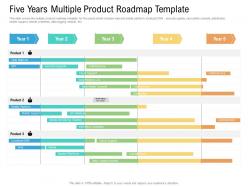
Five years multiple product roadmap timeline powerpoint template





Try Before you Buy Download Free Sample Product
 Impress Your
 Audience
 100%
100% Editable
 Save Hours
 of Time


Our Five Years Multiple Product Roadmap Timeline Powerpoint Template are topically designed to provide an attractive backdrop to any subject. Use them to look like a presentation pro.
People who downloaded this PowerPoint presentation also viewed the following :
Five years multiple product roadmap timeline powerpoint template with all 2 slides:
Use our Five Years Multiple Product Roadmap Timeline Powerpoint Template to effectively help you save your valuable time. They are readymade to fit into any presentation structure.
FAQs for Five years multiple product roadmap
You basically need five things: objectives that actually tie to business goals, prioritized features with rough timing, your target audiences, metrics to track if stuff's working, and dependencies mapped out. Flexibility matters more than people think though - rigid roadmaps just piss everyone off when things change. Mine always do. Start with your 3-6 month themes first, then work backwards from there. The whole thing should tell a story about where you're going and why, not just be some boring feature list. Focus on the narrative - it'll make way more sense to stakeholders.
Okay so you basically need to juggle three things: what customers actually want, what helps your business, and whether your devs can realistically build it. I'd start digging into support tickets and user feedback first - that's where the real pain points live. Then figure out how each feature idea connects to your main goals, like growing revenue or keeping users around. The tricky part is estimating dev time because that "simple" feature always ends up being way more complex than expected, ha. I score everything 1-10 on those three factors and multiply them together. Works pretty well for bubbling the good stuff to the top.
Honestly, customer feedback is everything for roadmap planning. You can't just guess what users want - you'll end up building features nobody cares about. Collect feedback through surveys, support tickets, interviews, whatever works. Usage data tells you a lot too. The tricky part is balancing what your biggest users are asking for with your business goals. Sometimes they don't align perfectly. Set up weekly or bi-weekly sessions with your team to review all this stuff. Trust me, it's way better than realizing months later you built something completely useless.
Quarterly is usually the sweet spot for roadmap updates. Monthly works too if you're in something crazy fast-moving like AI. Don't overthink it though - the real trick is staying flexible without giving everyone whiplash every time you pivot. I've seen teams burn out from constant changes. Maybe do quarterly deep dives with quick monthly pulse checks? Oh and seriously, put it on your calendar now or you'll forget and suddenly it's been 8 months since you looked at the thing. Markets move fast but your team needs some stability too.
ProductPlan, Roadmunk, and Aha! are solid choices - they're made for this stuff and look pretty slick. But honestly? Most teams I know just stick with what they've got already. Notion works great, Miro's awesome for visual people, hell even PowerPoint gets the job done. If you're already using Jira for dev work, might as well try their roadmap features first. My take is don't overthink it. Pick whatever feels right for how your team actually works. You can always switch later if you need fancier stuff like stakeholder dashboards or integrations. The best tool is the one people will actually update.
Honestly, just set up regular check-ins between product and leadership - saves so much headache later. Map every roadmap item to actual business goals like revenue or user growth. Can't tell you how many teams I've watched build "cool" features that literally nobody cares about! Do quarterly reviews where you reassess what matters. Oh, and create some simple scoring system - business impact vs effort works great. This way everyone stays honest about priorities and you won't get distracted by random feature requests that sound fun but don't actually help the business grow.
Depends on who you're showing it to, honestly. Executives want the big picture - Gantt charts or something like ProductPlan with themes and major outcomes. Development teams need the nitty-gritty feature breakdowns, so Aha! works well (though I've seen teams do fine with just spreadsheets). For customers, focus on benefits over features - Roadmunk's great because you can customize what different people see. Oh, and don't overthink it. Sometimes simple beats fancy. Just match the detail to what each group actually needs to decide stuff.
So here's the deal - agile roadmaps change constantly based on what users actually tell you and what you figure out each sprint. Traditional ones? They're basically set-in-stone timelines where everything's planned upfront (which never works out anyway, let's be honest). You'll focus on bigger themes and outcomes instead of locking yourself into specific features with hard dates. That's the main thing - agile roadmaps grow with you as you learn more about what people actually need. Traditional approaches trap you with detailed requirements from day one and hate any changes. Just think of your roadmap as something that's gonna evolve, not some contract written in blood.
Ugh, the worst thing you can do is get super granular with stuff that's months away. Stakeholders will literally ask for the moon if you let them - I've seen it happen so many times. Keep things high-level past your next quarter and always call timelines "estimates," not deadlines. Don't promise what you can't deliver, and definitely leave wiggle room for changes. You'll be updating this thing constantly as new info comes in. Honestly? Flexibility beats perfection every time when it comes to roadmaps.
Think about your roadmap like climbing a ladder - every short-term win should actually move you toward that bigger vision, not just fill time. I've found the 70/20/10 split works well: most resources go to immediate stuff that's working, 20% to emerging opportunities that fit your vision, and 10% for wild experiments. Quick wins are great, but they can't just be random feature requests if they don't build toward your 2-3 year goals. Honestly, quarterly reviews are clutch for making sure you're not just spinning your wheels on busy work.
Honestly, you've gotta match what each group actually cares about. Executives just want the business impact and big picture stuff. Your dev team? They need those nitty-gritty technical details and realistic timelines. Throw in some visuals too - charts, timelines, whatever. People are drowning in text already. Keep sending regular updates even when nothing's changed because radio silence makes everyone panic. I learned that one the hard way. Ask for feedback and actually respond to concerns. Start with a quick async update, then do separate focused convos for each audience.
Build competitive research right into your regular planning—don't just wing it. I check what 3-4 main competitors are doing monthly (sounds nerdy but whatever). Actually read those industry reports you subscribe to. Then connect what you learn to your feature priorities and timing. The trick is making it routine instead of scrambling once a year when someone asks "what's the competition doing?" Set quarterly calendar reminders to question your assumptions. Your roadmap should shift based on what you find. Trust me, this beats getting blindsided by a competitor's surprise launch.
Honestly, you need those dates or your roadmap just becomes this fantasy document that's useless for everyone else. Marketing can't plan campaigns, sales doesn't know what to promise customers – it's a mess. Timelines also force you to actually prioritize instead of cramming every "brilliant" idea onto the list. When you start missing deadlines, that's your early warning system something's wrong. Oh, and always pad your estimates because I've literally never seen a project finish early. Trust me on that one.
Track your main KPIs first - revenue, user adoption, whatever you set as success metrics. Customer satisfaction scores will tell you if people actually like what you built. The timeline comparison is brutal but necessary. Did you deliver on time? Survey your team too - roadmaps are useless if they don't help with prioritization decisions. Support ticket volume is sneaky helpful for spotting problems. Set up quarterly reviews so you can pivot when things aren't working. Oh, and be ready to admit when features flopped - that's honestly the hardest part but super valuable.
Honestly, just bake flexibility right into your roadmap from the start. Review everything monthly or quarterly - when tech changes or customers start acting different, you can pivot fast. Kill features that aren't working, adjust timelines, whatever. The trick is having solid metrics so you actually know when to bail on something. I've watched so many teams cling to their original plan while the world shifted around them - it's painful to see. Set up customer feedback loops, watch what competitors do, and don't hesitate to completely restructure if the data screams at you. Oh, and make sure everyone expects changes instead of freaking out every time you update things.
-
Great designs, really helpful.
-
Great designs, really helpful.
-
Understandable and informative presentation.
-
Appreciate the research and its presentable format.
-
Awesome presentation, really professional and easy to edit.
-
Designs have enough space to add content.
-
Visually stunning presentation, love the content.
-
Presentation Design is very nice, good work with the content as well.