


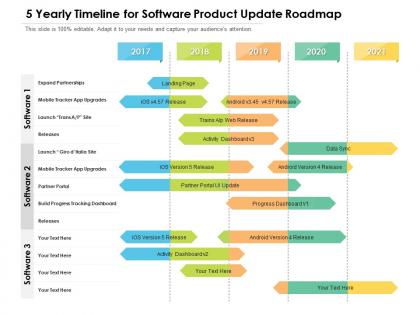
5 yearly timeline for software product update roadmap




Try Before you Buy Download Free Sample Product
 Impress Your
 Audience
 100%
100% Editable
 Save Hours
 of Time


The success rate of business plans is hugely dependent on the plan of action, and this editable 5 Yearly Timeline For Software Product Update Roadmap rightly serves the purpose. Encapsulate all the information related to the project in a well structured manner to obtain maximum efficiency by incorporating our stunning PowerPoint theme. State the critical deliverable, steps involved, time frame, workforce allocation, and lots more in an easy to understand manner by utilizing this pre designed roadmap PowerPoint layout. You can also prioritize your tasks and discuss the problem areas with your colleagues by incorporating this tailor made PPT layout. Empower your work plan by employing this professionally designed PPT theme. Entrepreneurs can download 5 Yearly Timeline For Software Product Update Roadmap as a beneficial communication tool that facilitates in collaborating with different tasks and achieve targets.
People who downloaded this PowerPoint presentation also viewed the following :
5 yearly timeline for software product update roadmap with all 2 slides:
Use our 5 Yearly Timeline For Software Product Update Roadmap to effectively help you save your valuable time. They are readymade to fit into any presentation structure.
FAQs for 5 yearly timeline for software
A software product roadmap should include strategic objectives, feature priorities, timeline milestones, resource allocation requirements, and stakeholder dependencies. These elements work together by aligning development teams with business goals, managing customer expectations, and facilitating cross-functional coordination, with many organizations finding that comprehensive roadmaps significantly enhance product delivery efficiency and strategic decision-making.
Feature prioritization involves evaluating customer feedback, business value, technical feasibility, market demands, and strategic alignment with company goals. Through frameworks like MoSCoW, RICE scoring, and value-based assessments, product teams streamline decision-making by balancing user needs with resource constraints, ultimately delivering enhanced user experiences and competitive advantage in increasingly dynamic markets.
Effective software product roadmap tools include Aha!, ProductPlan, Roadmunk, Jira Product Discovery, and Azure DevOps, combined with techniques like user story mapping, prioritization frameworks, and stakeholder interviews. These approaches streamline feature planning, resource allocation, and timeline visualization, with many development teams finding that strategic roadmapping ultimately delivers clearer product direction and enhanced cross-functional alignment.
Stakeholder feedback influences software product roadmaps by providing market insights, user pain points, competitive intelligence, and technical constraints that guide feature prioritization and development timelines. Through regular surveys, user interviews, and stakeholder meetings, product teams can identify high-impact opportunities, validate assumptions, and align roadmap decisions with actual business needs, ultimately delivering solutions that enhance user satisfaction and drive market adoption.
Software product roadmaps should be reviewed monthly and updated quarterly, with major revisions occurring semi-annually or when significant market changes arise. This cadence enables teams to respond to customer feedback, competitive pressures, and technological advances while maintaining strategic direction, with many organizations finding that regular reviews enhance alignment between development priorities and business objectives, ultimately delivering more responsive products.
Balancing long-term vision with short-term delivery requires strategic prioritization through milestone-based planning, incremental feature releases, and regular stakeholder alignment sessions. Successful organizations achieve this by implementing quarterly review cycles, maintaining flexible sprint structures, and establishing clear success metrics, with many tech companies finding that this approach enables sustainable growth while delivering immediate value to customers and maintaining competitive advantage.
Market research provides critical insights into customer needs, competitive landscapes, feature prioritization, and emerging technology trends that directly inform roadmap decisions. Through user surveys, competitive analysis, and market trend evaluation, development teams can validate assumptions, identify high-impact features, and align product evolution with market demands, ultimately ensuring their roadmap delivers competitive advantage and meets actual user requirements.
Effective roadmap communication requires tailoring content and format to each audience, using visual presentations for executives, detailed timelines for development teams, and benefit-focused summaries for customers. Strategic communication involves regular updates, clear priority explanations, and transparent milestone tracking, with many organizations finding that consistent stakeholder alignment through targeted messaging ultimately delivers stronger product adoption and reduced scope changes.
Managing scope creep requires establishing clear prioritization frameworks, implementing regular stakeholder reviews, maintaining detailed documentation of feature requests, and creating formal change control processes. Through strategic communication and data-driven decision making, product teams can evaluate new requests against original objectives while ensuring roadmap flexibility, ultimately delivering focused solutions that align with business goals and customer needs.
Success measurement involves tracking key performance indicators like feature adoption rates, customer satisfaction scores, revenue growth, time-to-market metrics, and development velocity against initial roadmap goals. Organizations increasingly use analytics dashboards, user feedback systems, and business intelligence tools to monitor these outcomes, with many finding that regular roadmap retrospectives and stakeholder alignment reviews ultimately deliver clearer strategic insights and competitive advantage.
Best practices for roadmap transitions include conducting stakeholder impact assessments, maintaining transparent communication timelines, preserving critical feature dependencies, establishing clear milestone mappings, and implementing phased rollout strategies. These approaches streamline organizational alignment by minimizing disruption to development cycles, preserving team momentum, and ensuring customer commitments remain intact, with many software companies finding that structured transition frameworks ultimately deliver faster adoption and sustained competitive advantage.
Managing competing priorities requires strategic frameworks like value-based scoring, stakeholder impact analysis, and resource allocation models to evaluate initiatives objectively. Many organizations find success by establishing clear criteria for priority ranking, regular cross-functional alignment sessions, and transparent communication channels, ultimately enabling teams to balance customer needs, technical debt, and business objectives while maintaining development momentum.
Common pitfalls include overcommitting to unrealistic timelines, lacking stakeholder alignment, ignoring customer feedback integration, setting vague priorities, and failing to build flexibility for market changes. These roadmap challenges can derail product development by creating unrealistic expectations, resource conflicts, and misaligned objectives, with many software teams finding that regular roadmap reviews and stakeholder communication ultimately deliver better outcomes.
Agile methodologies transform software product roadmaps from rigid, linear plans into flexible, iterative frameworks that emphasize shorter development cycles, continuous user feedback integration, and adaptive prioritization based on changing market demands. This approach enables teams to pivot quickly when user needs shift, deliver value incrementally through regular releases, and maintain competitive advantage by responding to market opportunities faster than traditional waterfall approaches.
Key metrics for evaluating roadmap progress include feature completion rates, milestone adherence, user adoption metrics, customer satisfaction scores, and revenue impact measurements. These indicators enable product teams to assess delivery velocity, market response, and strategic alignment, with many organizations finding that combining leading indicators like development velocity with lagging indicators like customer retention delivers comprehensive visibility into roadmap success.
No Reviews