


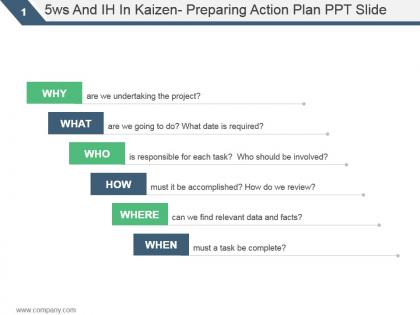
5ws and ih in kaizen preparing action plan ppt slide




Try Before you Buy Download Free Sample Product
 Impress Your
 Audience
 100%
100% Editable
 Save Hours
 of Time


Alert folks about any instability with our 5ws And Ih In Kaizen Preparing Action Plan Ppt Slide. Identify changing circumstances.
People who downloaded this PowerPoint presentation also viewed the following :
5ws and ih in kaizen preparing action plan ppt slide with all 5 slides:
Defy borders with our 5ws And Ih In Kaizen Preparing Action Plan Ppt Slide. Your ideas acquire global attention.

FAQs for 5ws and ih in kaizen preparing action
Kaizen's core principles include continuous improvement, employee involvement, waste elimination, standardization, and customer focus. These principles streamline everyday business practices by encouraging small daily improvements, empowering teams to identify inefficiencies, and standardizing successful processes, with many manufacturing and service organizations finding that consistent application delivers enhanced productivity, reduced costs, and sustained competitive advantage.
Kaizen contributes to continuous improvement by fostering incremental changes through employee engagement, systematic problem-solving, and regular process evaluation across all organizational levels. This methodology enables companies, particularly in manufacturing and healthcare, to reduce waste, enhance quality, and boost operational efficiency, while cultivating a culture where innovation becomes sustainable and competitive advantage grows consistently.
Employee involvement serves as the foundation of successful Kaizen initiatives, as frontline workers possess intimate knowledge of daily processes, operational bottlenecks, and practical improvement opportunities that management often overlooks. Through active participation in problem identification, solution development, and implementation feedback, employees drive meaningful change while building ownership and engagement, with many manufacturing and service organizations finding that worker-led Kaizen teams deliver faster implementation and sustained results.
Toyota's production system revolutionized manufacturing through continuous improvement, while banks like JPMorgan Chase streamlined loan processing, and hospitals enhanced patient flow efficiency. These implementations deliver reduced waste, faster service delivery, and improved quality across sectors, with many organizations finding that small, incremental changes ultimately generate significant competitive advantages and operational cost reductions.
Kaizen differs from Six Sigma through its focus on incremental daily improvements driven by all employees, while Six Sigma emphasizes data-driven project-based solutions targeting specific defects. Kaizen promotes cultural transformation through small, continuous changes across entire organizations, while Six Sigma delivers structured problem-solving for complex issues, with many companies finding that combining both methodologies creates comprehensive operational excellence.
Common challenges when adopting Kaizen include employee resistance to change, lack of leadership commitment, insufficient training, cultural misalignment, and failure to sustain momentum over time. These obstacles often emerge because organizations underestimate the cultural transformation required, with many companies finding that successful implementation demands consistent management support, comprehensive employee education, and systematic integration into daily operations to ultimately deliver lasting operational improvements.
Technology enhances Kaizen practices by enabling real-time data collection, automating process monitoring, and facilitating collaborative improvement tracking across organizations. Digital tools like IoT sensors, workflow management platforms, and analytics dashboards streamline continuous improvement initiatives, with manufacturing and healthcare sectors finding that automated data capture accelerates problem identification and solution implementation.
Organizations should measure Kaizen effectiveness through productivity ratios, defect rates, cycle times, employee suggestion implementation rates, and cost savings per improvement project. These metrics enable companies to track operational efficiency gains, quality enhancements, and workforce engagement levels, with many manufacturing and service organizations finding that combining quantitative results with employee participation rates delivers comprehensive insights into continuous improvement success.
Kaizen transforms team dynamics by fostering collaborative problem-solving, empowering employee input, and creating shared ownership of continuous improvement initiatives. This approach builds trust, enhances communication, and develops a learning-oriented culture where teams actively seek solutions together, ultimately delivering higher engagement, reduced resistance to change, and sustained operational excellence across organizations.
Effective Kaizen engagement requires comprehensive training in problem-solving methodologies, data analysis techniques, process mapping, root cause analysis, and collaborative teamwork skills. Organizations typically provide workshops on continuous improvement principles, quality management tools, and change management approaches, with many manufacturing companies and healthcare institutions finding that hands-on mentoring and regular skill-building sessions ultimately deliver sustained operational excellence.
Kaizen integrates into project management through continuous retrospectives, incremental process improvements, and regular stakeholder feedback loops throughout project lifecycles. Organizations implementing Kaizen-enhanced frameworks, particularly in manufacturing and software development, find that small, frequent optimizations reduce project delays, minimize resource waste, and enhance team collaboration, ultimately delivering faster project completion and improved quality outcomes.
Sustaining Kaizen momentum requires establishing regular review cycles, celebrating incremental wins, embedding continuous improvement metrics into performance evaluations, and creating cross-functional improvement teams. Organizations maintain long-term success by integrating Kaizen principles into daily workflows, providing ongoing employee training, and linking improvement outcomes to strategic business objectives, with many companies finding that consistent leadership support and transparent progress tracking ultimately deliver sustained operational excellence and competitive advantage.
Small businesses can implement Kaizen through employee suggestion programs, daily huddles, simple process mapping, and focusing on one improvement area monthly rather than organization-wide changes. These low-cost approaches enable teams to identify waste, streamline workflows, and enhance customer service without major investments, with many small retailers and service providers finding that consistent small improvements ultimately deliver significant operational efficiency and competitive advantage.
Kaizen adapts to remote environments through virtual suggestion systems, digital workflow mapping, online team improvement sessions, and cloud-based performance tracking. Remote teams can implement daily stand-ups for continuous feedback, use collaborative platforms for process documentation, and establish virtual gemba walks through screen sharing, ultimately maintaining the culture of ongoing improvement while enhancing distributed team engagement and operational efficiency.
Kaizen serves as the foundational philosophy of continuous improvement within Lean Management, emphasizing small, incremental changes that eliminate waste and enhance value streams. This strategic combination enables organizations across manufacturing, healthcare, and service industries to streamline operations, reduce costs, and improve quality systematically, with many companies finding that sustained kaizen practices ultimately deliver significant competitive advantages.
-
Unique and attractive product design.
-
Easily Editable.