


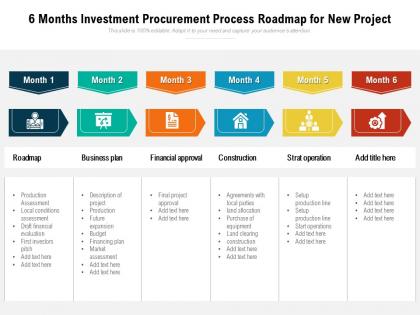
6 months investment procurement process roadmap for new project




Try Before you Buy Download Free Sample Product
 Impress Your
 Audience
 100%
100% Editable
 Save Hours
 of Time


Utilize our pre build 6 Months Investment Procurement Process Roadmap For New Project to present your plan of action in the most effective way. Reduce the paperwork and showcase how different activities are linked to each other by incorporating this attention grabbing PowerPoint theme. This completely editable roadmap PPT layout is suitable to fit all your needs and to have a structured outline of the entire process flow using color coding. Provide guidelines to your teammates about the progression process by employing our PPT theme. Team members can easily be designated into teams by accessing the work milestones to be accomplished within the timeframe. You can easily modify the PowerPoint slide according to real time situations. Download our stunning 6 Months Investment Procurement Process Roadmap For New Project, and you are good to go to prove your expertise in strategic planning.
People who downloaded this PowerPoint presentation also viewed the following :
6 months investment procurement process roadmap for new project with all 2 slides:
Use our 6 Months Investment Procurement Process Roadmap For New Project to effectively help you save your valuable time. They are readymade to fit into any presentation structure.
FAQs for 6 months investment procurement process roadmap
An effective investment procurement roadmap includes strategic sourcing frameworks, vendor evaluation matrices, risk assessment protocols, budget allocation timelines, and performance measurement systems. These components work together by streamlining supplier selection, enhancing cost transparency, and minimizing procurement risks, with many financial institutions finding that systematic roadmaps deliver faster investment decisions and improved portfolio outcomes.
Organizations align procurement strategies with business objectives by establishing clear KPIs, integrating procurement teams into strategic planning processes, and ensuring supplier selections support broader company goals like sustainability or innovation targets. Through cross-functional collaboration and regular performance reviews, companies streamline resource allocation, enhance operational efficiency, and strengthen competitive positioning, with many finding that strategic procurement alignment delivers measurable cost reductions and accelerated business growth.
Stakeholder engagement ensures investment procurement roadmaps align with organizational priorities, risk tolerance, and strategic objectives through collaborative input from finance teams, department heads, legal advisors, and executive leadership. This comprehensive involvement streamlines decision-making processes, minimizes procurement delays, and enhances resource allocation accuracy, with many organizations finding that early stakeholder buy-in ultimately delivers faster implementation and stronger competitive positioning.
Risk assessment integrates into procurement planning through supplier financial evaluations, market volatility analysis, compliance audits, and contingency planning frameworks. These strategic assessments enable organizations to identify potential disruptions early, diversify supplier portfolios, and establish backup procurement channels, ultimately delivering more resilient supply chains and reduced operational vulnerabilities.
Best practices for sourcing and evaluating potential investment opportunities include conducting thorough due diligence, diversifying across sectors and geographies, leveraging data analytics for risk assessment, establishing clear investment criteria, and maintaining robust pipeline management. These strategic approaches enable institutional investors, private equity firms, and venture capital organizations to minimize risk exposure, accelerate decision-making processes, and ultimately deliver superior portfolio returns while navigating increasingly competitive markets.
Technology enhances investment procurement by automating vendor evaluations, providing real-time market analytics, and streamlining compliance tracking through AI-powered platforms. Through advanced data visualization and predictive modeling, financial institutions and asset managers accelerate due diligence processes, reduce operational costs, and improve risk assessment accuracy, ultimately delivering faster investment decisions and enhanced portfolio performance.
Organizations should measure procurement roadmap success through cost savings percentages, supplier performance scores, contract compliance rates, procurement cycle time reduction, and stakeholder satisfaction metrics. These indicators enable finance teams, manufacturing companies, and healthcare systems to track operational efficiency improvements, identify bottlenecks in sourcing processes, and demonstrate strategic value delivery, ultimately ensuring procurement initiatives align with broader organizational objectives.
Procurement professionals ensure compliance by establishing comprehensive vendor due diligence protocols, implementing automated approval workflows, and maintaining detailed audit trails throughout investment decisions. These frameworks streamline regulatory adherence through real-time monitoring, standardized documentation processes, and integrated risk assessment tools, with many financial institutions finding that systematic compliance management ultimately delivers faster procurement cycles while minimizing regulatory exposure.
**INPUT**: What strategies can be employed to facilitate collaboration between procurement teams and other departments? **OUTPUT**: Effective collaboration strategies include cross-functional teams, shared performance metrics, integrated technology platforms, regular communication protocols, and joint planning sessions. These approaches streamline decision-making by aligning procurement objectives with departmental needs, enhancing transparency, and enabling faster approvals, with many organizations finding that strategic collaboration ultimately delivers cost savings and improved supplier relationships. *[Word count: 54]*
Organizations adapt procurement roadmaps by implementing flexible contract terms, diversifying supplier networks, establishing real-time market monitoring systems, and creating contingency planning frameworks. Through agile procurement strategies, companies can pivot quickly during market volatility, renegotiate terms based on current conditions, and leverage alternative sourcing options, ultimately maintaining operational continuity while capturing cost advantages in dynamic markets.
Investment prioritization within procurement frameworks utilizes cost-benefit analysis, risk assessment matrices, strategic alignment scoring, supplier performance evaluations, and ROI calculations to rank potential opportunities. These methods enable organizations to systematically evaluate procurement investments by weighing financial returns, operational impact, and strategic value, with many enterprises finding that combined scoring approaches deliver optimal resource allocation and measurable competitive advantages.
Cultural factors significantly influence investment procurement through varying risk tolerance levels, relationship-building preferences, regulatory compliance expectations, and decision-making hierarchies across regions. Asian markets often emphasize long-term partnerships and consensus-driven processes, while Western approaches typically prioritize competitive bidding and rapid execution, with many multinational organizations finding that adapting procurement strategies to local cultural norms ultimately delivers better stakeholder engagement and sustainable investment outcomes.
Current trends shaping investment procurement include AI-driven due diligence automation, ESG integration requirements, blockchain-enabled transparency, real-time risk analytics, and digital-first vendor onboarding processes. These technologies streamline decision-making by accelerating evaluation cycles, enhancing compliance monitoring, and delivering comprehensive risk assessment capabilities, with many investment firms finding that automated procurement ultimately reduces costs while improving investment outcomes.
Organizations leverage data analytics to inform procurement decisions by analyzing supplier performance metrics, market pricing trends, demand forecasting, and risk assessment data to optimize sourcing strategies. Through predictive analytics and spend analysis tools, companies streamline vendor selection, negotiate better contracts, and identify cost-saving opportunities, with many enterprises finding that data-driven procurement ultimately delivers 15-20% cost reductions while enhancing supplier relationships.
Companies often face budget constraints, vendor selection complexities, stakeholder alignment issues, timeline delays, and inadequate risk assessment when executing investment procurement roadmaps. These challenges can be mitigated through strategic planning frameworks, cross-functional collaboration protocols, and phased implementation approaches, with many organizations finding that structured governance and regular milestone reviews ultimately deliver enhanced procurement efficiency and reduced project risks.
No Reviews