


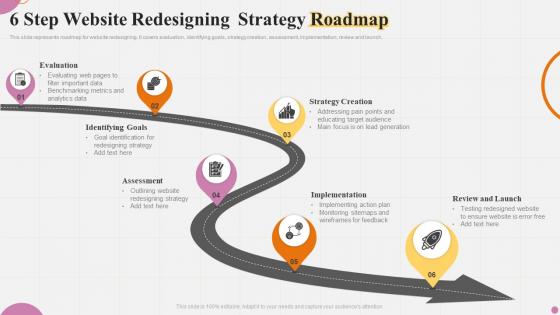
6 Step Website Redesigning Strategy Roadmap




Try Before you Buy Download Free Sample Product
 Impress Your
 Audience
 100%
100% Editable
 Save Hours
 of Time


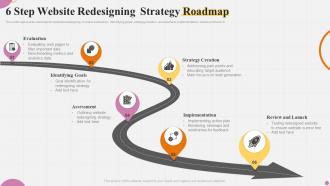
This slide represents roadmap for website redesigning. It covers evaluation, identifying goals, strategy creation, assessment, implementation, review and launch.
People who downloaded this PowerPoint presentation also viewed the following :
6 Step Website Redesigning Strategy Roadmap with all 6 slides:
Use our 6 Step Website Redesigning Strategy Roadmap to effectively help you save your valuable time. They are readymade to fit into any presentation structure.





FAQs for 6 Step Website
Key indicators include declining conversion rates, outdated visual design, poor mobile responsiveness, slow loading speeds, and high bounce rates. These metrics often reflect user experience issues that impact business performance, with many organizations finding that addressing navigation complexity, technical functionality, and brand alignment through strategic redesign ultimately delivers improved customer engagement and competitive advantage.
Website redesign improves user experience through enhanced navigation, faster loading speeds, mobile optimization, intuitive layouts, and streamlined content architecture. These improvements enable businesses to reduce bounce rates, increase conversion rates, and boost customer satisfaction, with many e-commerce and service companies finding that strategic redesigns deliver significantly higher engagement metrics and competitive advantage.
Branding serves as the foundational framework that guides design decisions, visual elements, user experience, and messaging consistency throughout a website redesign strategy. A strong brand identity streamlines the redesign process by establishing clear parameters for color schemes, typography, and content tone, while ensuring the new site authentically represents the company's values and effectively communicates with target audiences.
Businesses should prioritize website redesign features by focusing on user experience fundamentals, mobile responsiveness, site speed optimization, clear navigation architecture, and conversion-focused elements like streamlined checkout processes. Through strategic prioritization, organizations across retail, healthcare, and professional services enhance customer engagement, reduce bounce rates, and increase conversions, ultimately delivering improved user satisfaction and competitive advantage in digital markets.
Best practices for conducting user research before a redesign include user interviews, surveys, analytics analysis, usability testing, and competitive benchmarking. These research methods streamline redesign decisions by identifying pain points, understanding user behavior patterns, and validating design assumptions, with many organizations finding that comprehensive upfront research ultimately delivers higher conversion rates and enhanced user experiences.
Analytics inform website redesign strategy by identifying user behavior patterns, page performance metrics, conversion bottlenecks, traffic sources, and engagement levels across different site sections. Through tools like Google Analytics and heatmapping software, organizations can pinpoint high-exit pages, popular content areas, and user journey obstacles, ultimately enabling data-driven design decisions that enhance user experience and boost conversion rates.
Critical mobile responsiveness elements include flexible grid layouts, touch-friendly navigation, optimized images and media, fast loading speeds, and streamlined content hierarchy. These design principles enhance user experience by ensuring seamless functionality across devices, reducing bounce rates, and improving search rankings, with many retailers and service providers finding that mobile-optimized sites significantly increase conversion rates and customer engagement.
SEO significantly impacts website redesign planning by requiring comprehensive keyword analysis, URL structure preservation, content optimization strategies, and technical performance enhancements from the project's inception. Through strategic SEO integration, businesses maintain search rankings while improving site architecture, page load speeds, and user experience, with many organizations finding that early SEO consideration prevents traffic loss and accelerates post-launch visibility improvements.
**INPUT**: What tools and technologies can streamline the redesign process? **OUTPUT**: Website redesign tools include content management systems like WordPress, design platforms such as Figma, analytics tools like Google Analytics, wireframing software, and collaboration platforms. These technologies streamline workflows by enabling real-time collaboration, automating content migration, and providing data-driven insights, with many organizations finding that integrated toolsets reduce project timelines while enhancing design quality and stakeholder alignment. [Word count: 60]
Businesses can effectively budget for website redesigns by allocating 15-25% for strategy and planning, 40-50% for design and development, 10-15% for content creation, and 15-20% for contingencies. Many organizations find that investing in thorough upfront planning, quality hosting infrastructure, and post-launch optimization ultimately delivers better user experiences and higher conversion rates.
Common website redesign pitfalls include neglecting SEO considerations, ignoring user feedback, drastically changing navigation structures, failing to maintain brand consistency, and launching without thorough testing. These oversights can disrupt search rankings, confuse existing customers, and impact conversion rates, with many organizations finding that a phased approach with stakeholder input delivers smoother transitions and better user adoption.
Content strategy should evolve through comprehensive audits, user journey mapping, SEO optimization, mobile-first approaches, and conversion-focused messaging aligned with new design elements. Through strategic content restructuring, organizations streamline navigation, enhance user engagement, and improve search rankings, while ensuring messaging consistency across touchpoints, ultimately delivering stronger brand experiences and measurable business growth.
Successful website redesign transitions involve comprehensive backup creation, staged deployment, thorough user testing, SEO preservation, and stakeholder communication throughout the process. These approaches minimize disruption by maintaining functionality, preserving search rankings, and ensuring user experience continuity, with many organizations finding that phased rollouts and extensive testing ultimately deliver smoother launches and sustained performance.
Stakeholder feedback can be effectively integrated through structured workshops, regular review cycles, feedback matrices, and collaborative design sessions that prioritize input by business impact and user value. These approaches streamline decision-making by creating clear communication channels, establishing feedback deadlines, and using visual prototypes, with many organizations finding that systematic stakeholder engagement delivers faster approvals and enhanced user experiences.
Key metrics include conversion rates, bounce rates, page load times, user engagement duration, and mobile responsiveness scores. These indicators help organizations measure improved user experiences, operational efficiency, and revenue impact, with many companies finding that tracking customer journey analytics and search rankings ultimately delivers comprehensive insights into redesign effectiveness and competitive advantage.
-
This PowerPoint layout is very helpful from a business point of view, and it's visually stunning too! I'm so happy with this product because it has helped me understand and deliver great presentations.
-
Informative design.