


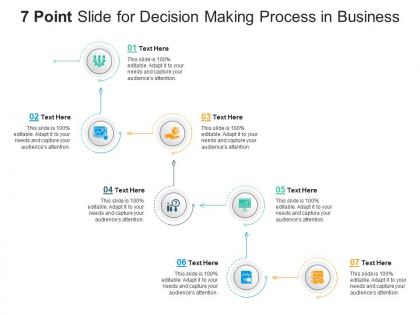
7 point slide for decision making process in business infographic template




Try Before you Buy Download Free Sample Product
 Impress Your
 Audience
 100%
100% Editable
 Save Hours
 of Time


Professionals belonging to any sector can use this set titled 7 Point Slide For Decision Making Process In Business Infographic Template. From managers, executives to lower level employees, every individual can use this tool to present insightful details and implications in a well structured format. Various charts and graphs are added to this infographic design that makes it a resourceful set. Not only will this add to the informative qualities of this template, but it also makes it an instant attention grabber. Apart from this, it offers at a glance view of the topics, thus simplifying complex concepts. This helps in retaining the information presented for a long time. The biggest quality of this template is its visual elements, all added to elevate the aesthetic appeal of the presentation. Therefore download this template and present a customized version of it without any trouble.
People who downloaded this PowerPoint presentation also viewed the following :
7 point slide for decision making process in business infographic template with all 2 slides:
Use our 7 Point Slide For Decision Making Process In Business Infographic Template to effectively help you save your valuable time. They are readymade to fit into any presentation structure.
FAQs for 7 point slide for decision making process in
The key stages in business decision-making include problem identification, information gathering, alternative generation, evaluation and analysis, implementation planning, and outcome monitoring. These stages enable organizations to systematically address challenges by assessing risks, weighing options, and allocating resources strategically, with many companies finding that structured processes ultimately deliver faster resolutions and competitive advantage.
Data analytics enhances organizational decision-making by providing evidence-based insights, predictive modeling, and real-time performance tracking across all business functions. Through advanced analytics platforms, companies streamline resource allocation, minimize operational risks, and accelerate strategic responses, with many financial services and retail organizations finding that data-driven approaches ultimately deliver competitive advantage and measurable ROI improvements.
Intuition serves as a valuable complement to data-driven analysis in business decision-making, particularly when facing time constraints, incomplete information, or novel situations where historical data may be limited. It proves most effective in leadership decisions, crisis management, and creative strategy development, with many experienced executives finding that combining analytical rigor with intuitive insights enhances decision quality and competitive responsiveness.
Businesses can effectively identify risks through comprehensive stakeholder analysis, scenario planning, historical data review, market research, and cross-functional team assessments. These methodologies enable organizations to evaluate potential financial, operational, and strategic impacts systematically, with many companies in manufacturing and financial services finding that structured risk frameworks ultimately deliver better decision outcomes and competitive advantages.
Leaders can foster collaborative decision-making through structured brainstorming sessions, cross-functional workshops, anonymous feedback systems, rotating leadership roles, and inclusive facilitation techniques. These approaches enhance team dynamics by leveraging diverse perspectives, reducing hierarchical barriers, and ensuring equal participation, with many organizations finding that collaborative frameworks ultimately deliver faster consensus-building and more innovative solutions.
Organizational culture significantly impacts decision-making by shaping communication patterns, risk tolerance levels, hierarchical structures, and collaborative approaches within companies. In hierarchical cultures, decisions flow top-down through multiple approval layers, while collaborative cultures enable cross-functional teams to make faster, more innovative choices, ultimately delivering improved agility and employee engagement across diverse industries.
Strategic decisions involve long-term planning, resource allocation, and competitive positioning, while tactical decisions focus on medium-term implementation of strategies through specific programs and initiatives. Operational decisions address day-to-day activities like scheduling, inventory management, and customer service processes, with many organizations finding that aligning these three levels enhances efficiency and delivers sustained competitive advantage.
Businesses can utilize decision-making frameworks like SWOT and PESTLE analysis to systematically evaluate internal strengths and weaknesses alongside external opportunities and threats, while assessing political, economic, social, technological, legal, and environmental factors. These strategic frameworks enable organizations across sectors like retail, healthcare, and manufacturing to make data-driven decisions, minimize risks, and identify growth opportunities, ultimately delivering competitive advantage and improved strategic outcomes.
Scenario planning aids informed business decisions by developing multiple plausible future scenarios, identifying potential risks and opportunities, and stress-testing strategic options against various outcomes. Through systematic evaluation of different possibilities, organizations can enhance preparedness, minimize uncertainty, and develop contingency plans, with many financial services and manufacturing companies finding that scenario-based approaches ultimately deliver more resilient strategies and competitive positioning.
Cognitive bias significantly impacts corporate decision-making by creating systematic errors in judgment, leading to overconfidence in projections, anchoring to initial data, and confirmation bias in strategy selection. These biases can result in poor resource allocation, missed market opportunities, and flawed risk assessments, with many organizations finding that structured decision frameworks and diverse perspectives help minimize these effects while enhancing strategic outcomes.
Businesses can ensure ethical considerations by establishing clear ethical guidelines, conducting regular ethics training, implementing stakeholder impact assessments, and creating diverse decision-making teams. Through structured ethical frameworks, organizations in healthcare, finance, and technology streamline moral evaluation processes while maintaining compliance standards, ultimately delivering sustainable practices, enhanced stakeholder trust, and long-term competitive advantage in increasingly regulated markets.
Decision-making tools include business intelligence platforms, data analytics software, project management systems, collaboration platforms, and automated workflow solutions. These technologies streamline processes by centralizing data access, facilitating real-time collaboration, and providing predictive insights, with many organizations finding that integrated dashboard systems significantly reduce decision latency while enhancing strategic accuracy.
Stakeholder analysis integrates into business decision-making by identifying key parties, assessing their influence and interests, and evaluating potential impacts of proposed decisions. This systematic approach enables organizations to anticipate resistance, build strategic alliances, and craft solutions that balance competing priorities, ultimately delivering more sustainable outcomes and stronger stakeholder buy-in across complex business initiatives.
**INPUT**: What are the challenges of making decisions in a rapidly changing market environment? **OUTPUT**: Decision-making in rapidly changing markets presents challenges including incomplete information, compressed timeframes, shifting customer preferences, volatile competitive landscapes, and resource allocation uncertainties. These complexities require organizations to balance speed with accuracy, with many businesses finding that agile decision frameworks, real-time data analytics, and scenario planning ultimately deliver competitive advantage while minimizing risk exposure. **Word count: 54 words**
Feedback loops enhance decision-making by collecting performance data, analyzing outcomes against expectations, and identifying improvement opportunities for future choices. Organizations using systematic feedback mechanisms streamline their strategic planning, reduce repeated errors, and accelerate learning cycles, with many companies finding that structured feedback processes ultimately deliver faster responses to market changes and improved competitive positioning.
-
The Designed Graphic are very professional and classic.