


7 Steps Of Haccp To Ensure Food Safety Quality Assurance Plan And Procedures Set 3




Try Before you Buy Download Free Sample Product
 Impress Your
 Audience
 100%
100% Editable
 Save Hours
 of Time


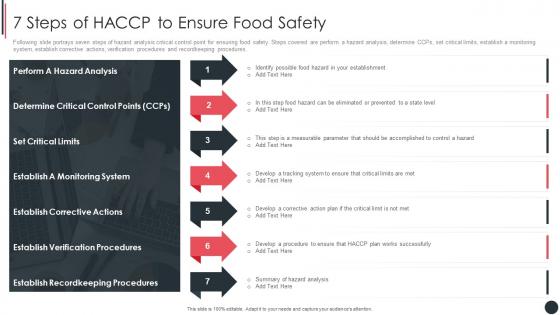
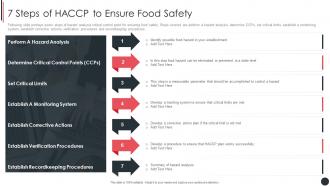
Following slide portrays seven steps of hazard analysis critical control point for ensuring food safety. Steps covered are perform a hazard analysis, determine CCPs, set critical limits, establish a monitoring system, establish corrective actions, verification procedures and recordkeeping procedures.
People who downloaded this PowerPoint presentation also viewed the following :
7 Steps Of Haccp To Ensure Food Safety Quality Assurance Plan And Procedures Set 3 with all 6 slides:
Use our 7 Steps Of Haccp To Ensure Food Safety Quality Assurance Plan And Procedures Set 3 to effectively help you save your valuable time. They are readymade to fit into any presentation structure.





FAQs for 7 Steps Of Haccp To Ensure Food Safety Quality Assurance Plan And
HACCP's seven key principles include conducting hazard analysis, identifying critical control points, establishing critical limits, monitoring procedures, and implementing corrective actions, verification, and record-keeping systems. These principles enable food manufacturers, restaurants, and processing facilities to systematically prevent contamination, ensure product safety, and maintain regulatory compliance, ultimately delivering consistent quality while minimizing costly recalls and protecting consumer health.
Businesses can effectively implement HACCP by conducting thorough hazard analyses, establishing critical control points, setting monitoring procedures, and training staff comprehensively. Through systematic documentation and regular audits, food manufacturers, restaurants, and pharmaceutical companies streamline compliance processes, reduce contamination risks, and ensure consistent product safety, ultimately delivering enhanced consumer protection and regulatory confidence.
Hazard analysis and risk assessment form the foundation of HACCP methodology by systematically identifying biological, chemical, and physical hazards throughout food production processes, then evaluating their likelihood and severity. These critical steps enable food manufacturers, restaurants, and processing facilities to prioritize control measures, establish critical control points, and implement targeted monitoring systems, ultimately delivering safer products and regulatory compliance.
Regulatory agencies view HACCP implementation as essential for systematic food safety management, requiring comprehensive hazard analysis, critical control points identification, and continuous monitoring protocols. Through mandatory compliance frameworks, agencies like FDA and USDA ensure food manufacturers, processors, and restaurants maintain rigorous safety standards, ultimately delivering consumer protection and industry accountability in an increasingly complex global food supply chain.
Common challenges include identifying all potential hazards, establishing accurate critical control points, developing effective monitoring procedures, ensuring staff training compliance, and maintaining comprehensive documentation systems. These obstacles often overwhelm smaller food businesses initially, though many restaurants, processors, and retailers find that systematic implementation with phased approaches ultimately streamlines operations while ensuring regulatory compliance and food safety standards.
Staff training enhances HACCP effectiveness by ensuring proper hazard identification, critical control point monitoring, and corrective action implementation across all operational levels. Through comprehensive education programs, food service organizations, restaurants, and manufacturing facilities achieve consistent compliance, reduce contamination risks, and maintain regulatory standards, ultimately delivering safer products and enhanced consumer confidence.
Monitoring critical control points ensures food safety by tracking temperature, pH levels, cooking times, and contamination risks in real-time, enabling immediate corrective actions when deviations occur. This systematic approach helps restaurants, food manufacturers, and processing facilities prevent foodborne illnesses, maintain regulatory compliance, and protect brand reputation, ultimately delivering safer products and reduced liability risks.
HACCP differs from traditional quality control by emphasizing prevention rather than end-product testing, implementing systematic hazard analysis at critical control points, and establishing continuous monitoring throughout production processes. While traditional methods rely on sampling and reactive measures, HACCP enables food manufacturers, restaurants, and processors to identify potential contamination risks proactively, ultimately delivering enhanced safety protocols and regulatory compliance.
HACCP principles can effectively be applied beyond food industries to pharmaceuticals, cosmetics, medical device manufacturing, and chemical processing sectors. These systematic approaches streamline quality control by identifying critical control points, establishing monitoring procedures, and implementing corrective actions, with many organizations finding that HACCP frameworks enhance operational efficiency, ensure regulatory compliance, and deliver consistent product safety standards.
HACCP software tools include digital monitoring systems, temperature tracking applications, automated record-keeping platforms, compliance management software, and cloud-based documentation systems. These technologies streamline food safety processes by automating data collection, generating real-time alerts, and maintaining audit trails, with many food manufacturers finding that integrated HACCP platforms significantly reduce compliance costs while enhancing operational efficiency.
Companies ensure continuous improvement in their HACCP system through regular internal audits, employee training updates, customer feedback analysis, and performance metric monitoring. By implementing corrective action protocols, conducting periodic hazard reassessments, and benchmarking against industry standards, organizations streamline food safety processes while reducing compliance risks, ultimately delivering enhanced product quality and operational efficiency.
Non-compliance with HACCP guidelines results in foodborne illness outbreaks, regulatory fines, product recalls, facility shutdowns, and severe reputational damage. These consequences can devastate businesses through legal liability, lost consumer trust, and market share erosion, with many food companies finding that recovery costs far exceed preventive compliance investments, ultimately threatening long-term viability.
Small food businesses can effectively adopt HACCP by starting with simplified risk assessments, focusing on critical control points specific to their operations, and utilizing free templates from regulatory agencies. Many restaurants and cafes find that phased implementation, employee cross-training, and leveraging digital monitoring tools streamlines compliance while minimizing costs, ultimately delivering food safety assurance and competitive advantage.
Documentation serves as the foundation of HACCP programs, providing evidence of hazard analysis, critical control point monitoring, corrective actions, verification procedures, and record-keeping systems. These comprehensive records enable food manufacturers, restaurants, and processing facilities to demonstrate compliance, track performance trends, and respond quickly to audits, ultimately ensuring food safety integrity and regulatory adherence across operations.
Consumer awareness of HACCP drives food industry transformation by increasing demand for transparency, encouraging proactive compliance measures, and influencing purchasing decisions based on safety standards. This heightened awareness compels manufacturers, restaurants, and retailers to strengthen their quality systems, implement more rigorous monitoring protocols, and communicate safety practices more effectively, ultimately delivering enhanced consumer confidence and competitive market positioning.
-
Thrilled to see several customizable templates catering various verticals and industries.
-
Professionally designed slides with color coordinated themes and icons. Perfect for enhancing the style of the presentations.