


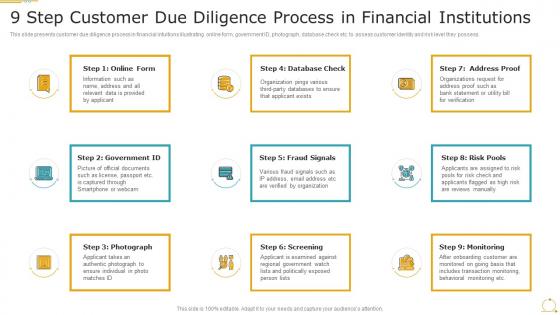
9 Step Customer Due Diligence Process In Financial Institutions




Try Before you Buy Download Free Sample Product
 Impress Your
 Audience
 100%
100% Editable
 Save Hours
 of Time


This slide presents customer due diligence process in financial intuitions illustrating online form, government ID, photograph, database check etc. to assess customer identity and risk level they possess.
People who downloaded this PowerPoint presentation also viewed the following :
9 Step Customer Due Diligence Process In Financial Institutions with all 6 slides:
Use our 9 Step Customer Due Diligence Process In Financial Institutions to effectively help you save your valuable time. They are readymade to fit into any presentation structure.





FAQs for 9 Step Customer Due Diligence Process
Customer Due Diligence components include identity verification, risk assessment, beneficial ownership identification, transaction monitoring, and ongoing review processes. These elements work together by establishing customer profiles, detecting suspicious activities, and ensuring regulatory compliance, with financial institutions and fintech companies finding that comprehensive CDD ultimately delivers enhanced security and streamlined operations.
CDD mitigates money laundering risks by verifying customer identities, assessing risk profiles, and monitoring transaction patterns for suspicious activities. Through comprehensive background checks and ongoing surveillance, financial institutions can detect unusual behaviors, prevent illicit fund flows, and ensure regulatory compliance, ultimately protecting their reputation while reducing operational and legal risks.
Customer Due Diligence operates under diverse regulatory frameworks including the Bank Secrecy Act and USA PATRIOT Act in the United States, Anti-Money Laundering Directives in the European Union, and FATF recommendations globally. These frameworks streamline compliance by establishing standardized verification procedures, risk assessment protocols, and reporting requirements, with financial institutions finding that harmonized approaches ultimately deliver enhanced transparency and reduced regulatory complexity across multiple jurisdictions.
Businesses can implement automated CDD solutions through AI-powered identity verification, machine learning risk scoring algorithms, robotic process automation for document collection, and integrated compliance platforms that connect multiple data sources. These technologies streamline workflows by reducing manual verification time, enhancing accuracy through real-time monitoring, and enabling faster customer onboarding, with financial institutions finding significantly improved operational efficiency and regulatory compliance.
Customer segmentation enhances CDD effectiveness by enabling risk-based approaches, targeted monitoring protocols, streamlined compliance processes, and resource optimization strategies. Through strategic segmentation, financial institutions categorize clients by risk profiles, transaction patterns, and regulatory requirements, while automating low-risk assessments and intensifying high-risk scrutiny, ultimately delivering enhanced compliance efficiency and regulatory accuracy.
Organizations should approach ongoing monitoring through automated transaction screening, periodic risk assessments, behavioral analytics, and regular documentation updates to detect unusual patterns or changes in customer profiles. This continuous surveillance enables banks and financial institutions to identify potential money laundering, fraud, or regulatory violations early, while streamlining compliance processes and ultimately delivering enhanced security and reduced operational risk.
Best practices for verifying customer identity during CDD include multi-source document verification, biometric authentication, database cross-referencing, real-time identity validation, and risk-based authentication protocols. These technologies streamline verification by automating document checks, enhancing fraud detection, and ensuring regulatory compliance, with many financial institutions finding that strategic combinations ultimately deliver faster onboarding and stronger security.
AI and machine learning enhance CDD processes by automating document verification, analyzing customer behavior patterns, and streamlining risk assessment workflows. These technologies enable financial institutions to process applications faster, detect suspicious activities more accurately, and reduce manual review time, with many banks finding that automated CDD systems deliver improved compliance accuracy while significantly lowering operational costs.
Organizations face challenges including incomplete customer data, complex regulatory requirements across jurisdictions, manual verification processes, resource constraints, and difficulty assessing beneficial ownership structures. These obstacles can delay onboarding, increase compliance costs, and create operational bottlenecks, with many financial institutions finding that streamlined digital CDD solutions significantly reduce processing times while enhancing regulatory accuracy.
CDD for high-risk customers requires enhanced verification procedures, ongoing transaction monitoring, source of wealth documentation, and senior management approval, while low-risk customers undergo simplified identity verification and basic background checks. Financial institutions, for example, apply stricter scrutiny to politically exposed persons and foreign correspondent banks, whereas domestic retail customers receive streamlined processing, ultimately enabling institutions to allocate compliance resources efficiently while maintaining regulatory standards.
Cultural factors significantly impact CDD effectiveness through varying communication styles, documentation practices, relationship-building preferences, and regulatory compliance approaches across different regions. Financial institutions operating globally find that adapting CDD processes to local cultural norms, while maintaining consistent risk standards, enhances customer cooperation and data accuracy, ultimately delivering more reliable risk assessments and stronger compliance outcomes.
Businesses ensure international CDD compliance by implementing robust customer identification procedures, conducting enhanced due diligence for high-risk clients, maintaining comprehensive transaction monitoring systems, and establishing regular compliance audits across all jurisdictions. Through standardized KYC frameworks and automated screening technologies, financial institutions streamline regulatory adherence while reducing operational costs, ultimately delivering consistent customer experiences and minimizing regulatory penalties across global markets.
Documentation serves as the foundation of CDD processes, creating audit trails, ensuring regulatory compliance, supporting risk assessments, and enabling ongoing monitoring activities. These comprehensive records streamline verification procedures, enhance transparency across financial institutions, and facilitate regulatory reporting, with many banks and investment firms finding that robust documentation systems ultimately deliver faster onboarding processes and stronger compliance frameworks.
CDD practices integrate into existing workflows through automated screening systems, real-time monitoring tools, and seamless API connections with current databases and CRM platforms. These technologies streamline compliance by embedding verification processes directly into customer onboarding, transaction processing, and account management systems, ultimately reducing manual workload while enhancing regulatory adherence and operational efficiency.
CDD training encompasses anti-money laundering regulations, customer risk assessment methodologies, documentation requirements, red flag identification, and ongoing monitoring protocols. Through comprehensive programs covering KYC procedures, sanctions screening, and suspicious activity reporting, financial institutions enhance compliance accuracy, reduce regulatory violations, and strengthen fraud detection capabilities, with many banks finding that well-trained staff significantly improve customer onboarding efficiency.
-
“Immediate response, professional support, and effective solutions that were customized and immediately provided. Well done- Thank you!”
-
I have just started downloading templates for my presentations and I must say this is a great design. It helped accelerate my presentation design process and made it more visually appealing.