


A Guide To Disadvantages Of Cryptocurrency Training Ppt





Try Before you Buy Download Free Sample Product
 Impress Your
 Audience
 100%
100% Editable
 Save Hours
 of Time


These slides in-depth cover the limitations of cryptocurrency, which are the inability to scale, price volatility, risk of data loss, high consumption of energy, and illegal transactions.
People who downloaded this PowerPoint presentation also viewed the following :
Content of this Powerpoint Presentation
Slide 1
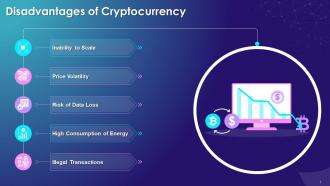
This slide lists the disadvantages of cryptocurrency. These include inability to scale, price volatility, risk of data loss, high consumption of energy, and illegal transactions.
Slide 2
The slide talks about poor scalability as a disadvantage of cryptocurrency. The scalability issues that cryptocurrencies pose are probably the most serious ones. While the number of digital coins and their usage is fast-growing, it is still dwarfed by the number of transactions that payment giants like VISA, Alipay, Amazon etc.
Slide 3
The slide discusses price volatility as a disadvantage of cryptocurrency. Cryptocurrency is seen as volatile since it is a newer asset class with the potential for big upward and downward moves over shorter periods.
Slide 4
The slide talks about risk of data loss as a disadvantage of cryptocurrency. Cryptocurrency creators sought to create invisible ASCII documents and robust hacking defenses, and impenetrable authentication processes. It is safer to keep money in cryptocurrency rather than cash or bank vaults. However, if a user loses their wallet's private key, there is no way to recover it.
Slide 5
The slide talks about high consumption of energy as a disadvantage of cryptocurrency. Cryptocurrency mining is energy-intensive as it requires a lot of processing power and electricity.
Instructor’s Notes: Bitcoin miners are concentrated in countries where coal is used to generate electricity, such as China. Such mining of bitcoins has increased China's carbon footprint.
Slide 6
The slide discusses illegal transactions as a disadvantage of cryptocurrency. Since cryptocurrency transactions are private and secure, it's difficult for authorities to track down or monitor any person by their wallet address. Bitcoin has previously been used as a means of payment (exchanging money) in unlawful transactions, such as buying narcotics on the dark web.
A Guide To Disadvantages Of Cryptocurrency Training Ppt with all 22 slides:
Use our A Guide To Disadvantages Of Cryptocurrency Training Ppt to effectively help you save your valuable time. They are readymade to fit into any presentation structure.



















FAQs for A Guide To Disadvantages Of
Primary security risks include exchange hacks, wallet vulnerabilities, phishing attacks, smart contract exploits, and private key theft. While these challenges present significant concerns for investors, many financial institutions and crypto platforms are increasingly implementing multi-factor authentication, cold storage solutions, and insurance coverage, ultimately delivering enhanced protection and greater investor confidence.
Regulatory uncertainties create hesitation among businesses and financial institutions considering cryptocurrency integration, as unclear legal frameworks make compliance planning difficult and risk assessment complex. This ambiguity slows institutional adoption, limits investment flows, and prevents mainstream financial services from fully embracing digital currencies, ultimately delaying widespread market acceptance and commercial scalability.
Cryptocurrencies contribute to environmental concerns primarily through energy-intensive mining processes, particularly Bitcoin's proof-of-work consensus mechanism, which requires substantial computational power and electricity consumption. While this presents sustainability challenges, many blockchain networks are increasingly adopting energy-efficient alternatives like proof-of-stake, with financial institutions finding that newer cryptocurrencies significantly reduce environmental impact.
Cryptocurrency volatility presents significant challenges including unpredictable portfolio valuations, difficulty in timing market entries and exits, increased emotional stress from rapid price swings, and complications in long-term financial planning. While this volatility creates trading opportunities, many investors find that effective risk management through diversified portfolios and strategic position sizing becomes essential for navigating these turbulent markets successfully.
The lack of consumer protection creates significant trust barriers, as investors face potential total losses without recourse through traditional financial safety nets like FDIC insurance or regulatory oversight. This uncertainty particularly deters institutional adoption and mainstream acceptance, with many traditional financial sectors finding that regulatory ambiguity ultimately limits cryptocurrency integration into established business operations.
Cryptocurrency fraud and scams undermine market integrity by eroding investor confidence, creating regulatory uncertainty, and distorting price mechanisms through manipulative practices like pump-and-dump schemes. These activities ultimately damage the sector's credibility with institutional investors and traditional financial institutions, while prompting stricter oversight that can stifle innovation and legitimate market development.
Cryptocurrency's technical complexity deters investors through challenging wallet management, private key security requirements, confusing transaction processes, and steep learning curves around blockchain technology. Many potential investors, particularly in traditional finance sectors, find navigating exchanges, understanding gas fees, and managing digital assets overwhelming, ultimately choosing familiar investment vehicles over cryptocurrencies despite their growth potential.
Cryptocurrency anonymity enables money laundering, tax evasion, drug trafficking, ransomware payments, and terrorist financing by obscuring transaction origins and destinations. While blockchain records exist permanently, the pseudonymous nature makes it challenging for law enforcement to trace funds in real-time, with many criminal organizations exploiting this gap between digital privacy and regulatory oversight.
**INPUT**: What are the disadvantages of relying on cryptocurrencies for everyday transactions? **OUTPUT**: Cryptocurrency disadvantages for daily transactions include extreme price volatility, limited merchant acceptance, complex technical requirements, regulatory uncertainty, and slower transaction speeds during peak periods. While these challenges present obstacles, many financial institutions and payment processors are developing solutions that streamline cryptocurrency integration, ultimately delivering more stable digital payment options for everyday commerce. [Word count: 54 words]
The lack of central authority creates significant price volatility in cryptocurrencies, as no institution can implement stabilizing monetary policies, regulate supply, or intervene during market panics. This decentralized structure, while offering independence from traditional banking systems, results in dramatic price swings that challenge adoption in retail and corporate finance, with many businesses finding that payment processing and treasury management become increasingly complex in such unpredictable environments.
**INPUT**: What barriers exist for technology adoption among non-technical users in the cryptocurrency space? **OUTPUT**: Technology adoption barriers for non-technical cryptocurrency users include complex wallet management, confusing private key security, intimidating exchange interfaces, volatile pricing uncertainty, and regulatory confusion. While these challenges present initial hurdles, many financial institutions and fintech companies are increasingly developing user-friendly platforms with simplified onboarding, automated security features, and educational resources, ultimately delivering more accessible crypto experiences. [Word count: 58 words]
Limited merchant acceptance significantly restricts cryptocurrency's practical utility, creating barriers for everyday transactions like purchasing goods, services, or paying bills in traditional retail environments. While major companies increasingly adopt crypto payments, many small businesses and service providers remain hesitant due to volatility concerns and regulatory uncertainty, ultimately limiting cryptocurrencies' mainstream adoption potential.
Market manipulation significantly impacts cryptocurrency through pump-and-dump schemes, whale trading, social media influence campaigns, and coordinated buying or selling by large holders. While regulatory frameworks are increasingly addressing these practices, many exchanges and investors find that implementing robust verification processes, diversified trading strategies, and thorough due diligence helps minimize exposure to manipulative activities, ultimately delivering more stable investment environments.
Cryptocurrencies challenge traditional financial institutions by bypassing established banking intermediaries, reducing transaction fee revenues, and creating regulatory compliance complexities that strain existing frameworks. While banks face disintermediation pressures and central banks lose monetary control mechanisms, many institutions are finding that strategic cryptocurrency integration, rather than resistance, ultimately delivers competitive advantages and enhanced customer services in an increasingly digital financial landscape.
Recovering lost or stolen cryptocurrency assets presents significant challenges including irreversible transactions, limited legal recourse, technical complexity of wallet recovery, and lack of centralized authority for dispute resolution. While blockchain's immutable nature enhances security, it also means that once cryptocurrency is transferred or accessed through compromised private keys, recovery becomes nearly impossible, with many investors finding that prevention through secure storage and backup strategies remains their primary protection.
-
“Excellent service from the customer support team when I wanted a slide that was a bit different from those on their standard menu. Super helpful.”
-
Perfect template with attractive color combination.