


ABC Analysis For Stock Inventory Management Retail Inventory Management Techniques




Try Before you Buy Download Free Sample Product
 Impress Your
 Audience
 100%
100% Editable
 Save Hours
 of Time


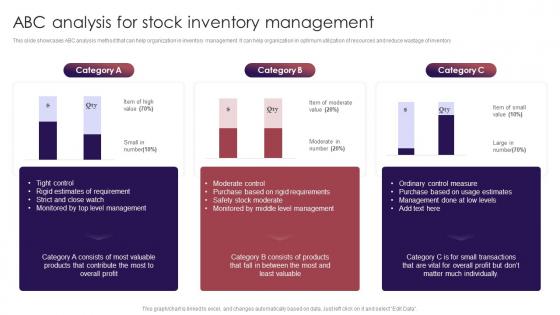
This slide showcases ABC analysis method that can help organization in inventory management. It can help organization in optimum utilization of resources and reduce wastage of inventory.
People who downloaded this PowerPoint presentation also viewed the following :
ABC Analysis For Stock Inventory Management Retail Inventory Management Techniques with all 7 slides:
Use our ABC Analysis For Stock Inventory Management Retail Inventory Management Techniques to effectively help you save your valuable time. They are readymade to fit into any presentation structure.
-
ABC Analysis For Stock Inventory Management Retail Inventory Management Techniques
-
ABC Analysis For Stock Inventory Management Retail Inventory Management Techniques
-

ABC Analysis For Stock Inventory Management Retail Inventory Management Techniques
-

ABC Analysis For Stock Inventory Management Retail Inventory Management Techniques
-

ABC Analysis For Stock Inventory Management Retail Inventory Management Techniques
-

ABC Analysis For Stock Inventory Management Retail Inventory Management Techniques
-

ABC Analysis For Stock Inventory Management Retail Inventory Management Techniques
FAQs for ABC Analysis For Stock Inventory Management Retail
ABC Analysis operates on the Pareto Principle, categorizing inventory items by their relative value contribution, where A-items represent high-value products requiring intensive management, B-items are moderate-value with standard control, and C-items are low-value with basic oversight. This strategic segmentation enables organizations to optimize resource allocation, streamline inventory costs, and enhance operational efficiency across manufacturing, retail, and distribution sectors.
ABC Analysis helps businesses prioritize inventory by categorizing items into high-value (A), moderate-value (B), and low-value (C) categories based on revenue contribution, enabling strategic resource allocation. This approach allows retailers and manufacturers to focus premium attention on top-performing products while streamlining management of lower-priority items, ultimately reducing carrying costs and improving cash flow efficiency.
ABC analysis commonly uses annual dollar usage (unit cost × annual demand), inventory value percentage, sales revenue contribution, profit margin impact, and supply chain criticality. These criteria enable organizations to categorize inventory strategically, with A-items typically representing 70-80% of total value, allowing businesses to optimize resource allocation, streamline procurement processes, and enhance operational efficiency.
ABC Analysis proves most effective in manufacturing, retail, healthcare, and logistics industries where inventory management directly impacts profitability and operational efficiency. These sectors benefit from ABC's ability to prioritize high-value items, streamline procurement processes, and optimize storage allocation, with many organizations finding that focusing resources on 'A' category items delivers significant cost reductions and improved service levels.
The Pareto principle forms the foundation of ABC Analysis by demonstrating that roughly 80% of effects come from 20% of causes, which translates to 80% of inventory value typically originating from 20% of items. This statistical relationship enables businesses to prioritize high-value A items for intensive management, while streamlining control processes for B and C categories, ultimately delivering improved resource allocation and operational efficiency.
ABC Analysis effectively extends beyond inventory to categorize vendor relationships, customer segments, service offerings, marketing channels, and operational processes by value and strategic importance. This strategic approach enables organizations to prioritize high-value vendors for partnership development, focus resources on premium customer segments, and streamline operations, ultimately delivering enhanced efficiency and competitive advantage across multiple business dimensions.
ABC Analysis limitations include oversimplification of complex inventory relationships, static categorization that doesn't adapt to market changes, potential neglect of strategic items with lower values, and heavy reliance on historical data. While these challenges require careful consideration, many organizations find that combining ABC Analysis with dynamic forecasting and regular category reviews ultimately delivers more nuanced inventory management and competitive advantage.
Businesses should reevaluate ABC categorizations quarterly or semi-annually, though dynamic industries may require monthly reviews to maintain accuracy. Market fluctuations, seasonal demand shifts, and evolving customer preferences can quickly alter item classifications, with many retailers and manufacturers finding that regular reassessment ensures optimal inventory allocation and prevents costly misclassification of critical items.
ABC Analysis tools include specialized inventory management software like SAP, Oracle, and Microsoft Dynamics, advanced Excel templates with automated calculations, and dedicated analytics platforms like Tableau and Power BI. These technologies streamline categorization by automating data processing, generating visual reports, and enabling real-time inventory tracking, with many organizations finding that integrated solutions deliver enhanced accuracy and faster decision-making capabilities.
Companies integrate ABC Analysis with other inventory management techniques by combining it with Just-in-Time for A-items, Economic Order Quantity calculations for B-items, and bulk purchasing strategies for C-items. This strategic combination enables organizations to optimize procurement cycles, reduce carrying costs, and enhance inventory turnover, with many retailers and manufacturers finding that integrated approaches deliver significantly improved operational efficiency.
Demand forecasting enhances ABC Analysis by enabling more accurate classification of items based on predicted consumption patterns, seasonal variations, and market trends. This strategic combination allows organizations to optimize inventory levels, reduce carrying costs, and improve service levels, with many retailers and manufacturers finding that forecasting-driven ABC classifications ultimately deliver better resource allocation and competitive advantage.
Market conditions significantly impact ABC Analysis classifications by altering demand patterns, supplier costs, pricing structures, and customer preferences, requiring regular reclassification reviews. Economic shifts, seasonal fluctuations, and industry disruptions can transform B-category items into A-category priorities, with many organizations finding that quarterly reassessments enable better inventory optimization and strategic resource allocation.
Companies should establish clear objectives, gather comprehensive inventory data, calculate annual usage values, rank items by consumption value, and define A-B-C categories with appropriate thresholds. This systematic approach enables organizations to identify high-impact inventory items, streamline resource allocation, and implement targeted management strategies, with many retail and manufacturing companies finding that proper categorization delivers enhanced operational efficiency and significant cost reductions.
Key metrics include inventory turnover rates, carrying costs, stockout frequencies, order fulfillment times, and cost per unit across A, B, and C categories. Organizations typically monitor category-specific service levels, storage optimization ratios, and procurement efficiency improvements, with many retailers and manufacturers finding that tracking these KPIs reveals significant cost reductions and enhanced operational performance.
Staff training enhances ABC Analysis effectiveness by teaching proper inventory categorization, accurate data collection methods, and strategic resource allocation principles. Through comprehensive training programs, employees develop skills in identifying high-value items, implementing appropriate control measures, and making data-driven decisions, ultimately delivering improved inventory accuracy and operational efficiency across the organization.
-
Such amazing slides with easy editable options. A perfect time-saver.
-
Editable templates with innovative design and color combination.