


Advantages And Disadvantages Of Traditional Marketing Training Ppt




Try Before you Buy Download Free Sample Product
 Impress Your
 Audience
 100%
100% Editable
 Save Hours
 of Time


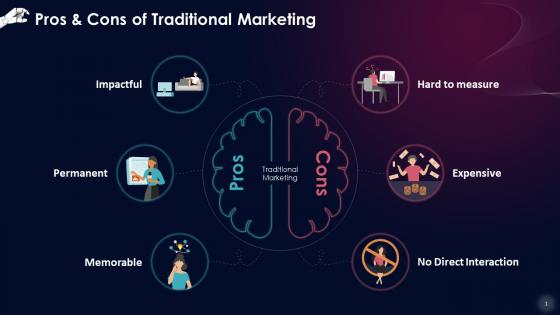
This slide lists the advantages and disadvantages of traditional marketing. The pros include that it is impactful and easy to understand, permanent, and gets recall, whereas the cons are that it is hard to measure, expensive, and offers no direct interaction with the consumer.
People who downloaded this PowerPoint presentation also viewed the following :
Advantages And Disadvantages Of Traditional Marketing Training Ppt with all 17 slides:
Use our Advantages And Disadvantages Of Traditional Marketing Training Ppt to effectively help you save your valuable time. They are readymade to fit into any presentation structure.














FAQs for Advantages And Disadvantages Of Traditional
Key components of a successful traditional marketing strategy include market research, brand positioning, print advertising, broadcast media, direct mail, and public relations. These elements work together by establishing brand awareness through multiple touchpoints, reaching diverse demographics across various channels, and building credibility through consistent messaging, with many organizations finding that integrated traditional campaigns deliver measurable ROI and sustained customer engagement.
Traditional marketing reaches audiences through offline channels like television, radio, print, and billboards, offering broad demographic targeting but limited geographic flexibility and real-time engagement. Digital marketing leverages online platforms, social media, and search engines to deliver precise targeting, global reach, and immediate audience interaction, with many organizations finding that strategic combination of both approaches maximizes market penetration and customer acquisition.
Print advertising maintains significant value in today's marketing landscape through targeted reach, credibility enhancement, and complementary digital integration. While digital channels dominate, print delivers tangible brand presence and trusted messaging, with many luxury brands, healthcare organizations, and financial services finding that strategic print campaigns enhance overall marketing effectiveness and provide competitive differentiation.
Direct mail campaigns deliver response rates of 3-5%, significantly higher than email's 0.6%, while digital approaches offer superior targeting, real-time analytics, and cost efficiency. Many retail and financial services companies find that strategic combinations work best, using direct mail for high-value prospects and digital channels for broader reach, ultimately maximizing engagement while optimizing marketing spend.
Traditional marketing success metrics include reach and frequency, brand awareness surveys, sales revenue attribution, customer acquisition costs, and geographic market penetration analysis. These measurements enable businesses to track campaign effectiveness across television, radio, print, and outdoor advertising channels, with many retailers and consumer brands finding that combining multiple metrics delivers comprehensive insights into ROI and market impact.
Businesses can integrate traditional marketing with digital marketing through cross-channel campaigns, consistent messaging across platforms, QR codes linking print to digital, retargeting website visitors with direct mail, and unified customer databases. This strategic combination enhances brand reach and customer touchpoints, with many retailers finding that coordinated campaigns deliver significantly higher conversion rates and stronger customer relationships than isolated approaches.
Common misconceptions about traditional marketing include that it's completely obsolete, ineffective for younger audiences, prohibitively expensive, impossible to measure, and incompatible with digital strategies. While digital channels dominate conversations, many organizations find that traditional methods like direct mail, radio, and print advertising deliver strong ROI when strategically integrated with digital campaigns, ultimately enhancing overall marketing effectiveness.
Consumer behavior has shifted toward skepticism and avoidance of traditional marketing, with audiences increasingly preferring authentic, personalized experiences over broad advertising campaigns. Many consumers now research independently, rely on peer reviews, and engage with brands through digital channels, while companies find that combining traditional methods with targeted digital strategies delivers better engagement and measurable results.
Television, radio, print newspapers, magazines, and outdoor billboards remain highly effective traditional advertising media, each offering unique audience reach and engagement opportunities. Television delivers broad demographic targeting with visual storytelling, while radio provides cost-effective local market penetration, and print media enables detailed messaging, with many retailers and service providers finding that strategic combinations across these channels significantly enhance brand recognition and customer acquisition rates.
Businesses must consider truth-in-advertising laws, intellectual property rights, privacy regulations, accessibility compliance, and industry-specific guidelines when executing traditional marketing campaigns. These legal frameworks ensure responsible messaging across print, broadcast, and outdoor media, with many organizations finding that proactive compliance strategies ultimately deliver stronger brand reputation and customer trust while minimizing regulatory risks.
Storytelling enhances traditional marketing by creating emotional connections, improving brand recall, and making messages more memorable and relatable to target audiences. Through compelling narratives in print ads, radio spots, and television commercials, companies like Coca-Cola and Nike transform product features into meaningful experiences, ultimately driving stronger customer engagement and brand loyalty.
Brands relying heavily on traditional marketing face limited audience targeting, high costs with unclear ROI, difficulty measuring campaign effectiveness, and reduced consumer engagement compared to digital channels. These challenges result in inefficient resource allocation and missed opportunities, with many companies finding that traditional-only approaches struggle to compete in an increasingly digital marketplace where personalized, data-driven strategies deliver superior customer experiences.
Traditional marketing typically involves higher upfront costs through print advertisements, television commercials, radio spots, and direct mail campaigns, while digital marketing offers more flexible budget allocation with pay-per-click advertising, social media promotions, and email campaigns. Many organizations find that digital approaches deliver better cost efficiency and measurable ROI through targeted audience reach, real-time analytics, and scalable campaign optimization, ultimately enabling more strategic resource allocation.
Small businesses can leverage traditional marketing through cost-effective strategies like local newspaper ads, radio sponsorships, direct mail campaigns, community event participation, and strategic partnerships with complementary businesses. These approaches enable targeted local reach, relationship building, and brand visibility within specific geographic markets, with many small retailers and service providers finding that community-focused traditional marketing delivers higher conversion rates and customer loyalty than broader digital campaigns.
Traditional marketing evolves into strategic integration with digital channels, emphasizing multi-touchpoint campaigns, experiential events, and targeted print media for specific demographics. While many brands increasingly adopt hybrid approaches, traditional methods like direct mail, radio, and outdoor advertising deliver measurable ROI when combined with digital analytics, ultimately enhancing customer reach and brand credibility.
-
World-class PowerPoint designs that are fully customizable!
-
Informative presentations that are easily editable.