


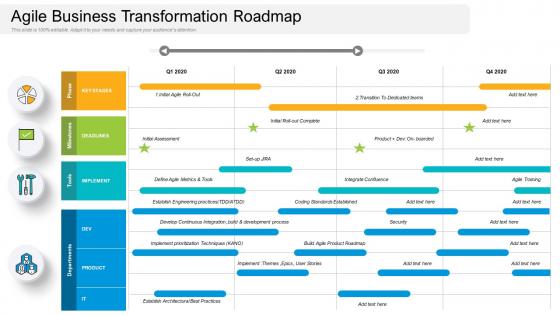
Agile business transformation roadmap





Try Before you Buy Download Free Sample Product
 Impress Your
 Audience
 100%
100% Editable
 Save Hours
 of Time


Folks insist on you giving the decision due to our Agile Business Transformation Roadmap. You will be their favorite judge.
People who downloaded this PowerPoint presentation also viewed the following :
Agile business transformation roadmap with all 2 slides:
Judge correctly due to our Agile Business Transformation Roadmap. Be able to investigate every inner detail.
FAQs for Agile
So you'll want your product vision first, then map out your big themes and rough timing. Success metrics are crucial too - otherwise how do you know if it's working? Show the dependencies between features and who you're building for. Honestly, don't stress too much about exact dates because we both know how that usually goes in Agile! Make it visual so anyone can get it quickly. Build in review points where you can change direction. The whole thing needs to stay flexible - update it after each sprint based on what you learn.
Look, an Agile roadmap basically shows everyone how your sprint work connects to actual business goals. When leadership says "boost revenue 20%," you can map that to building your checkout feature - makes the connection obvious. Best part? It shuts down random feature requests. Stakeholders start asking for weird stuff, just point to the roadmap. "Nope, here's what we're doing and why." Update it every quarter (don't let it get stale), and honestly, share it with everyone. Sales, marketing, whoever. Short sentences work. Longer ones help explain the why behind prioritization decisions. Keeps the whole company aligned instead of working in silos.
Honestly, the biggest trap is making your roadmap way too detailed upfront. Don't treat it like some fixed project plan - that kills the whole agile thing. Talk to your users first! I've watched teams build these gorgeous roadmaps that totally missed what people actually wanted. Stay high-level and focus on outcomes, not specific features. Your roadmap should change as you learn stuff - that's the point. Oh, and update it regularly because a dusty roadmap sitting in some folder is basically useless. Short version: keep it flexible and actually use the thing.
Quarterly reviews are the bare minimum, but honestly? Monthly works way better. The teams that actually succeed check in every 4-6 weeks or whenever shit hits the fan. Think of it like your GPS - it needs to recalculate when there's traffic, you know? Your roadmap definitely isn't set in stone. I'd set up a recurring meeting with stakeholders right now because otherwise everyone will keep pushing it off. Then you're stuck with some outdated thing nobody believes in anymore. Keep glancing at it between formal reviews too.
Your stakeholders are goldmines for roadmap input - they know the business priorities, customer pain points, and what's actually happening in the market. Get them in planning sessions so they can dump all their insights about user feedback and competitive stuff. They're honestly better at catching blind spots than we give them credit for. Monthly check-ins work well to keep everyone aligned when priorities inevitably shift (and they always do). Just don't let these meetings turn into feature request free-for-alls. Use them to validate assumptions and make sure you're building something people actually want.
Jira's probably your best bet if you're doing actual dev work - integrates with everything. ProductPlan makes gorgeous visual roadmaps that non-technical people actually understand, which is huge. Aha! is decent but honestly feels like way too much for most teams. Started simple myself with Miro for wireframing stuff, and you'd be surprised how far Google Sheets can take you when you're figuring things out. The real trick is finding something everyone will actually open and use daily. Grab free trials for 2-3 tools and see what doesn't make your team want to pull their hair out.
Honestly, track whether your planned stuff matches what you actually ship and the business impact. Velocity trends matter, plus feature adoption rates and hitting milestones stakeholders care about. Sprint burndowns are fine but customer satisfaction scores tied to releases? That's where it gets interesting. Team morale counts too - burnt out developers don't deliver consistently. I'd set up maybe 3-4 key metrics on a dashboard. Review monthly with the team to catch problems early. Oh, and don't overthink it - simple tracking beats complex systems you'll never maintain.
Honestly, customer feedback should drive everything in your Agile roadmap. I'm constantly pulling insights from user interviews, sprint reviews, and support tickets - sometimes the data surprises you completely. We've all been there though, building features we thought were genius only to have users ignore them entirely. My advice? Build those feedback loops right into your planning process. Schedule regular check-ins with customers and actually listen to what they're saying. Yeah, it might mean scrapping that feature you've been excited about for months, but that's way better than wasting sprints on something nobody wants.
So an Agile roadmap stops teams from working in separate bubbles - which honestly happens way too often. Marketing won't find out about feature changes through random hallway conversations anymore. Everyone sees the same priorities and timing. Sales knows what they can actually promise customers, support can get ready for new stuff, and dev spots problems early. The trick is making sure it stays visible and current, otherwise people just ignore it. I'd start with weekly reviews where all your team leads sit down together. Sounds boring but it works.
Make it visual first - execs hate reading but love pretty pictures. Build simple roadmaps that show big themes and outcomes, not every tiny feature. Quarterly sessions work great for walking through priorities and explaining your reasoning. Monthly email updates are clutch too, just keep them short and highlight what changed. Oh and this is key - always connect roadmap stuff back to business goals or people won't get why it matters. Use the same format across teams so everyone's speaking the same language. Honestly, the visual thing can't be overstated. Way more effective than drowning them in spreadsheets.
Honestly, just start with whatever's gonna solve your biggest customer headaches - that stuff goes right to the top. Quick wins are clutch too because everyone loves seeing movement (learned that the hard way lol). After that, think about technical dependencies and how much bandwidth your team actually has. MoSCoW method works great for this - Must/Should/Could/Won't makes everything way clearer. But here's the thing: don't get married to your roadmap. I'm always shuffling priorities around every couple sprints based on what we're learning. Your first guess is rarely perfect, and that's totally fine.
For the next sprint or two, get super detailed with your user stories and committed features. Beyond that? Stay high-level with themes and outcomes. Honestly, planning more than 3 months out is just fancy guesswork anyway - I've learned that the hard way. Your roadmap's gonna change as you discover what users actually want (versus what they say they want). Set clear success metrics for each timeframe, but don't get too attached to the long-term stuff. Review it regularly with stakeholders and be ready to pivot when the data tells you something different.
Honestly, analytics is a game changer for roadmap stuff. Instead of those painful meetings where everyone's just shouting their opinions, you can actually see what users are doing. Track feature adoption, user behavior, all that good data. It shows you what's bombing vs what's crushing it. Plus you can test assumptions super fast - like if that shiny new feature idea will actually help users or if it's just... well, shiny. I always set up dashboards for each major initiative (sounds fancy but takes like 10 minutes) then check them during planning. Way less guessing, way more winning.
Yeah, so software roadmaps are way more flexible than other industries. You can pivot constantly based on user feedback - sometimes we're pushing updates daily which is pretty wild. Manufacturing companies? They're stuck planning years ahead with tons of upfront work. Healthcare and finance have all these compliance headaches that basically lock them into specific deliverables. Your advantage is being able to experiment and fail fast. Keep your roadmap loose enough to actually adapt when things change. Other industries wish they had that kind of flexibility, honestly.
Focus on outcomes instead of getting stuck in feature weirdness or exact dates. Monthly reviews work for most stuff - quarterly if things move slower. You'll want breathing room too, don't jam-pack everything because random opportunities always pop up. Honestly, I've seen too many people treat roadmaps like they're written in blood or something. Your roadmap should change as you learn new things. Start with putting a review session on your calendar this week and make it repeat automatically. The whole point is keeping it flexible so you can actually pivot when needed.
No Reviews