


Agile Marketing Powerpoint Presentation Slides





Try Before you Buy Download Free Sample Product
 Impress Your
 Audience
 100%
100% Editable
 Save Hours
 of Time


Create achievable marketing goals with our visually appealing ready to use Agile Marketing Powerpoint Presentation Slides. Showcase key principles of agile marketing using agile methodology PPT visuals. The professionally designed scrum marketing PowerPoint complete deck contains content ready templates such as Agile marketing introduction, how does it work, outline, values, role of agile marketing team, agile marketing process, value proposition, manifesto, agile approach to marketing, key pieces of implementation, sprints, stand-up meetings, board to track project progress, teamwork, benefits, etc. Additional slides like our team, comparison, financial, about us, dashboard, location, post-it notes, our mission, mind map, Venn, our target, stacked bar, clustered bar, pie chart, area chart and thank you slide, etc can help in simplifying your work. You’ll find all the PPT slides fully customizable and easy to edit. Download agile sales to increase the speed, quality, flexibility, and effectiveness of the marketing department. Cut down the intervals with our Agile Marketing Powerpoint Presentation Slides. Be able to ensure fewer gaps.
People who downloaded this PowerPoint presentation also viewed the following :
Content of this Powerpoint Presentation
Slide 1: This slide introduces Agile Marketing. State Your Company Name and begin.
Slide 2: This is an Agenda slide. State your agendas here.
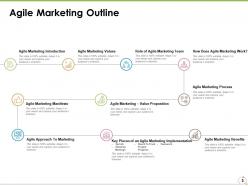
Slide 3: This slide shows Agile Marketing Outline describing- Agile Marketing – Value Proposition, Agile Marketing Manifesto, Agile Approach to Marketing, Agile Marketing Benefits, Key Pieces of an Agile Marketing Implementation, Agile Marketing Introduction, Agile Marketing Values, Role of Agile Marketing Team, How does Agile Marketing Work? Agile Marketing Process.
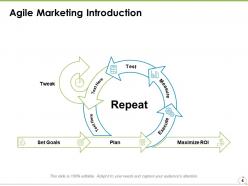
Slide 4: This slide presents Agile Marketing Introduction describing- Maximize ROI, Plan, Set Goals, Tweak, Measure, Execute, Test.
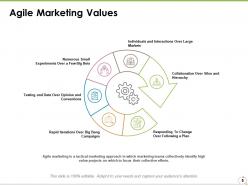
Slide 5: This slide displays Agile Marketing Values describing- Numerous small experiments over a few big bets, Responding to change over following a plan, Testing and data over opinion and conventions etc.
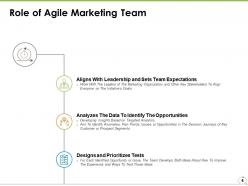
Slide 6: This slide represents Role of Agile Marketing Team which includes- Analyzes the data to identify the opportunities, Aligns with leadership and sets team expectations, Designs and prioritizes tests.
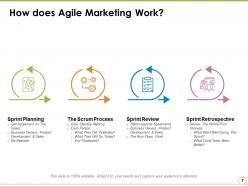
Slide 7: This slide showcases How does Agile Marketing Work describing- The Scrum Process, Sprint Planning, Sprint Review, Sprint Retrospective.
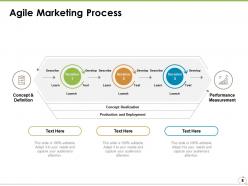
Slide 8: This slide shows Agile Marketing Process as- Describe, develop, test, launch and learn.
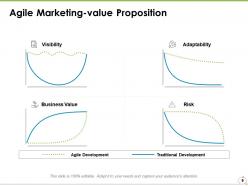
Slide 9: This slide presents Agile Marketing – Value Proposition describing- Adaptability, Visibility, Risk, Business Value.
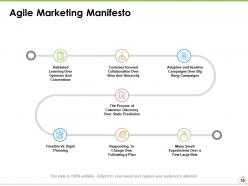
Slide 10: This slide displays Agile Marketing Manifesto describing- Validated learning over opinions and conventions, Flexible vs. rigid planning, Customer-focused collaboration over silos and hierarchy, Responding to change over following a plan, Adaptive and iterative campaigns over Big Bang campaigns, Many small experiments over a few large bets, The process of customer discovery over static prediction.
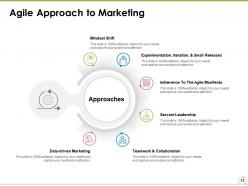
Slide 11: This slide represents Agile Approach to Marketing describing- Mindset shift, Experimentation, iteration, & small releases, Adherence to the Agile manifesto, Servant leadership, Teamwork & collaboration, Data-driven marketing.
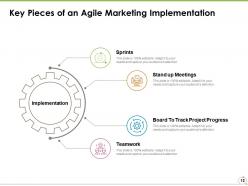
Slide 12: This slide showcases Key Pieces of an Agile Marketing Implementation describing- Sprints, Stand up Meetings, Board to track project progress, Teamwork.
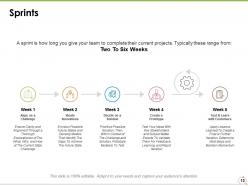
Slide 13: This slide shows Sprints describing- Align on a Challenge, Ideate Innovations, Decide on a Solution, Create a Prototype, Test & Learn with Customers.
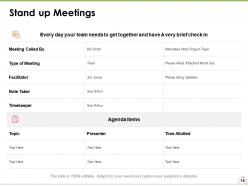
Slide 14: This slide presents Stand up Meetings in a table form with related text.
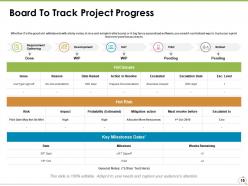
Slide 15: This slide displays Board to Track Project Progress describing- Requirement Gathering, Development, UAT, Pilot, Rollout.
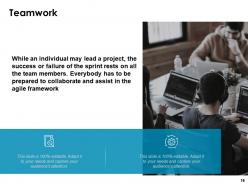
Slide 16: This slide shows Teamwork with imagery and text boxes to show information.
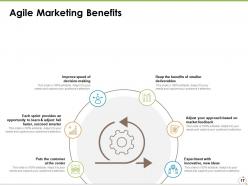
Slide 17: This slide presents Agile Marketing Benefits as- Puts the customer at the center, Each sprint provides an opportunity to learn & adjust, Improve speed of decision-making, Reap the benefits of smaller deliverables, Adjust your approach based on market feedback, Experiment with innovative, new ideas.
Slide 18: This slide displays Agile Marketing Icons.
Slide 19: This slide is titled as Additional Slides for moving forward.
Slide 20: This is About Our Company slide to show company specifications etc.
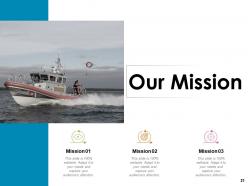
Slide 21: This is Our Mission slide with imagery and text boxes.
Slide 22: This is Meet Our Team slide with names and designation.
Slide 23: This is a Financial slide. Show finance related stuff here.
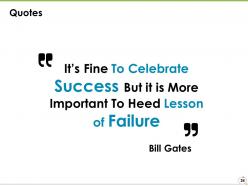
Slide 24: This is a Quotes slide to convey message, beliefs etc.
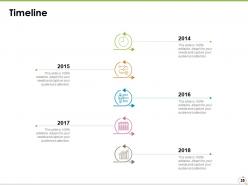
Slide 25: This is a Timeline slide. Show information related with time period here.
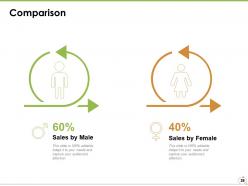
Slide 26: This is a Comparison slide to state comparison between commodities, entities etc.
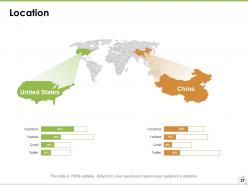
Slide 27: This is a Location slide with maps to show data related with different locations.
Slide 28: This is a Target slide. State your targets here.
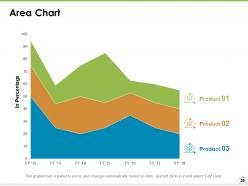
Slide 29: This slide displays Area Chart with three products comparison.
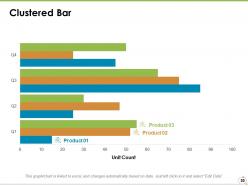
Slide 30: This slide showcases Clustered Bar chart with three products comparison.
Slide 31: This is a Thank You slide with Address, contact numbers and email address.
Agile Marketing Powerpoint Presentation Slides with all 31 slides:
Use our Agile Marketing Powerpoint Presentation Slides to effectively help you save your valuable time. They are readymade to fit into any presentation structure.


FAQs for Agile Marketing
So agile marketing is basically the opposite of those huge campaigns we used to spend forever planning. Instead of crossing your fingers and hoping it works, you run quick experiments and pivot based on actual data. Test something small for a week, see what happens, then adjust. Honestly, it's way less stressful than betting everything on one big launch. The whole point is failing fast and learning from it rather than guessing what'll work. Pick one campaign you're working on and just break it into smaller tests you can tweak as you go.
Pick 3-5 metrics that actually move the needle for your business - conversion rates, engagement, lead quality, that kind of stuff. Don't try to track everything or you'll go crazy. Set up quick check-ins every week or two to see what's working. Google Analytics and your CRM are your best friends here. The whole point of agile is being able to switch gears fast when something's not hitting. I learned this the hard way - used to obsess over like 15 different metrics and it was totally overwhelming. Focus on what matters and check those numbers religiously.
Honestly, good communication is what makes or breaks agile marketing. Your team needs those constant feedback loops - otherwise you're just guessing what works. I've seen teams fall apart because nobody talked to each other and priorities got all mixed up. Silos are the worst enemy here. Regular standups and retrospectives sound boring but they actually help you figure out when to kill failing campaigns and double down on winners. Oh, and make sure different departments can actually work together smoothly. Set up your communication channels early - trust me on this one.
So agile marketing is basically working in short 1-2 week sprints instead of those massive 6-month plans that always go sideways. You can test stuff, see what's bombing, and pivot fast. Like within days, not months. Pretty game-changing honestly. The trick is having regular team check-ins and actually knowing what metrics matter - don't just track vanity numbers. I'd start small though. Pick one campaign and try running it in weekly chunks instead of your normal timeline. You'll probably be surprised how much faster you can react to what's actually working.
Definitely grab a project management tool first - Trello or Asana work great for tracking sprints. Slack is basically non-negotiable for team communication, trust me on that one. You'll need something like Google Analytics to watch your campaigns in real-time since agile is all about quick pivots based on data. Oh, and Figma or Canva are lifesavers for cranking out creative stuff fast. Honestly though, pick one from each category and just commit to it. Tool-hopping will drive you insane and kill your momentum.
Honestly, data analytics is a game-changer for agile marketing. Instead of guessing what works, you're getting real-time feedback on campaigns and can pivot immediately when something's not hitting. No more waiting weeks for reports - you'll see results within hours, which is pretty wild when you think about it. Your sprint planning gets way better too since you actually know which channels bring in results versus the ones that are just... there. I'd start with automated dashboards for your main metrics. That way your team can make quick decisions during sprint reviews instead of flying blind. Trust me, once you start making moves based on actual user behavior, there's no going back.
So agile marketing is all about testing stuff with real customers instead of just guessing what they want. You run these quick experiments - maybe test different subject lines or try a new platform - then see what actually works. Way better than planning some massive campaign months out and crossing your fingers, you know? I honestly think most traditional marketing is just throwing money at the wall. The whole point is short bursts of testing, then you double down on whatever gets results. Pick one thing you're assuming about your customers and test it this week - you'll probably be surprised by what you learn.
Honestly, the hardest part is getting people to buy into it. Your team's gonna hate showing unfinished work - marketers are perfectionists by nature. Breaking big campaigns into bite-sized pieces feels super weird at first. Plus stakeholders will resist giving feedback on rough drafts instead of polished finals. Change is just hard, you know? But here's what works: pick one small campaign to test it out. Once they see how much faster you can pivot and respond to what's actually working, they'll get it. Then you can roll it out everywhere else.
So Agile Marketing basically gets your marketing and sales teams synced up through shared sprint cycles. They plan together every 2-4 weeks instead of operating in silos - no more nasty surprises about lead quality. The feedback happens constantly, which honestly makes such a difference. Sales tells marketing what's actually working with prospects, then marketing can adjust messaging on the fly. Both teams track the same metrics too. Oh, and they review performance together regularly instead of pointing fingers later. Try getting marketing into those weekly pipeline reviews first, then bring sales into sprint planning. Way easier than you'd think.
Netflix crushed it during COVID by flipping their whole strategy to focus on home streaming once theaters shut down. Spotify's constantly tweaking playlists based on what's trending - super smart move. And that Oreo "dunk in the dark" Super Bowl tweet? Still legendary marketing. The key is these companies test small stuff first, see what hits, then go bigger. They're not waiting months to pivot - we're talking days here. Small experiments are where the magic happens, honestly. You can always scale up what works later.
So basically you chop up your marketing campaigns into these short 1-4 week bursts instead of those soul-crushing quarterly marathons. Pick one clear goal per sprint - launch an email series, test some ads, whatever. Then you execute fast and review what bombed before jumping into the next round. Honestly, it's such a relief compared to pouring months into campaigns that go nowhere. I'd say start with just one campaign and slice it into 2-week pieces. You can actually pivot when things aren't working instead of being stuck with garbage for three months straight.
Honestly, MoSCoW method saves my life - just bucket everything into Must have, Should have, Could have, Won't have for each sprint. RICE scoring is pretty solid too (Reach, Impact, Confidence, Effort). I always come back to those value vs. effort grids though - they're weirdly satisfying and you can immediately spot the low-hanging fruit. Oh, and timebox everything for daily tasks. My team does weekly backlog reviews which helps, but really it comes down to constantly asking yourself what actually moves your campaign forward right now. Don't overthink it.
Honestly, I'm kinda obsessed with getting feedback fast because waiting too long just creates bigger messes. Set up weekly team check-ins first - that's your easiest win. Then grab customer input through quick surveys or polls, whatever fits your thing. Track some basic metrics in real-time too, like Google Analytics or social responses. The trick is being systematic about it instead of just crossing your fingers. Oh, and don't overcomplicate it at first - pick literally one method this week and actually stick to reviewing it. Short cycles catch problems before they blow up on you.
So cross-functional teams are huge for agile marketing. You get marketers, designers, devs, data people - sometimes sales too - all working together in short sprints. No more of that BS where creative sits waiting for copy, then copy waits for approvals forever. Everyone jumps in from the start, which honestly saves so much time. You spot problems early instead of at the end when everything's a mess. The trick is letting people stay in their lane but also speak up when they have ideas. Works way better than the old relay race approach we used to do.
Honestly, start with one pilot team mixing people from different departments - like marketing, sales, and product working together on the same goals. Set up shared sprint cycles so everyone's moving at the same pace. Regular sync meetings are crucial, otherwise it becomes a total disaster (trust me, I've seen it happen). Pick departments that already work together naturally, then expand from there. You'll need shared metrics and tools that people actually want to use - not just another platform gathering dust. The magic happens when you break down those annoying silos. Short cycles work way better than long ones. Don't try to boil the ocean right away though.
-
Graphics are very appealing to eyes.
-
Awesome presentation, really professional and easy to edit.
-
Awesome use of colors and designs in product templates.
-
Innovative and attractive designs.