


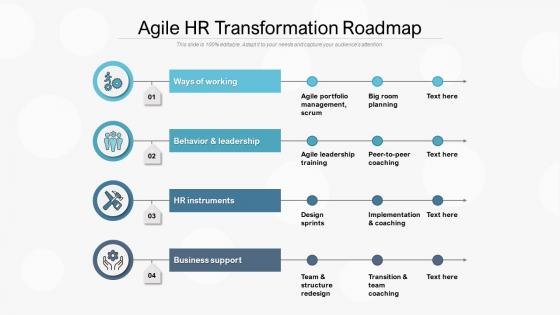
Roadmap zur agilen HR-Transformation





Try Before you Buy Download Free Sample Product
 Impress Your
 Audience
 100%
100% Editable
 Save Hours
 of Time


Dank unserer Agile HR Transformation Roadmap können Sie jedes innere Detail untersuchen. Es stellt sicher, dass Sie richtig beurteilen.
People who downloaded this PowerPoint presentation also viewed the following :
Agile HR Transformation Roadmap mit allen 2 Folien:
Beurteilen Sie aus jedem Blickwinkel mit unserer Agile HR Transformation Roadmap. Untersuchen Sie jede Facette des Problems.
FAQs for Agile
Honestly, just start with ditching annual reviews for ongoing feedback - way better for everyone. Get your hiring teams to include people who'll actually work with the new person instead of HR doing everything solo. That alone changed everything at my last place. Try short sprints for stuff like fixing onboarding or updating policies. You don't need to overhaul everything at once though. Pick one broken process and iterate based on what people are telling you they need. Cross-functional collaboration beats those old rigid playbooks every time. Focus on what actually adds value for employees rather than just following the same tired HR handbook.
Dude, agile HR is a game changer for engagement. Your team gets way more say in how things work - no more waiting forever for annual reviews or stupid policy updates. Quick pulse surveys, flexible schedules, teams that actually care what employees think. It beats old-school HR bureaucracy by miles! People feel heard when their feedback creates real change instead of disappearing into some black hole. Satisfaction goes up because stuff actually happens. Start with something simple - maybe weekly check-ins or switching to quarterly goals. Trust me, once you ditch the annual-everything approach, there's no going back.
Honestly, go with cloud HRIS stuff like Workday or BambooHR - they're way more flexible when you need to pivot fast. Slack and Teams are obvious choices for collaboration, plus throw in Jira or Trello for project tracking. Analytics matter too, so Tableau or whatever dashboards your system has built-in work great. Oh, and Culture Amp is solid for getting continuous feedback from people. The real trick? Don't create some frankenstein tech mess. Pick one main platform first, then add things that actually talk to each other. I've seen companies go overboard and end up with like 15 different tools that don't sync.
So basically, agile HR flips your whole hiring game. No more waiting weeks for feedback - you get input constantly from managers and candidates. Job descriptions get way more flexible too, focusing on what people actually need to accomplish instead of those crazy long requirement lists that nobody meets anyway. Cross-functional teams handle interviews, cycles get shorter, and here's the kicker - you start tracking stuff that actually matters. Like how fast someone becomes productive, not just how long it took to fill the seat. Honestly, just pick your worst bottleneck and try shortening one piece of it. See what happens.
Oh man, leadership makes or breaks this whole thing. I've watched so many agile transformations crash and burn because executives just talked a good game but didn't actually walk it. Your leaders have to model the behavior first - like actually showing up to retrospectives and being okay with failing fast. They need to create that psychological safety where people can speak up and challenge old HR practices without getting their heads chopped off. Breaking down silos is messy work, and if leadership isn't genuinely bought in, you'll hit walls everywhere. Get them trained on agile principles before you do anything else - trust me on this one.
Honestly, ditch the annual review stuff and check in more often. Monthly pulse surveys work way better than waiting a whole year to see how people feel. I'd track things like how fast teams can switch gears on projects, employee NPS scores, and whether people are actually learning new skills. That old "time to fill" metric? Pretty useless when you're trying to build flexible teams. Focus on retention in your best squads instead. Pick maybe 3-4 metrics that actually matter for what you're trying to do and measure quarterly. Don't go crazy with too many right away.
Honestly? Resistance to change is gonna be your biggest headache. Managers hate giving up control, employees freak out about job security - the usual stuff. Plus you'll get stuck dealing with ancient HR systems that weren't built for this kind of flexibility. Communication is everything though. Without clear messaging about the "why," people just make up their own stories (and they're usually worse than reality). That whole "we've always done it this way" mindset is so draining to fight. I'd say start small with pilot programs to prove it actually works.
So basically, instead of doing those awful once-a-year training sessions, you bake learning into everyday stuff. Weekly 15-minute check-ins work great - just ask what people figured out and what they're curious about next. Teams do quick retrospectives and share skills with each other. Honestly, the "fail fast, learn faster" thing actually works when you're not scared of messing up. People can try new things and change direction quickly if it's not clicking. Oh, and those real-time feedback loops? They catch knowledge gaps before they become huge problems.
Just bake it right into your sprint cycles - quick pulse surveys, retrospectives, maybe some real-time feedback tools. Weekly check-ins work way better than those awful annual reviews (honestly, who even likes those?). Anonymous suggestion boxes are clutch for the touchy stuff. But here's the thing - you gotta show people what actually changed from their feedback, otherwise they'll stop caring. Try peer feedback during sprint reviews too. Daily standups can work for this. Make employee input part of your regular HR process instead of something you remember to do once a year.
Honestly, agile HR is perfect for remote teams - both are all about being flexible anyway. I've seen companies do sprint-based performance reviews instead of those dreaded annual ones, which is way better for remote workers who need more frequent check-ins. Daily standups keep everyone connected across time zones, and you can use digital kanban boards for tracking team goals. The continuous feedback thing is clutch when you can't just pop by someone's desk. Oh, and the iterative approach? Total game-changer for distributed teams. I'd start small - pick one HR process, make it agile and digital, then see how your team reacts.
So there are a few good frameworks to look at - Agile HR Manifesto principles, Spotify's squad model, ING's transformation approach. SHRM has their methodology too, which is pretty solid. But honestly? Most companies just cherry-pick what works and create their own hybrid thing. You'll want to assess where you're at now, then grab pieces that actually fit your culture. Oh, and definitely check out the Agile HR Community's stuff first - they've got toolkits you can use right away instead of wading through tons of theory. Way more practical than most resources out there.
Honestly, cross-functional teams are a game changer for breaking down those stupid departmental walls. You get thrown in with IT, marketing, operations - whoever. Way better than sitting in the HR corner waiting for people to tell you what's wrong after it's already a mess. When you're actually embedded with other teams, you catch problems early and can fix stuff without waiting for seventeen approvals. My old manager always said HR should be where the action is, not separate from it. You'll finally get what other departments actually need instead of making assumptions. Just pick one team to start with - don't go crazy trying to join everything at once.
So you know how Agile HR works? It's all about testing stuff in bite-sized pieces instead of doing these huge rollouts that crash and burn. Break your HR projects into smaller chunks and run them for like 2-3 weeks at a time. Performance reviews are a perfect example - ditch that awful once-a-year torture session and do monthly check-ins instead. Way less painful for everyone. Each round teaches you what's working and what sucks, so you keep tweaking as you go. Honestly, just pick one process to start with, try it for a few weeks, get people's honest feedback, then adjust and go again.
Oh totally, agile HR is actually perfect for DEI work! You can test things fast - like new hiring practices or different ERG setups - then adjust based on what's actually working. No more waiting around for those painfully slow annual reviews. Plus you're constantly measuring through pulse surveys, so when something flops you can pivot right away. Honestly, traditional HR bureaucracy kills momentum on this stuff. The whole continuous improvement thing just clicks with DEI goals. I'd say pick one initiative and try running it like a sprint - you'll be shocked how much quicker things move.
So ING Bank threw out all their traditional job titles and built cross-functional squads instead - pretty bold move. Spotify does something similar with their squad model, but they apply it to HR too with autonomous teams handling different employee stuff. Then there's Haier who went absolutely nuts and broke their 80,000 employees into like 4,000 tiny companies. Honestly sounds chaotic but apparently it works? The smart thing all these companies did was start small with pilot programs first. You should definitely try that - pick one thing like performance reviews or hiring and test it out before going crazy with the whole system.
No Reviews