

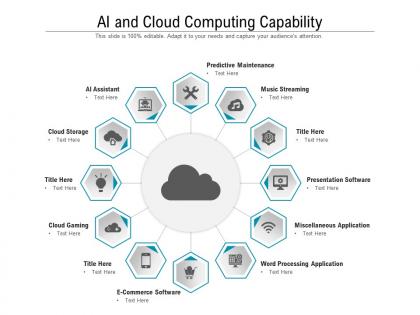
Ai and cloud computing capability





Try Before you Buy Download Free Sample Product
 Impress Your
 Audience
 100%
100% Editable
 Save Hours
 of Time


Our AI And Cloud Computing Capability are topically designed to provide an attractive backdrop to any subject. Use them to look like a presentation pro.
People who downloaded this PowerPoint presentation also viewed the following :
Ai and cloud computing capability with all 2 slides:
Use our AI And Cloud Computing Capability to effectively help you save your valuable time. They are readymade to fit into any presentation structure.
FAQs for Ai and
Honestly, the biggest thing is you don't have to drop a ton of cash upfront on hardware that might sit there collecting dust. Cloud lets you scale up when you need it, back down when you don't. Deployment's way faster too - no dealing with setting up infrastructure (which is honestly a nightmare). Most providers have pre-built AI tools ready to go, so you're not reinventing the wheel for months. Your team can actually work on real problems instead of babysitting servers all day. I'd probably start small though - pick one project to test it out first.
So cloud AI integration is pretty much a game-changer for data analytics. You get access to crazy powerful ML tools and processing without buying your own servers - which honestly saves so much headache. Your datasets can be way bigger, you'll catch patterns you'd miss otherwise, and real-time predictions become totally doable. The cloud does the heavy work while you focus on insights. Oh and you only pay for what you actually use, not some massive upfront cost. I'd figure out where your data's getting stuck first, then see which cloud services might fix it.
Honestly, data security is gonna be your biggest pain point - legal teams freak out about moving sensitive stuff to the cloud. Integration with your current systems? Total nightmare. Costs can get crazy fast if you're not watching your usage closely. Plus good luck finding people who actually know both AI and your business inside out. That talent pool is pretty shallow right now. Oh, and cloud bills have this sneaky way of surprising you at month-end. I'd definitely start with something small first - maybe just one department or process to see how it goes before committing to anything major.
So APIs are basically how your app connects to AI services in the cloud. You send requests (REST calls usually) and get back whatever AI results you need - predictions, text analysis, whatever. The nice thing is you don't have to build the models yourself or deal with all that infrastructure headache. Just plug into their endpoints and you're good to go. I'd start with some simple API calls first to get the hang of it. Oh, and definitely read through their docs - some providers explain things way better than others. It's honestly pretty straightforward once you try a few examples.
Alright, so three big things you gotta nail down. First - encrypt everything, both when it's moving around and just sitting there. Non-negotiable with AI stuff. Second, lock down who can access what with solid identity controls. Trust me, audit those permissions constantly because they turn into a nightmare otherwise. Also pick a cloud provider that actually knows compliance for your industry and has decent AI security tools. Honestly though, the biggest thing is don't just assume your provider's got your back on everything. Layer your security like you would with any other sensitive system.
Dude, there's so many ways to use AI cloud stuff depending on your industry. Healthcare does automated diagnosis and patient data analysis. For retail, think inventory optimization and those personalized recommendations you see everywhere. Manufacturing is where it gets really cool though - predictive maintenance and quality control that'll blow your mind. Financial companies are all over fraud detection and risk assessment. Oh, and logistics uses it for route planning and demand forecasting. Honestly, just figure out what's driving you crazy in your business first, then find the AI solution that actually fixes it.
Honestly, cloud scalability is a game-changer for AI training. You can grab hundreds of GPUs when you need them, then drop back down afterwards. Way better than buying expensive hardware that just sits there doing nothing 90% of the time. Deep learning models are total resource hogs - they absolutely love parallel processing. This means you can mess around with bigger datasets and crazy complex architectures without hitting hardware walls. My buddy started small with his experiments, then scaled up once he figured out what actually worked. Makes the whole process way less stressful.
Dude, AI cloud stuff is a game changer for getting work done faster. It handles all the boring repetitive tasks automatically, so your team can actually focus on important stuff. The real-time data insights are pretty sweet too - way faster than digging through spreadsheets manually. When you get busy, it scales up without waiting around for IT to set up new servers (which honestly used to drive me crazy). Decision-making gets quicker since it processes everything instantly. I'd say pick one workflow to test it on first. Measure how much time you save, then expand from there. The cloud setup means no infrastructure nightmares either.
First thing - figure out where your data actually sits and what laws apply there. Your cloud provider better be compliant with whatever you need (GDPR, HIPAA, etc). The AI stuff gets weird though - models can leak training data or accidentally spit out sensitive info. Really annoying how fast this whole space changes tbh. Check that you've got proper access controls and audit trails set up. Oh, and document your data flows first - sounds boring but you'll need to map compliance requirements to each piece. It's honestly like hitting a moving target with AI compliance right now.
Honestly, start with containerizing stuff - Docker makes everything so much easier when you're moving between cloud providers. Auto-scaling is huge too since you don't want to burn cash when nobody's using your models. Most people totally screw up the data side though. Your preprocessing and data loading need to be fast or you'll hate your life waiting for everything to sync between storage and compute. Oh, and those cloud ML services like SageMaker aren't bad if you don't want to deal with all the server nonsense. Just containerize one model first and see how it performs.
AWS SageMaker, Google Cloud AI, and Azure ML Studio are your main options here. They handle deployment and scaling without making you build everything yourself. SageMaker's got the most features honestly, but Google's AutoML is way easier if your team isn't super technical. Azure works great if you're already using Microsoft stuff - which half the corporate world is anyway. I'd just grab free trials for all three and mess around with them. You'll know pretty quick which one feels right for how you work.
So it's basically like Netflix recommendations but for your whole business - the AI watches how customers behave and changes everything in real time. Website content, support messages, all of it. Cloud processing is key because it crunches way more data than your regular systems could handle. Honestly, the predictive stuff is pretty wild - it figures out what people want before they do. You'll see better engagement and fewer people just giving up and leaving your site frustrated. I'd say start with whatever's annoying your customers most and see if AI can fix that first.
Dude, edge AI is getting crazy smart right now. AutoML tools are literally so simple that anyone can build models without being a data scientist - I'm talking drag-and-drop level easy. Multi-cloud strategies are killing vendor lock-in, which is huge. Serverless AI functions are going mainstream too. Your cloud providers are baking responsible AI governance right into their platforms now, plus those specialized AI chips are making everything faster and cheaper. Oh, and the orchestration tools don't suck anymore like they used to. Honestly? Start messing around with AutoML on whatever platform you're using. You'll thank me later.
Honestly, you gotta track both the obvious stuff and the sneaky benefits. Direct savings are easy - less infrastructure costs, fewer manual hours, that kind of thing. But the real money? It's usually in productivity gains like faster launches and better decisions from cleaner data. Customer satisfaction scores matter too, though they're harder to pin down with exact numbers. I'd set your baselines before rolling anything out, then check quarterly. Most companies I've seen hit decent ROI around 12-18 months, assuming they're not measuring totally random metrics.
Focus on one cloud platform first - AWS or Azure are your best bets. Python's pretty much essential, and you'll want ML basics down solid. Data engineering stuff like APIs and pipelines is honestly where you'll spend most of your time anyway. Docker and Kubernetes will save your sanity later, trust me. Security knowledge is non-negotiable since AI workloads are super sensitive. The field moves crazy fast so you're basically always learning something new. I'd say get a cloud cert to start - gives you a roadmap instead of just wandering around YouTube tutorials forever.
No Reviews