

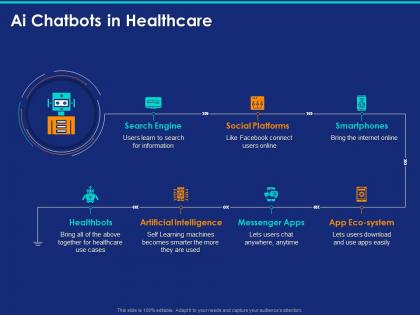
Ai chatbots in healthcare ppt powerpoint presentation professional file




Try Before you Buy Download Free Sample Product
 Impress Your
 Audience
 100%
100% Editable
 Save Hours
 of Time


Our Ai Chatbots In Healthcare Ppt Powerpoint Presentation Professional File are topically designed to provide an attractive backdrop to any subject. Use them to look like a presentation pro.
People who downloaded this PowerPoint presentation also viewed the following :
Ai chatbots in healthcare ppt powerpoint presentation professional file with all 2 slides:
Use our Ai Chatbots In Healthcare Ppt Powerpoint Presentation Professional File to effectively help you save your valuable time. They are readymade to fit into any presentation structure.
FAQs for Ai chatbots in healthcare ppt powerpoint
Honestly, chatbots are pretty solid for patient engagement because they're available 24/7. Your patients can book appointments and get medication reminders without calling during business hours - which let's be real, nobody wants to do anyway. They handle basic health questions and can even learn what each patient prefers over time. Symptom checking is another big one, plus they do follow-ups after visits. The bite-sized health education stuff works well too. Your staff will thank you since it cuts down on routine calls. I'd start simple though - maybe just appointment booking first, then add the more complex health guidance later once you see how it goes.
So basically these chatbots take care of all the boring stuff that drives your staff crazy. Scheduling appointments, insurance checks, collecting patient info - they'll do it round the clock without complaining. Unlike actual humans, right? Your team can route tricky issues automatically and focus on what actually matters instead of drowning in forms. Claims processing gets way smoother too. I'd start by looking at whatever tasks take forever - that's where you'll see the biggest difference. Plus patients can get basic billing answers anytime, which honestly cuts down on so many calls.
So basically these chatbots can handle your initial screening 24/7 - patients just input symptoms and medical history before talking to anyone. Pretty cool actually. They're way better at this than they used to be. You'll get consistent risk assessment that flags who needs immediate help vs who can wait. Low-priority cases get directed to self-care stuff or auto-scheduled for later appointments. Honestly, your nurses will thank you since they won't be stuck doing the same intake questions over and over. I'd probably start small with a pilot program for non-emergency cases first.
So these healthcare chatbots basically encrypt everything - like your data gets locked up tight whether it's moving around or just sitting there. They're pretty smart about anonymizing patient info too, stripping out names and stuff but keeping it useful. Only authorized people can access sensitive data, and there's always a paper trail showing who looked at what. Oh, and this is key - make sure whatever chatbot you're looking at has a signed BAA (Business Associate Agreement) with your org. That's basically your legal cover if things go sideways. The encryption part is honestly the most important though.
Honestly, the biggest problem is that chatbots just can't read people well enough yet. Someone might say their stomach "feels weird" but they're actually having a heart attack - that vague language trips up AI constantly. They also miss when patients are being shy about embarrassing symptoms or totally downplaying serious pain. Medical stuff needs you to understand the person's whole background, their culture, emotional state - it's a lot happening at once. Oh and people use such random slang for body parts sometimes! Right now I'd only trust them for basic triage, nothing diagnostic.
Honestly, AI chatbots are pretty solid for chronic disease management. They'll ping patients about meds, track daily symptoms, and send personalized tips. Basically a health assistant that never sleeps - which patients actually love more than I expected. When symptoms look sketchy, the bot flags me immediately. It handles appointment booking too, plus answers those basic questions that usually clog up your phone lines. I'd start small though - maybe pilot one for diabetes first? See how your specific patient population vibes with it before going all-in.
Focus on user satisfaction and accuracy first - those are your make-or-break metrics. Track completion rates too, plus whether patients actually follow the bot's advice (that part's harder to measure but super important). Response accuracy is obviously critical since bad medical advice could be a nightmare. I'd also look at time savings for staff and if you're getting fewer calls/appointment requests. Don't go crazy measuring everything though. Pick maybe 3-4 things that match what you're trying to achieve. Start simple and see what the data tells you.
So most chatbots hook up to your EHR through APIs - basically they connect to Epic, Cerner, whatever you're using. They grab patient info, schedules, medical histories in real time so responses feel personalized. Your IT folks handle the setup but honestly it gets messy with all the compliance stuff. The chatbot conversations usually get pushed back into your EHR too for record keeping. Oh and definitely check what your current EHR vendor offers first - they've usually got partnerships with specific chatbot companies that'll make your life way easier.
Honestly, AI chatbots are getting pretty decent for basic mental health stuff. They're available 24/7 for crisis situations and can walk people through CBT exercises or mood tracking. Obviously they won't replace real therapists - that's not even close to happening. But they're solid for filling those annoying gaps when therapy's too expensive or there's a massive waitlist. I've seen them work well for initial screenings too, then connecting people to actual humans when things get serious. My cousin used one while waiting months for an appointment and it actually helped. Just make sure patients know it's extra support, not the main thing. You'll definitely need backup plans for emergencies though.
So first thing - get training data from tons of different communities, including their health beliefs and how they actually talk about medical stuff. Partner with cultural experts early on (most people skip this step but it's huge). Build in frameworks that handle language preferences and family decision-making styles - some cultures involve way more people in health choices than others. Test for bias constantly. Oh and definitely work with community liaisons who can check responses before you launch anything. Start by figuring out which communities you're targeting first.
Look, the biggest improvements are contextual understanding and sentiment analysis - chatbots can actually figure out what patients really mean now, not just match keywords. Those transformer models remember your whole conversation, so no more repeating yourself constantly. Medical NLP trained on healthcare data handles all that clinical jargon properly too. What's really cool is they're getting scary good at multiple languages. The emotional stuff matters most though - these bots can tell when someone's freaking out and get them to a real person fast. Test how well they keep context going, that's where you'll see the difference.
Honestly, it's pretty split. People love that they can ask weird health questions at 2am without judgment - like, no awkward eye contact about that rash, you know? The convenience factor is massive for basic stuff and scheduling. But when shit gets real? They still want an actual doctor. Studies back this up too - folks trust humans for serious issues but are totally fine with bots for routine questions. I think the magic happens when you use both. Start with the chatbot for initial triage, then bump people up to real care when needed. Makes way more sense than trying to replace doctors entirely.
Oh man, there's actually a bunch of sketchy stuff here. Privacy's huge since you're dealing with medical data - that's scary if it gets leaked. Plus these things can totally mess up diagnoses, and people might trust them way too much instead of seeing real doctors. What really bugs me is when patients don't even know they're talking to a bot. That feels dishonest? The worst part is AI can't do empathy or handle complex situations like humans can. You definitely need to tell people it's AI upfront and have real doctors available when things get serious.
Look, these healthcare chatbots are basically programmed to catch certain red flag words - stuff like chest pain, can't breathe, wanting to hurt yourself. When they spot those, they'll interrupt everything and either patch you through to a crisis line or tell you to call 911. They can't actually diagnose anything though, which is probably for the best tbh. The better ones will stay online with you until help shows up. Think of them more like those emergency dispatch systems than actual doctors. But honestly? If your gut's telling you something's really wrong, just skip the bot and call 911 yourself.
Oh this is actually pretty smart! Chatbots can send out surveys after visits and do those quick satisfaction polls during appointments. Patients are way more honest with bots than they are face-to-face - like, who wants to tell their doctor they sucked at bedside manner? You can track everything from wait times to how well treatments are working. The cool part is setting up alerts so anything below a certain score immediately pings your team. Real-time symptom tracking between visits is huge too. Honestly beats chasing people down for feedback later.
-
Helpful product design for delivering presentation.
-
Very well designed and informative templates.
-
Great product with highly impressive and engaging designs.
-
Good research work and creative work done on every template.
-
Awesome use of colors and designs in product templates.