Current ai trends in healthcare industry ppt powerpoint presentation outline graphics
Try Before you Buy Download Free Sample Product
Audience
Editable
of Time
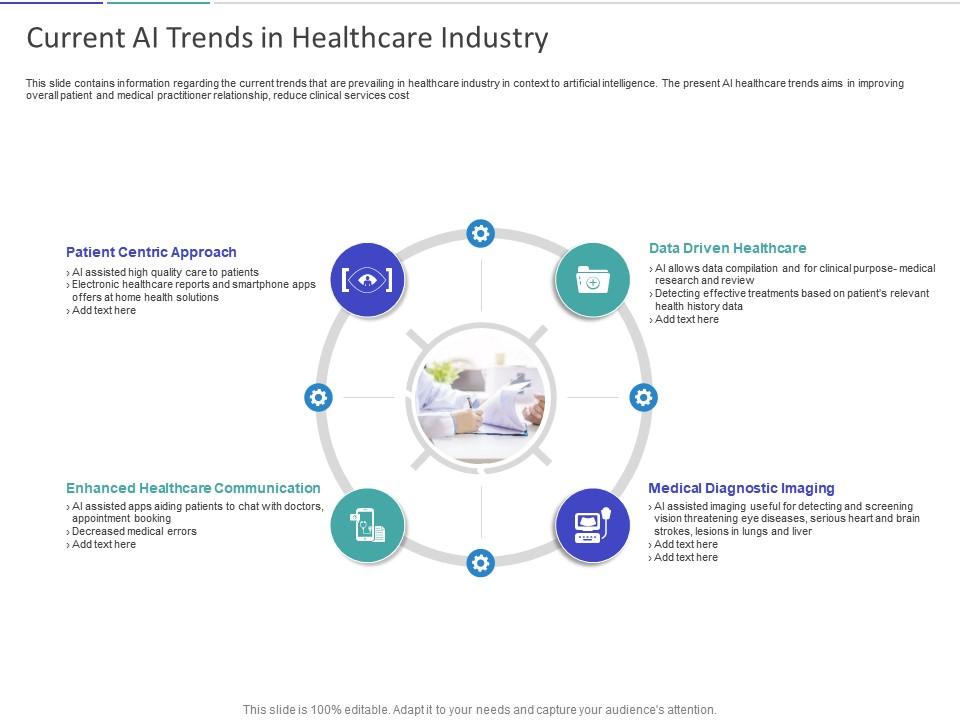
This slide contains information regarding the current trends that are prevailing in healthcare industry in context to artificial intelligence. The present AI healthcare trends aims in improving overall patient and medical practitioner relationship, reduce clinical services cost.
People who downloaded this PowerPoint presentation also viewed the following :
Current ai trends in healthcare industry ppt powerpoint presentation outline graphics with all 2 slides:
Give your audience a fulfilling experience. They will find our Current AI Trends In Healthcare Industry Ppt Powerpoint Presentation Outline Graphics elevating.
FAQs for Current ai trends in healthcare industry ppt powerpoint
Honestly, medical imaging AI is where it's at right now. Radiologists are catching cancers in mammograms and CT scans way earlier than they used to. There's also these dermatology apps that can spot skin lesions with insane accuracy - though obviously doctors still double-check everything. Blood work analysis got a huge upgrade too, plus hospitals can predict when patients might crash before it happens. What's wild is this stuff isn't stuck in labs anymore, it's actually being used. Oh and if you're diving into this, definitely look at what Google's DeepMind and IBM Watson Health are doing with diagnostics.
So AI looks at your DNA and figures out which treatments will actually work for you instead of doctors just guessing. It analyzes how your body breaks down different drugs and compares your genetic markers to huge databases. Pretty cool tech - the algorithms can spot patterns in thousands of genetic sequences that humans would miss. Your doctor gets personalized recommendations for medications and dosages that'll be safest for your specific genetics. Honestly, I'd ask about pharmacogenomics testing next time you're in. Way better than the trial-and-error approach we're used to.
Dude, ML is completely changing radiology right now. These algorithms can catch stuff in scans that doctors might miss - early cancers, hairline fractures, you name it. They're not replacing radiologists though, more like giving them a really smart second opinion. Breast cancer screening is already seeing crazy results, like 30% fewer false positives. Short sentences feel weird to write but whatever. If you're dealing with any imaging departments, I'd totally ask what their AI plans are. This tech is spreading fast and honestly, it's pretty impressive how accurate it's getting.
So basically these chatbots are game changers - they're up 24/7 answering the boring stuff like "what are your hours" or basic symptom questions. Your staff can actually focus on patients who need real help instead of being stuck on the phone all day. The scheduling thing is huge too. Patients can book appointments whenever they want, get automatic reminders, even reschedule themselves. No-shows drop significantly when people have that flexibility. Honestly, I'd start small though - maybe just appointment booking first? My friend's clinic tried to automate everything at once and it was a mess.
So AI can basically predict which patients are gonna crash or need to come back to the hospital by looking at their data patterns. Pretty wild stuff. Your teams get early warnings before someone takes a turn for the worse. It also forecasts things like how many beds you'll need, staffing levels, even when the ER's about to get slammed during flu season. The accuracy is honestly getting a little freaky. Oh, and it helps with scheduling surgeries based on predicted recovery times too. My advice? Don't try to implement everything at once - pick one thing like readmission alerts and nail that first.
So basically AI is speeding up drug discovery like crazy by figuring out which compounds will work before labs waste years on dead ends. Machine learning can crunch huge datasets to spot good drug targets and predict how molecules behave. Some models even design new compounds from nothing - DeepMind's protein folding stuff proves this actually works. Discovery times could drop from 10+ years to just a few, which is honestly insane. If you're in pharma, I'd seriously consider partnering with AI companies. The early movers will destroy the competition.
You're looking at three major headaches: patient privacy, bias, and transparency. Health data is super sensitive, so you'll need bulletproof protection and clear consent processes. Bias might be the scariest one though - if your training data skews toward certain demographics, the AI could totally fail other patient groups. That's lawsuit territory. Clinicians also can't work with black box systems they don't understand. Oh, and set up an ethics board ASAP with people from different backgrounds. Trust me on this one - catching problems early beats dealing with disasters later.
Most AI health systems encrypt your data when it's moving around and when stored. Access controls are pretty tight too - only specific people can see certain info. They'll also anonymize data by stripping out anything that identifies you personally. HIPAA compliance is basically mandatory, so companies build that stuff in from day one. There's this cool thing called federated learning where AI models can train on data without actually copying it to different locations - honestly didn't know that was possible until recently. But yeah, definitely ask any vendor about their security certs and audits before signing anything.
Dude, AI is seriously changing the telemedicine game. It handles all the tedious scheduling and does initial symptom checks before patients even talk to real doctors. The diagnostic stuff is actually impressive - analyzes images, spots urgent cases, fills out patient info automatically. Chatbots deal with follow-ups and med reminders too, so doctors can focus on the tricky cases. Honestly saves tons of time. Oh, and if you're looking at telemedicine platforms, definitely check what AI features they've got built in. Some are way ahead of others.
So basically AI can analyze your patient data and catch warning signs way before any symptoms show up. Like it'll spot patterns in bloodwork or imaging that point to diabetes or heart disease risks months ahead. Pretty crazy how it processes thousands of data points at once - stuff we'd totally miss. Then you can jump in with lifestyle changes or preventive treatment before things get bad. Honestly, the algorithms are getting scary good at finding these subtle correlations. You should check out diagnostic tools that'll work with whatever monitoring systems you're already using.
So hospitals are crushing it with AI right now, mostly for predicting patient loads and automating boring stuff like scheduling. Radiology's probably the biggest win - AI screens images first so doctors only see what matters. Smart move tbh. Billing automation is saving crazy money too, like millions per hospital. Even electronic records are getting better at catching problems early before they cost a fortune. Oh, and supply chain algorithms are nailing inventory predictions. My advice? Don't go overboard - pick one workflow and nail it first. Way less headache that way.
Dude, voice recognition for medical docs is a game changer. You just talk and it writes everything down while you're with patients - no more furious typing. Dragon Medical is solid, but these newer ambient tools are honestly kind of creepy how well they pick up medical jargon. Some even grab the important clinical stuff automatically. The eye contact thing is huge though - you're not staring at a screen the whole time. My cousin's practice finally switched last year and she kicks herself for waiting so long. The time you'll save is ridiculous.
Integration with your current EMR is probably the biggest nightmare - nobody wants to flip between different systems all day. Training takes forever too, and your staff is already drowning. Trust me, doctors won't touch AI if they can't figure out how it reached its conclusions. The workflow chaos at first is honestly pretty rough. My advice? Pick one narrow thing to start with, find a few people who are actually excited about it (they exist, I promise), and whatever you do, make sure it works smoothly with what you've already got running.
So basically your phone and apps can spot depression/anxiety signs from how you text, sleep patterns, social media activity - all that digital stuff we leave behind. It's honestly kind of creepy how accurate these predictive models are getting. They'll catch changes in your mental health before you even realize something's off. The cool part though? Your doctor could potentially reach out early instead of waiting for things to get really bad. Just heads up - think about whether you're actually okay with that level of monitoring before signing up for anything like that.
So the coolest stuff happening right now is needle-free glucose monitoring and AI that actually optimizes your sleep patterns. Smartwatches can predict when you're getting sick before you even feel it - honestly blew my mind when I first heard that. There's also real-time stress tracking through heart rate changes and way better ECG analysis for catching heart issues early. Oh, and hydration sensors through your skin now too. The game-changer though? These devices finally stopped giving you false alarms every five minutes thanks to machine learning. If you're shopping around, definitely go for multi-sensor devices over single-metric ones - that's where you'll see real accuracy.
No Reviews