

AI Driven Defense And Military Training Ppt




Try Before you Buy Download Free Sample Product
 Impress Your
 Audience
 100%
100% Editable
 Save Hours
 of Time


These slides showcase the importance of AI in Defense and the Military. The AI applications in defense and military include surveillance, training, cybersecurity, arms and ammunition, and logistics.
People who downloaded this PowerPoint presentation also viewed the following :
Content of this Powerpoint Presentation
Slide 1
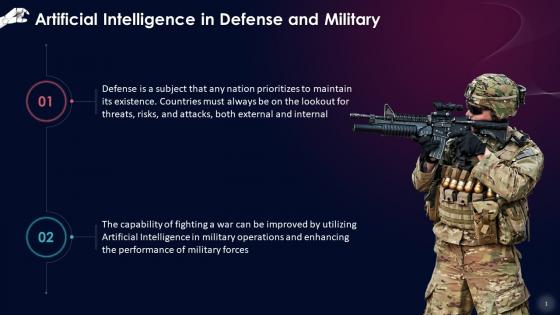
This slide showcases the importance of Artificial Intelligence in Defense and Military. Artificial Intelligence advancements will open up new possibilities in defense technologies. The capability of fighting a war can be improved by utilizing Artificial Intelligence in military operations and improving the performance of military forces.
Slide 2
This slide highlights that many countries across the world are using Artificial Intelligence to enhance their defense and military operations. Technologies such as Deep Learning machines, which require Big Data and artificial neural networks, are being used.
Instructor’s Notes:
Many countries across the world are using AI to improve the effectiveness of their defense forces in the following ways:
- With the extensive use of AI gadgets every operator in the defense network can be brought together to carry out and complete operations or assignments
- Unmanned and manned systems can be brought together for human and machine combat scenarios
Slide 3
This slide lists the advantages of Artificial Intelligence in defense and military operations. These benefits include better decision making, detection of mines underwater, deployment of military robots, better targeting, and unmanned vehicles & use of drones.
Instructor’s Notes:
- Better decision making: Artificial Intelligence can compile data from numerous sensors and satellites and draw judgments. This may also make it easier for defense personnel to make decisions on what measures to take
- Unmanned vehicles & use of drones: The number of unmanned vehicles, such as planes and combat tanks, will undoubtedly increase. This will allow officers to make choices more quickly, save money, and remove these expensive machines from risky situations. AI can help a drone take off and land without the need for human intervention, and it can even carry out the operation
- Better targeting potential: Some land-based combat vehicles employ AI and Machine Learning to improve targeting capabilities
- Deployment of military robots: Military robots with Artificial Intelligence can carry out operations or jobs on their own, saving precious human lives
Slide 4
This slide highlights applications of Artificial Intelligence in defense and military. These include surveillance, training, cybersecurity, arms & ammunition, and logistics.
Instructor’s Notes:
- Surveillance: AI paired with geospatial analysis can help extract valuable information from networked equipment like radars and automatic identification systems. Analysis of this data can reveal illegal or suspect activity and warn the proper authorities. IoT-enabled robots can also aid target detection and characterization with AI and computer vision
- Training: Training and simulation are two fields that use system and software engineering ideas to create models that can help soldiers train on combat systems used by real-world armed forces. The US Navy and Army have already started sensor simulation programs. Additionally, augmented and virtual reality (VR) technology can create effective, accurate, and dynamic training simulations
- Cybersecurity: Cyberspace is now viewed as the fourth front after land, sea, and air. A maliciously hacked network might put the entire region's security in jeopardy. Defense organizations are employing Machine Learning to predict and protect against illegal breaches.
- Arms & Ammunition: New-age weaponry now incorporates AI-enabled technology. Advanced missiles, for example, can estimate and assess target levels for kill zones without the involvement of humans
- Logistics: One of the factors in determining whether or not a military mission succeeds is logistics. Military logistic systems are combined with Machine Learning and geospatial analysis to reduce labor, time, and error
- Detection of underwater mines: Currently, ships equipped with sonar are widely employed to detect mines beneath the water. However, as AI advances, a submersible boat or vessel might be equipped with AI to identify mines. The time it takes to identify mines would be reduced, and it would examine the object, identify it, and take the appropriate decision
Slide 5
This slide showcases how different countries are using Artificial Intelligence in military operations. USA, China, and Russia are the first ones to use cutting-edge technology to strengthen their forces.
Instructor’s Notes:
- USA: The US Department of Defense unveiled its first AI plan in 2019, asking for expanded use of AI systems across the army, from decision-making to problem forecasting, through investment and engagement with private AI research organizations
- China: The Chinese government has also pushed for more AI and Machine Learning-based military technology development.They have advocated for "military-civil fusion-style innovation" incorporated into China's national strategy. China's State Council AI Plan outlines the country's ambitious plan to establish a 150 billion RMB AI industry, was released in 2017
- Russia: The military capability of Russia is well-known throughout the world. High-ranking army officials have been seen supporting the development of AI-based technology. According to sources, Russian defense forces are mulling the use of Artificial Intelligence, Big Data, and Machine Learning to conduct more effective intelligence operations. In both the military and commercial sectors, Russia is heavily investing in Artificial Intelligence (AI) for the detection, analysis, and refutation of misinformation
Slide 6
This slide talks about the AI powered drones used by the Turkish military for use in the defense sector. Turkey's drones are one of the most potent symbols of the country's air might as they can neutralize enemy targets in high-risk warfares.
Instructor’s Notes: Kargu-2, Alpagu, Togan, and Simsek are four types of autonomous drones that have been deployed in the Turkish defense sector. These kamikaze-style drones can perform intelligence gathering, surveillance, target acquisition, and reconnaissance tasks in addition to attacking. They can attack targets in places where the operator and the warhead don't have access to mobile data or the Internet.
Slide 7
This slide discusses the use of Artificial Intelligence in Israel’s Iron Dome. Israel's Iron Dome was developed by Rafael Advanced Defense Systems and Israel Aerospace Industries to detect, intercept, and destroy rockets and 155mm artillery shells fired from a range of between 2.5 miles and 43 miles.
Instructor’s Notes: According to reports, the AI-powered anti-missile system is 90% successful. The Iron Dome radar tracks the missile route after detecting and identifying an external rocket, and the Battle Management and Control (BMC) estimates the potential place of impact based on that information. If the AI system detects a credible threat, it orders the dome to fire an interceptor or a quicker missile at the threat, blowing off the enemy missile at a high altitude or over a neutral area.
Slide 8
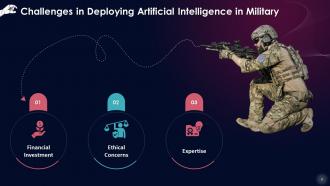
This slide depicts the challenges associated with the deployment of Artificial Intelligence in defense and military. These challenges include financial investment, expertise, and ethical concerns.
Instructor’s Notes:
- Expertise: Investing a significant amount in a panel of experts to discuss the future of military strength and share views on how Artificial Intelligence and Machine Learning will affect national security is necessary yet tough, particularly for middle-income countries
- Financial Investment: The financial investment required to adopt AI-based technology is one of the key hurdles. How much we can afford to invest in infrastructure to support the development of such technologies is a significant question, especially in middle-income countries. One possible solution is for governments to identify and pursue AI initiatives that are critical to national security
- Ethical Concerns: The use of AI in defense creates ethical considerations. Such technologies have been developed by experts and organizations worldwide, thereby creating tensions between governments. One of the arguments is that if an AI system fails to operate as intended, the results could be severe. Several human and civil rights organizations have asked for a complete ban on autonomous defensive techniques, including weapons
AI Driven Defense And Military Training Ppt with all 24 slides:
Use our AI Driven Defense And Military Training Ppt to effectively help you save your valuable time. They are readymade to fit into any presentation structure.












FAQs for AI Driven Defense And
Honestly, the personalized learning thing is huge - AI can match training to each person's skill level instead of that generic stuff everyone usually gets. Cost-wise, you're saving tons on helicopter hours and live exercises (which are ridiculously expensive, btw). Real-time feedback is solid too, catches things instructors might miss. The data tracking across your whole program is pretty useful for seeing who's actually improving. Oh, and the simulations feel realistic without all the logistics headaches. I'd probably test it on just one module first - see how it goes before committing to the whole thing, you know?
Dude, it's like giving your commanders superhuman awareness during training. Real-time data from drones and sensors gets processed way faster than any human could handle - honestly pretty crazy how much info it crunches at once. Pattern recognition helps predict what the enemy might do next, which is huge for tactical planning. Your troops get instant intel updates instead of waiting around. The whole thing basically turns chaos into a clearer battlefield picture. Oh, and definitely start small - integrate it with whatever surveillance gear you're already running first. Makes the transition way smoother.
So machine learning basically turns training into this crazy adaptive thing where the AI responds to what your team actually does in real-time. No more boring scripted drills. The system pulls from tons of historical combat data and creates realistic enemy tactics that change based on your decisions. It's like having a really smart opponent that never gets predictable - honestly way more engaging than the static stuff most units are stuck with. Your troops get hit with scenarios that actually mirror battlefield complexity instead of the same recycled exercises. I'd definitely push for those ML simulators if you can swing it.
So AI basically tracks everything during training - accuracy, reaction times, how fast people make decisions, the whole deal. Way more detailed than old-school methods. You'll catch stuff like hesitation in stressful situations or pinpoint exactly where someone's aim is off. The teamwork analysis through communication patterns is actually pretty cool too. Best part? Instant feedback instead of waiting around for instructor reviews. Your people know immediately what they crushed and what needs fixing. Makes the whole training cycle way faster - though honestly the amount of data it collects is kind of insane.
Honestly, the real-time pattern recognition is pretty insane - it'll spot stuff in your training data that would take humans forever to catch. Tracks troop movements, resource allocation, all that tactical stuff. But here's where it gets interesting: it can actually predict outcomes based on historical data and what's happening right now. So instead of waiting weeks for those boring after-action reports, you get feedback instantly. Your commanders can pivot mid-exercise and actually learn something. I'd definitely start small though - maybe simple scenarios first? Build some trust before you throw it at complex multi-unit ops.
Look, bias in training algorithms is huge - you don't want your AI making decisions based on skewed data. Privacy of personnel info is another big one. The scary part? AI making lethal decisions without human input. Soldiers need to actually understand these systems they're depending on, not just blindly trust them. When AI screws up during exercises, who's responsible? That gets complicated fast. There's also this broader worry we might be making conflict too easy to jump into. Oh, and definitely audit for bias regularly. Never remove human oversight completely - that's asking for trouble.
So basically the AI looks at how each person learns and where they're weak, then builds custom training just for them. Pretty neat stuff - kind of like those learning apps but for work training. Everyone gets their own path instead of the same boring modules. The system tweaks things as people go - makes it harder if you're crushing it, easier if you're struggling. Honestly feels like the future of training. You end up with people actually learning faster because they're getting exactly what works for their brain, not some one-size-fits-all approach.
Honestly, defense academies are gonna have to completely overhaul how they teach stuff. Instead of memorizing facts, cadets will focus on critical thinking around AI-assisted decisions. New classes on algorithmic warfare and human-AI teaming are already popping up. Those boring PowerPoint marathons? Getting ditched for immersive sims and learning that adapts to individual strengths. Future officers won't sit through lectures - they'll run interactive scenarios working directly with AI systems. My advice? Start playing around with AI tools now, because tomorrow's military leaders need to be just as smooth with algorithms as they are with traditional tactics.
Oh totally! Wearables can track heart rate variability, sleep, stress hormones - all that stuff. The AI spots fatigue patterns way before soldiers actually feel tired, which is honestly pretty cool. Then it'll automatically dial back training intensity or suggest recovery time. Real-time schedule adjustments too. Some programs are already testing this with decent results. I'd say start by figuring out which biometrics you can realistically track consistently - that's probably the biggest hurdle. Don't go overboard trying to monitor everything at once, you know?
Dude, the cost difference is insane - you're looking at 70-90% savings with AI sims versus live exercises. No fuel costs, no ammo, no flying people out to the middle of nowhere. You mess up? Just hit restart and try again immediately. Though honestly, nothing beats that adrenaline rush of a real exercise when everything's on the line. Simulations still can't replicate that chaos factor. My take? Start with AI for building your core skills, then do targeted live runs for the scenarios that actually matter. Way more bang for your buck that way.
Honestly, the biggest headache is gonna be your legacy systems - most weren't designed for AI integration, so you're stuck with pricey overhauls or janky workarounds. Data quality is another nightmare. Military training data gets classified, stuck in silos, or it's just a complete mess, making it super hard to build reliable models. Finding people who actually know both AI and defense training? Yeah, good luck with that. Plus procurement moves at the speed of molasses compared to how fast AI evolves. My advice? Pick one tiny pilot program where you can show results fast and build from there.
So these new AI systems are actually pretty cool for military training - they track how fast you make decisions and spot patterns during simulations. Real-time analytics show exactly when your brain gets overloaded in stressful situations. The software adapts on the fly too, making things harder or easier based on how you're doing. Honestly, it's way better than the old pass/fail stuff we used to get. My buddy in the program says the personalized feedback is insane - it'll tell you exactly which cognitive skills need work. If you get into any of these programs, definitely ask for the detailed metrics instead of just basic scores.
Dude, the AI stuff is actually pretty cool - it watches how your team plays together and switches up scenarios based on what you're struggling with. Your communication sucks? It'll throw situations that force you to talk more. The feedback gets super specific too, like how fast you make calls or share info. Honestly, the unpredictable enemy AI is where it gets interesting - no more memorizing the same patterns. Oh, and it figures out everyone's strengths so you can build better team comps. I'd start with those AI after-action reviews though. They'll call out teamwork issues you didn't even realize were happening.
Honestly, the stuff that's really moving the needle right now is adaptive learning - basically AI that adjusts training scenarios on the fly based on how you're doing. Computer vision is getting insanely good at spotting mistakes and giving instant feedback too. There's also this crazy realistic simulation tech that makes virtual combat environments feel almost real. Natural language processing is another big one - AI can now break down your tactical decisions during debriefings like a human would. Predictive analytics helps catch skill gaps early, which is clutch. I'd probably start with just one AI simulation platform and see how it goes.
Honestly, AI training systems are a lifesaver when your team's all over the place. They run simulations that actually adapt to how fast people learn, plus you get those virtual scenario drills without needing anyone in the same room. The feedback happens instantly too - no waiting around for instructor reviews. What's really cool is how it spots skill gaps across remote teams and tweaks the modules automatically. Just don't make the mistake we did and wait until you're in crisis mode to set this stuff up. Build it now while things are calm, trust me on that one.
-
Love how there are no boring templates here! The design is fresh and creative, just the way I like it. Can't wait to edit and use them for my extended projects!
-
I am not the best at presentations but using SlideTeam’s PPT template made it easier for me. Thank you SlideTeam!