


AI Driven Digital Transformation Planning And Implementation Guide DT CD




Try Before you Buy Download Free Sample Product
 Impress Your
 Audience
 100%
100% Editable
 Save Hours
 of Time


Our AI Driven Digital Transformation Planning And Implementation Guide DT CD are topically designed to provide an attractive backdrop to any subject. Use them to look like a presentation pro.
People who downloaded this PowerPoint presentation also viewed the following :
Content of this Powerpoint Presentation
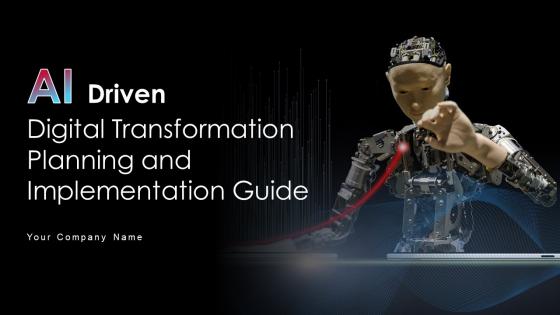
Slide 1: This slide introduces AI Driven Digital Transformation Planning and Implementation Guide. State your company name and begin.
Slide 2: This is an Agenda slide. State your agendas here.
Slide 3: This slide shows Table of Content for the presentation.
Slide 4: This slide continues showing Table of Content for the presentation.
Slide 5: This slide shows title for topics that are to be covered next in the template.
Slide 6: This slide provides glimpse about multiple digital transformation challenges faced by the businesses.
Slide 7: This slide displays glimpse about analyzing the key digital transformation metrics that help our business to assess current performance.
Slide 8: This slide shows title for topics that are to be covered next in the template.
Slide 9: This slide provides glimpse about solutions offered to common digital issues faced by businesses.
Slide 10: This slide shows title for topics that are to be covered next in the template.
Slide 11: This slide provides glimpse about digital transformation that can help businesses to adopt digitalization across multiple domains.
Slide 12: This slide displays glimpse about key market trends of digital transformation and AI adoption.
Slide 13: This slide provides glimpse about use of artificial intelligence in boosting productivity and operational efficiency of businesses.
Slide 14: This slide displays glimpse about benefits of digital transformation and AI that help overcoming the challenges posed by Traditional practices.
Slide 15: This slide provides glimpse about different services offered to various business for digital transformation and boosting operational efficiency.
Slide 16: This slide shows title for topics that are to be covered next in the template.
Slide 17: This slide provides glimpse about multiple steps to adopting digital transformation in corporations to boost productivity as well as customer experience.
Slide 18: This slide shows title for topics that are to be covered next in the template.
Slide 19: This slide displays glimpse about analysing existing state of business processes to estimate the need and extent of digital transformation.
Slide 20: This slide provides glimpse about multiple inefficiencies and pain points of business that can help in finding key areas of improvements.
Slide 21: This slide displays glimpse about estimating business readiness of a business to adopt digital transformation across various dimensions.
Slide 22: This slide shows title for topics that are to be covered next in the template.
Slide 23: This slide provides glimpse about various digital tools and solutions that can help businesses in boosting its digital transformation process.
Slide 24: This slide displays glimpse about roadmap for planning and implementing digital transformation in business to become future ready.
Slide 25: This slide provides glimpse about key principles that can help businesses in planning and building digital transformation strategy.
Slide 26: This slide displays glimpse about different solutions that can help businesses in adopting artificial intelligence to boost their operational efficiencies.
Slide 27: This slide provides glimpse about setting target KPIs (Key Performance Indicators) that can help businesses in tracking their digital transformation efforts.
Slide 28: This slide displays glimpse about framework that can help businesses follow structured approach to adopt digital transformation as per business goals.
Slide 29: This slide shows title for topics that are to be covered next in the template.
Slide 30: This slide provides glimpse about key pillars that can help businesses in using data as a core part of the decision making.
Slide 31: This slide displays glimpse about process of implementing advanced data analytics that can help businesses in breaking data silos.
Slide 32: This slide provides glimpse about various advanced analytics techniques that can help businesses in better data management and enhancing its value.
Slide 33: This slide shows title for topics that are to be covered next in the template.
Slide 34: This slide provides glimpse about multiple AI technologies and tools that can help businesses in boosting operational efficiency.
Slide 35: This slide shows title for topics that are to be covered next in the template.
Slide 36: This slide provides glimpse about machine learning (ML) adoption that can help businesses in making more accurate predictions.
Slide 37: This slide displays glimpse about using predictive analytics that can help businesses in risk management and demand forecasting.
Slide 38: This slide provides glimpse about adopting recommendation engines that can help businesses in providing enhanced customer value.
Slide 39: This slide showcases glimpse about using artificial intelligence and cloud computing powered anomaly detection.
Slide 40: This slide shows title for topics that are to be covered next in the template.
Slide 41: This slide provides glimpse about natural language processing (NLP) adoption that can help computers in understanding human language.
Slide 42: This slide displays glimpse about using virtual assistants (VAs) and chatbots that can help businesses in providing better customer experience.
Slide 43: This slide showcases glimpse about using sentiment analysis that can help businesses in understanding and incorporating customer feedback.
Slide 44: This slide shows title for topics that are to be covered next in the template.
Slide 45: This slide provides glimpse about computer vision adoption that can help computers in understanding images & videos data.
Slide 46: This slide showcases glimpse about using AI enabled image & video analysis that can help businesses in automating time consuming and error prone tasks.
Slide 47: This slide displays glimpse about AR/VR adoption that can help businesses in higher customer experience & engagement.
Slide 48: This slide provides glimpse about utilizing computer vision that can help businesses in building driverless cars.
Slide 49: This slide shows title for topics that are to be covered next in the template.
Slide 50: This slide provides glimpse about adoption of robotic process automaton (RPA) that can help businesses in automating repetitive manual tasks.
Slide 51: This slide displays glimpse about utilizing robotic process automation (RPA) that can help businesses in automating redundant tasks.
Slide 52: This slide showcases glimpse about utilizing robotic process automaton (RPA) that can help businesses in automating data entry and migration.
Slide 53: This slide shows title for topics that are to be covered next in the template.
Slide 54: This slide provides glimpse about adoption of deep learning that can help businesses in solving complex issues.
Slide 55: This slide showcases glimpse about utilizing deep learning that can help businesses in speech and image recognition.
Slide 56: This slide provides glimpse about utilizing deep learning based autonomous systems that can help businesses in boosting operational speed.
Slide 57: This slide shows title for topics that are to be covered next in the template.
Slide 58: This slide provides glimpse about comparative analysis of AI tools that can help companies in performing technology need assessment for their businesses.
Slide 59: This slide describes steps to integrate different artificial intelligence tools with existing systems.
Slide 60: This slide displays glimpse about steps for incorporating process automation in existing repetitive processes to enhance profitability.
Slide 61: This slide shows title for topics that are to be covered next in the template.
Slide 62: This slide provides glimpse about steps to transfer all business data on cloud based infrastructure.
Slide 63: This slide displays glimpse about comparison of multiple cloud migration tools that can help businesses in selecting right platform.
Slide 64: This slide provides glimpse about measures to ensure scalability & flexibility that can help businesses to scale bigger when required.
Slide 65: This slide displays glimpse about different strategies that can help businesses in optimizing various costs incurred for adopting cloud solutions.
Slide 66: This slide provides glimpse about different artificial intelligence (AI) applications that can help businesses with cloud computing.
Slide 67: This slide shows title for topics that are to be covered next in the template.
Slide 68: This slide provides glimpse about preparing digital workforce that can help businesses in adopting digital transformation easily.
Slide 69: This slide displays glimpse about different strategies that can help businesses in creating culture of continuous innovation.
Slide 70: This slide provides glimpse about different tactics that can help businesses in overcoming resistance to change required for digital transformation.
Slide 71: This slide showcases glimpse about employee training schedule that can help businesses in managing different sessions needed to learn latest technologies.
Slide 72: This slide shows title for topics that are to be covered next in the template.
Slide 73: This slide provides glimpse about different strategies & tools that can help businesses in providing more personalized services to customers.
Slide 74: This slide displays glimpse about framework for adoption of AI powered recommendation engines that can help businesses in boosting their sales revenue.
Slide 75: This slide showcases glimpse about various steps that can help businesses in building omni-channel customer engagement.
Slide 76: This slide provides glimpse about various steps that can help businesses in providing customer support on real time basis.
Slide 77: This slide shows title for topics that are to be covered next in the template.
Slide 78: This slide provides glimpse about various cybersecurity challenges that allow businesses in identification of digital transformation road blocks.
Slide 79: This slide displays glimpse about AI enabled threat mitigation architecture that allow businesses in identification and removal of any digital threat.
Slide 80: This slide provides glimpse about multiple strategies that can help businesses ensuring data privacy and compliance. It includes strategies such as AI model robustness etc.
Slide 81: This slide showcases glimpse about utilizing AI model robustness approach that can help businesses in managing imperfect data and noise.
Slide 82: This slide provides glimpse about utilizing secure multi-party computation (SMPC) approach that can help businesses in boosting data confidentiality.
Slide 83: This slide displays glimpse about utilizing differential privacy approach that can help businesses in boosting privacy & flexibility.
Slide 84: This slide provides glimpse about utilizing homomorphic encryption approach that can help businesses in privacy preservation.
Slide 85: This slide displays glimpse about utilizing federated learning approach that can help businesses in boosting centralization.
Slide 86: This slide shows title for topics that are to be covered next in the template.
Slide 87: This slide provides glimpse about introducing rapid prototyping & iterations that can help businesses in boosting innovative product development.
Slide 88: This slide showcases glimpse about comparative assessment of different AI tools that can help businesses in creating new product ideas at rapid pace.
Slide 89: This slide provides glimpse about various steps that can help businesses to streamline R&D processes with AI tools.
Slide 90: This slide shows title for topics that are to be covered next in the template.
Slide 91: This slide displays glimpse about various steps that can help businesses in measuring impact of adopting digital transformation.
Slide 92: This slide provides glimpse about steps to optimize various technologies and strategies implemented by e-commerce business.
Slide 93: This slide displays glimpse about creating continuous improvement culture that can help businesses to become more and more future ready.
Slide 94: This slide shows title for topics that are to be covered next in the template.
Slide 95: This slide provides glimpse about analyzing annual costs incurred in the new digital transformation process.
Slide 96: This slide shows title for topics that are to be covered next in the template.
Slide 97: This slide provides glimpse about impact assessment of digital transformation in business with various key parameters involved.
Slide 98: This slide shows title for topics that are to be covered next in the template.
Slide 99: This slide showcases the KPIs that would help a business organization to track the improvements in the current digital transformation process.
Slide 100: This slide shows title for topics that are to be covered next in the template.
Slide 101: This slide displays glimpse about business case that can help businesses in digitalizing their operations with AI and machine learning.
Slide 102: This slide provides glimpse about business case that can help businesses in digitalizing its vehicles and production processes.
Slide 103: This slide shows all the icons included in the presentation.
Slide 104: This is a Thank You slide with address, contact numbers and email address.
AI Driven Digital Transformation Planning And Implementation Guide DT CD with all 112 slides:
Use our AI Driven Digital Transformation Planning And Implementation Guide DT CD to effectively help you save your valuable time. They are readymade to fit into any presentation structure.










FAQs for AI Driven Digital Transformation Planning And Implementation
AI enhances customer experience during digital transformation by enabling personalized interactions, predictive analytics, intelligent chatbots, automated support systems, and real-time recommendation engines. These technologies streamline service delivery by reducing response times, anticipating customer needs, and providing 24/7 assistance, with many retail and financial service organizations finding significantly improved satisfaction rates and competitive advantage.
Businesses can effectively integrate AI technologies by conducting comprehensive infrastructure assessments, implementing cloud-based platforms, establishing robust data pipelines, and adopting modular deployment approaches. Through strategic API integration and containerization, organizations streamline operations, enhance decision-making capabilities, and minimize disruption to existing workflows, ultimately delivering scalable automation and competitive advantage.
Companies adopting AI for digital transformation commonly face data quality issues, integration complexities, skill gaps, change resistance, and budget constraints. These challenges often compound across organizations, with many enterprises finding that legacy system compatibility, employee retraining requirements, and scaling AI initiatives demand strategic planning and phased implementation approaches to ultimately deliver sustainable competitive advantage.
Data-driven AI insights enhance strategic business decisions by analyzing vast datasets, identifying market patterns, predicting customer behaviors, and revealing operational inefficiencies that human analysis might miss. Through machine learning algorithms, organizations streamline resource allocation, optimize pricing strategies, and anticipate market shifts, with many financial services and retail companies finding significantly improved forecasting accuracy and competitive positioning.
Technology, financial services, healthcare, retail, and manufacturing are currently leading AI-driven digital transformation initiatives. These sectors leverage AI through automated customer service, predictive analytics, personalized experiences, and operational optimization, with many organizations finding that strategic AI implementation delivers significant competitive advantages, enhanced efficiency, and improved customer satisfaction.
SMEs can leverage AI for digital transformation through cloud-based solutions, automation tools, pre-built AI platforms, and strategic partnerships with technology providers. These approaches enable smaller businesses to streamline operations, enhance customer experiences, and optimize resource allocation without significant upfront investments, with many finding that starting with targeted applications like chatbots or inventory management delivers immediate competitive advantages.
Companies should prioritize data privacy, algorithmic transparency, bias mitigation, employee impact assessment, and regulatory compliance when implementing AI-driven solutions. These considerations enable organizations to build trust with customers, ensure fair outcomes across diverse populations, and maintain competitive advantage, with many financial services and healthcare institutions finding that proactive ethical frameworks ultimately deliver stronger stakeholder relationships and sustainable growth.
AI enhances operational efficiency during digital transformation by automating repetitive tasks, optimizing resource allocation, and streamlining decision-making processes through predictive analytics. These technologies enable organizations to reduce labor costs, minimize errors, and accelerate service delivery, with many companies finding that AI-driven automation delivers significant cost savings while improving overall performance.
Key performance indicators for AI-driven digital transformation include operational efficiency metrics, customer satisfaction scores, cost reduction percentages, revenue growth rates, and automation adoption levels. These KPIs enable organizations to track tangible outcomes like faster processing times, enhanced customer experiences, and streamlined workflows, with many companies finding that strategic measurement ultimately delivers competitive advantage and validates their digital investment returns.
Organizations ensure employee buy-in for AI-driven changes through comprehensive training programs, transparent communication about benefits and job evolution, and involving staff in implementation planning. By providing reskilling opportunities, demonstrating how AI enhances rather than replaces human capabilities, and celebrating early wins, companies create a culture of innovation, with many finding that employee engagement increases when workers understand AI's role in improving their daily tasks and career growth.
Effective AI tools for digital transformation include machine learning platforms like TensorFlow and Azure ML, automation tools such as UiPath and Automation Anywhere, analytics platforms like Tableau and Power BI, and conversational AI solutions including chatbots and virtual assistants. These technologies streamline operations, enhance decision-making, and automate routine processes, with many organizations finding that strategic AI implementation delivers faster customer service, reduced operational costs, and significant competitive advantage.
AI facilitates better supply chain management through predictive analytics, demand forecasting, inventory optimization, automated logistics coordination, and real-time visibility tracking. These technologies streamline operations by reducing waste, minimizing stockouts, and accelerating delivery times, with many manufacturing and retail organizations finding that AI-driven insights ultimately deliver significant cost savings and enhanced customer satisfaction.
AI presents both enhanced security capabilities and new privacy challenges during digital transformation, requiring organizations to balance innovation with robust data protection measures. Through advanced encryption, anomaly detection, and automated threat response, companies across sectors like banking and healthcare can strengthen security while implementing AI governance frameworks, ultimately delivering more secure digital services with transparent data handling practices.
Leadership can foster innovation for AI success by encouraging experimentation, investing in continuous learning programs, establishing cross-functional AI teams, and creating safe spaces for failure. Through strategic communication, transparent change management, and employee upskilling initiatives, organizations streamline adoption while building trust, ultimately delivering enhanced operational efficiency and competitive advantage in an increasingly AI-driven marketplace.
Future AI trends shaping digital transformation include generative AI, autonomous systems, edge computing integration, quantum-AI hybrid models, and explainable AI frameworks. These technologies streamline operations by enabling real-time decision-making, personalizing customer experiences, and automating complex processes, with many organizations finding that strategic AI adoption ultimately delivers significant competitive advantages and operational efficiency gains.
-
Excellent products for quick understanding.
-
Happy to found you SlideTeam. You guys are value for money. Amazing slides.