


AI Role In Financial Algorithmic Trading Training Ppt




Try Before you Buy Download Free Sample Product
 Impress Your
 Audience
 100%
100% Editable
 Save Hours
 of Time


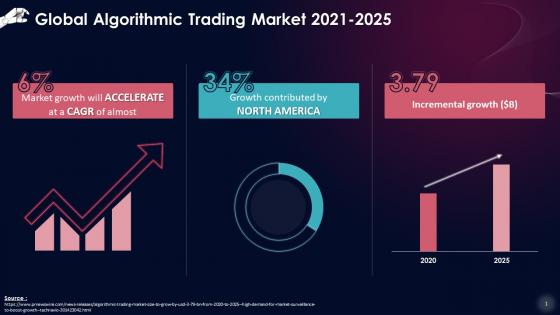
This slide showcases the role of Artificial Intelligence in algorithmic trading. Nowadays, powerful AI algorithms are used to generate approx. 50-70 per cent of equity market trades, about 60 per cent of futures deals, and approx. 50 per cent of treasury transactions.
People who downloaded this PowerPoint presentation also viewed the following :
AI Role In Financial Algorithmic Trading Training Ppt with all 17 slides:
Use our AI Role In Financial Algorithmic Trading Training Ppt to effectively help you save your valuable time. They are readymade to fit into any presentation structure.













FAQs for AI Role In Financial Algorithmic
Machine learning enhances predictive accuracy in algorithmic trading by analyzing vast datasets, identifying complex market patterns, and adapting to changing conditions in real-time. Through advanced algorithms like neural networks and ensemble methods, trading firms achieve more precise price forecasting, reduced false signals, and improved risk management, with many financial institutions finding that machine learning-driven strategies significantly outperform traditional rule-based approaches.
Sentiment analysis transforms news data into trading signals by processing market-related articles, social media posts, and financial reports to gauge investor mood and market direction. Through natural language processing algorithms, trading systems can automatically adjust portfolio positions, hedge risk exposure, and capitalize on sentiment-driven price movements, with many quantitative funds finding that combining sentiment data with traditional technical indicators delivers enhanced returns and faster market reaction times.
AI in algorithmic trading presents ethical challenges including market fairness concerns, potential systemic risks, transparency issues, and questions about human oversight in financial decisions. While these technologies can enhance market efficiency and reduce human bias, financial institutions increasingly recognize that responsible implementation requires robust risk management, regulatory compliance, and balanced approaches that ultimately deliver competitive advantage while maintaining market integrity.
Different machine learning algorithms vary significantly in trading performance, with neural networks excelling at pattern recognition, random forests providing robust risk management, and support vector machines delivering consistent trend analysis. While deep learning models often achieve higher returns in volatile markets, they require substantial computational resources, with many hedge funds and investment firms finding that ensemble methods combining multiple algorithms ultimately deliver the most reliable results and competitive advantage.
Overfitting risks in AI trading models include poor performance on new market data, excessive sensitivity to historical noise, reduced generalization capability, false confidence in backtesting results, and potential significant losses during live trading. These models perform well on training data but struggle with market volatility and changing conditions, with many hedge funds and institutional traders finding that robust validation and regularization techniques are essential for sustainable algorithmic performance.
Reinforcement learning optimizes trading decisions by learning from market interactions, adapting strategies based on reward feedback, and continuously improving through trial-and-error mechanisms. Through deep Q-networks and policy gradient methods, financial institutions enhance portfolio management, risk assessment, and execution timing, with many hedge funds finding that these AI agents deliver superior returns while minimizing market exposure risks.
**INPUT**: What data sources are most valuable for training AI algorithms in trading? **OUTPUT**: Valuable data sources include historical price movements, trading volumes, earnings reports, economic indicators, news sentiment, and alternative datasets like satellite imagery or social media trends. These diverse inputs enable AI systems to identify complex market patterns, predict price movements, and adapt to changing conditions, with many financial institutions finding that combining traditional market data with alternative sources delivers significant competitive advantages and enhanced trading performance. [Word count: 60 words]
Algorithmic trading's speed significantly impacts market volatility by enabling rapid position changes, amplifying price movements through high-frequency transactions, and creating cascade effects during market stress. While these systems enhance market liquidity and price discovery efficiency, they can also accelerate volatility spikes, with many financial institutions finding that millisecond execution speeds require sophisticated risk management protocols.
Implementing real-time AI analytics in trading presents challenges including latency requirements, data quality management, model accuracy under market volatility, regulatory compliance, and infrastructure scalability demands. While these systems require significant computational resources and robust risk management frameworks, many financial institutions find that successful implementation delivers faster trade execution, enhanced predictive capabilities, and competitive advantages in increasingly dynamic markets.
AI enhances risk management through real-time market monitoring, predictive analytics, dynamic position sizing, automated stop-loss mechanisms, and portfolio optimization algorithms. These technologies enable traders to identify potential threats faster, adjust exposure automatically based on volatility patterns, and minimize losses during market downturns, ultimately delivering more consistent returns and reduced drawdowns.
Natural language processing enables automated trade execution by analyzing news articles, earnings reports, social media sentiment, regulatory filings, and analyst recommendations to identify market-moving information. Through NLP algorithms, trading systems can instantly interpret textual data, extract relevant financial insights, and execute trades based on sentiment analysis, ultimately delivering faster market responses and enhanced decision-making capabilities compared to traditional manual analysis methods.
AI-driven trading strategies adapt to changing market conditions through real-time data analysis, pattern recognition, and continuous algorithm refinement based on market volatility and trends. Machine learning models enable these systems to identify emerging opportunities, adjust risk parameters automatically, and optimize execution timing, with many investment firms finding that adaptive algorithms deliver improved returns and reduced exposure during market fluctuations.
Transparency measures include algorithm documentation, audit trails, explainable AI models, regulatory compliance reporting, and stakeholder communication protocols. These approaches enable financial institutions to demonstrate decision-making processes, maintain regulatory oversight, and build client trust, with many trading firms finding that transparent practices ultimately deliver competitive advantage and enhanced market credibility.
Traders can balance algorithmic trading with human intuition by implementing hybrid strategies where algorithms handle high-frequency execution, pattern recognition, and risk management while humans provide market context, strategic oversight, and emotional intelligence during volatile periods. This approach enables financial institutions to leverage computational speed and data processing capabilities alongside experienced traders' judgment, market intuition, and ability to interpret unprecedented events, ultimately delivering more robust trading performance.
AI in algorithmic trading presents both challenges and opportunities for regulatory frameworks, requiring enhanced monitoring capabilities, updated compliance standards, real-time oversight mechanisms, and new risk assessment protocols. These technological advances enable regulators to streamline market surveillance, detect anomalies faster, and ensure transparency, while financial institutions increasingly find that adaptive regulatory approaches ultimately deliver greater market stability and competitive advantage.
-
It makes easy work of my work presentations. I’ve never had to be nervous about my presentations for meetings.
-
Colors used are bright and distinctive.