

Aims and objectives process flow powerpoint guide





Try Before you Buy Download Free Sample Product
 Impress Your
 Audience
 100%
100% Editable
 Save Hours
 of Time


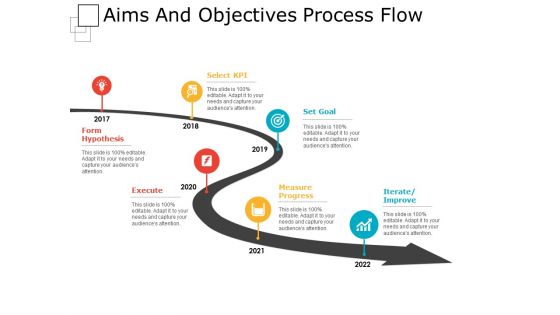
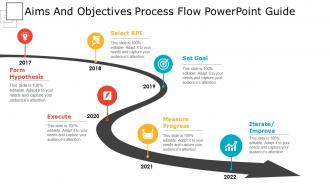
Map out the processes in a company to review if it is in accordance with the business objectives with our aims and objectives process flow PowerPoint guide. This presentation slide of goals and objective has been designed by our team of professional team members and helpful in process flow mapping to show the relationship of activities within the processes of business operations. Our research objective power point slide is useful to create flow of activities connected with arrows of timeline. The shapes contain different steps PPT slide provide a graphic illustration of how the process works and to display yearly achievements or future based approaches. This template of objective of process flow allows you to review steps which you are going to take to answer your research questions or a specific list of tasks needed to accomplish the goals of the project. Download this template and let your objectives to contribute to your aims. Invade their brains with our Aims And Objectives Process Flow Powerpoint Guide. Give them a fill of interesting ideas.
People who downloaded this PowerPoint presentation also viewed the following :
Aims and objectives process flow powerpoint guide with all 5 slides:
Advise on irrigation with our Aims And Objectives Process Flow Powerpoint Guide. Enable farmers to improve their crop.
FAQs for Aims and objectives process
So basically, aims are your big "why" - like "improve customer satisfaction." Objectives? Those are the actual concrete steps with numbers and deadlines - "boost response time 50% in 3 months." People confuse these constantly and honestly it drives me nuts lol. Your aim gives the whole project meaning. Then you break that down into maybe 3-5 objectives that are realistic and measurable. I always do the aim first, then figure out the specific targets. Makes way more sense that way. The objectives become your roadmap for actually hitting that bigger goal.
Honestly, just put your mission statement next to your current goals and see what doesn't match up. Every goal should connect to your mission somehow - if it doesn't, you're probably wasting time on random stuff. I swear, I've watched so many teams get distracted by cool-sounding projects that go nowhere. Be brutal about cutting things that don't fit. Maybe try scoring each goal monthly on how well it actually serves your mission? Anything under 7/10 is questionable. Oh, and don't feel bad about saying no to stuff - that's literally the point of having focus.
Honestly, you can't skip getting stakeholder input - they're the ones living with whatever you decide. Different people have totally different priorities, and you'll miss huge blind spots without their perspectives. When stakeholders help shape the goals from the start, they actually care about making it work instead of just going through the motions. I'd map out who matters most early on. Then figure out how to get their thoughts - could be surveys, quick meetings, whatever works for your group. Oh and bonus: they'll spot problems you never would've thought of. Trust me on this one.
Look, SMART criteria just make you stop being vague about your goals. Like instead of "improve customer satisfaction" you actually have to define what that means - real numbers, deadlines, stuff your team can measure. Yeah it's annoying to set up but trust me, you'll thank yourself later. The "achievable" part especially keeps you from setting impossible deadlines (been there). Plus it forces you to check if your goals actually make sense for your bigger strategy. Just take whatever objectives you have now and run them through each SMART element - you'll instantly see what's missing or unrealistic.
Ugh, the worst thing you can do is make everything super vague. Like, what does "improve customer satisfaction" even mean? Pick 3-5 objectives max - I've watched teams drown trying to juggle 15 different goals. Make sure each one has actual numbers and deadlines attached. Otherwise you'll be scrambling later trying to figure out if you even succeeded. Also double-check that your objectives actually connect back to your main goal. Sounds obvious but honestly, it's not always as clear as you think.
Honestly, the trick is making your goals modular from day one. Break them into tiers - core stuff vs nice-to-haves. Scope creep happens literally every time, so when it does, tackle your must-haves first. Then figure out what else still makes sense. Write down changes as they happen and tell everyone immediately. I learned this the hard way - people get confused fast when they don't know what "done" looks like anymore. Set up regular check-ins so you can adjust without totally starting over. Your objectives should evolve, not be carved in stone.
For mapping out your aims and objectives, I'd start with a basic flowchart - Lucidchart or Visio if you want something polished, or just use draw.io since it's free. SMART goals frameworks are clutch for structuring everything properly. You know what though? Some of the best planning sessions I've been in literally used sticky notes on a conference room wall - weirdly effective for getting everyone involved. If you need something more detailed later, logic models show how your objectives actually connect to real outcomes. Don't overthink it at first. Build simple, then add layers.
Honestly, having clear goals is like giving your team a North Star - everyone knows what they're working toward and why their piece matters. People get way more motivated when they actually understand the bigger picture. I'm a huge fan of breaking massive goals into smaller chunks, like weekly or monthly targets. That way you can celebrate the little wins too (and who doesn't love an excuse for cake?). It keeps energy up instead of waiting months to see progress. The trick is making objectives specific enough that people can feel accomplished on a regular basis, not just during those dreaded quarterly check-ins.
Dude, you NEED clear objectives or your project will be a total mess. I'm talking specific goals that everyone actually understands - not some wishy-washy "improve efficiency" garbage. When people know what success looks like, you'll get way fewer revisions and less scope creep. I've watched projects completely implode because teams couldn't agree on basic goals. Vague objectives = vague results. Your stakeholders will hate you, deadlines get missed, everything spirals. Honestly, if you can't explain your project's purpose to some random person in like 30 seconds, you're already screwed. Figure that out first.
Honestly, you've gotta track both the numbers and the feelings. Numbers are obvious - did you hit deadlines, stay on budget, meet your revenue targets, whatever. But don't skip the softer stuff like feedback sessions and how people actually feel about the changes. That qualitative data is gold, even though most people ignore it. Check in monthly instead of waiting till the end - I learned this the hard way on a project last year. Just make a simple tracker or dashboard so you can catch problems early. Way easier to fix things as you go than scramble at the finish line.
Get everyone together first and hash out what they actually care about. Map out where their priorities overlap - there's usually more common ground than people think. When things get messy (they will), use something like SMART criteria to objectively weigh the competing goals. Honestly, prioritizing by business impact and feasibility saves a ton of headaches later. If you're still stuck, push it up to leadership for the final call. Document whatever trade-offs you make so nobody conveniently "forgets" what was agreed on. Then circle back in a few weeks to see if it's actually working.
Honestly, visuals are your best friend here - slides or diagrams that map everything out so everyone's literally looking at the same picture. After that, break into smaller groups because that's where the real "oh I get it now" moments happen. People need to connect those big goals to what they're actually doing day-to-day, you know? Don't get too abstract either - give them concrete examples and real timelines they can wrap their heads around. Oh, and definitely send written follow-ups afterward since half the room will forget the details anyway. You'll probably need to explain it a few different ways before it clicks for everyone.
Honestly, I'd check in on your goals after each big milestone or whenever the scope gets wonky. Set up those checkpoint meetings to see if what you originally planned still makes sense - trust me, half the time you'll realize your first ideas were way too ambitious or just plain wrong. When things need changing, make sure it works with what your stakeholders expect and document why you're shifting gears so everyone's on the same page. Oh, and book your next review while you're thinking about it because you'll totally forget otherwise.
Honestly, just pick one good project management tool first - Asana or Trello work great for tracking your objectives without drowning in email updates. Digital dashboards are a game changer because you can actually see what's happening in real-time instead of guessing. Your team can jump in from wherever they are to help set goals, which is pretty nice. Oh, and automated reports will save you so much time (I used to spend forever on those manually). Start with whatever's bugging you most - tracking progress or reporting - then add other tools later.
Dude, vague goals are a total resource killer. Your team ends up scattered, working on random stuff that doesn't even move the needle. Some people duplicate work while others waste time on completely irrelevant tasks. Honestly, it's worse than trying to pack when you have no clue if you're hitting the beach or hiking mountains. Plus you can't prioritize anything properly - suddenly everything's "urgent" but nothing gets proper attention or budget. Trust me, spending extra time upfront to get crystal clear on what you're actually trying to achieve will save you so much pain later.
-
Presentation Design is very nice, good work with the content as well.
-
Attractive design and informative presentation.