


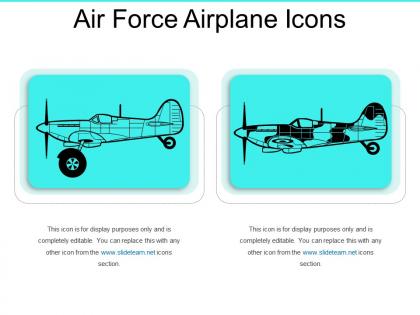
Air force airplane icons




Try Before you Buy Download Free Sample Product
 Impress Your
 Audience
 100%
100% Editable
 Save Hours
 of Time


Employ this Air Force Airplane Icons PowerPoint presentation to showcase the facts and figures pertaining to aircraft. Take advantage of this airways PPT template to depict the strength of your army including the number of deployed troops, vehicles, etc. Take the assistance of this aviation career PowerPoint slideshow to show the lucrative job opportunities in the field of airlines including flight stewardship, air ticketing, etc. Utilize this flight PPT layout to compare various planes thereby highlighting their features for a selection of right aircraft. Illustrate the types of military aircraft such as attack planes, bombers, transport planes, fighter jets and many more with this aviation layout slide. This aviation visual is appropriate for air force, defense, and governmental organizations. Download this army PPT infographic to intimidate your enemies and show your caliber.
People who downloaded this PowerPoint presentation also viewed the following :
Air force airplane icons with all 5 slides:
Create harmony with our Air Force Airplane Icons. They help foster an air of agreement.


FAQs for Air
The most iconic Air Force aircraft include the P-51 Mustang, B-17 Flying Fortress, F-86 Sabre, B-52 Stratofortress, and F-22 Raptor. These legendary aircraft revolutionized military aviation by delivering superior performance, strategic capabilities, and technological advancement, with many serving across multiple conflicts and ultimately establishing air superiority that enhanced national defense operations worldwide.
Design innovations in Air Force airplanes have revolutionized modern military aviation through advanced stealth technology, enhanced avionics systems, improved fuel efficiency, and superior maneuverability capabilities. These technological breakthroughs enable faster mission deployment, reduced operational costs, and strategic superiority in combat scenarios, with many defense organizations finding that integrated systems deliver enhanced operational efficiency and maintain competitive advantage in increasingly complex aerospace environments.
Aircraft logos and emblems serve as vital identification markers, unit designators, mission indicators, and morale symbols that distinguish Air Force aircraft by squadron, base, and operational purpose. These visual elements enhance operational efficiency by enabling rapid aircraft recognition, streamline maintenance tracking and logistics coordination, and ultimately deliver stronger unit cohesion and organizational identity across military aviation operations.
**INPUT**: Which Air Force airplanes have become symbols of national pride and why? **OUTPUT**: Iconic Air Force aircraft like the F-22 Raptor, B-2 Spirit, Thunderbirds demonstration team, and Blue Angels have become symbols of national pride through their technological superiority, strategic capabilities, and public visibility. These aircraft showcase advanced engineering excellence, combat effectiveness, and precision performance at airshows and ceremonial events, ultimately representing military strength and innovation that enhances national prestige. [Word count: 60]
Air Force airplanes demonstrate technological evolution through propulsion systems, avionics, materials engineering, stealth capabilities, and weapons integration that define each generation. From World War II's mechanical systems to today's fly-by-wire controls and composite materials, these aircraft showcase how aerospace innovation drives operational superiority, with modern jets delivering enhanced speed, precision, and battlefield dominance.
Countries have adapted iconic airplane designs through strategic modifications including enhanced avionics systems, specialized weapons configurations, climate-specific engineering adaptations, and customized communication technologies. Through these adaptations, nations like India with modified Rafales, Japan with F-35 variants, and European NATO members with Eurofighter customizations deliver enhanced operational capabilities, improved regional compatibility, and stronger defense readiness, ultimately enabling strategic military advantages tailored to specific geographic and operational requirements.
Stealth technology revolutionized Air Force aircraft design by requiring angular geometries, radar-absorbing materials, internal weapon bays, and specialized coatings to minimize detection signatures. These innovations transformed aircraft like the F-117 and B-2, enabling penetration of heavily defended airspace while maintaining operational effectiveness, ultimately delivering strategic advantages through reduced vulnerability and enhanced mission success rates.
Iconic Air Force airplanes inspire through their representation of technological advancement, national pride, heroic service history, and engineering excellence, capturing imaginations across generations. These aircraft, from the F-22 Raptor to the B-2 Spirit, demonstrate innovation and capability that motivates careers in aerospace, engineering, and military service, while fostering public appreciation for aviation achievements and national defense capabilities.
Legendary Air Force fighter jets feature advanced avionics systems, supersonic capabilities, stealth technology, precision weaponry, and exceptional maneuverability. These aircraft revolutionize military operations by delivering superior air-to-air combat effectiveness, strategic bombing precision, and reconnaissance capabilities, with many defense organizations finding that these technological advances ultimately enhance mission success rates and operational dominance.
Training aircraft prioritize safety, ease of handling, and cost-effectiveness through simplified controls, forgiving flight characteristics, and dual cockpit configurations for instructor oversight. Combat-capable planes emphasize speed, maneuverability, advanced weaponry systems, and stealth capabilities, with military organizations finding that training platforms ultimately enable pilot development while combat aircraft deliver operational superiority and strategic defense capabilities.
Several Air Force aircraft have successfully transitioned to civilian use, including the C-130 Hercules for cargo transport, KC-135 Stratotanker converted to passenger jets, T-6 Texan II for flight training, and C-47 Skytrain for commercial aviation. These aircraft deliver operational efficiency, proven reliability, and cost-effective solutions across industries like logistics, agriculture, and emergency services, with many organizations finding that military-grade engineering ultimately enhances safety standards and performance capabilities.
The legacy of iconic Air Force airplanes influences current aircraft development by establishing proven design principles, inspiring technological advancement, and setting performance benchmarks that guide engineering decisions. Modern aircraft manufacturers integrate lessons from legendary planes like the F-16's maneuverability and B-52's durability into contemporary designs, ultimately delivering enhanced operational capabilities and strategic advantages for defense organizations worldwide.
Air shows and exhibitions serve as powerful platforms for demonstrating Air Force capabilities, enhancing public engagement, and strengthening national pride through live displays of iconic aircraft. These events enable military organizations to showcase technological advancement, recruit talent, and build strategic partnerships with defense contractors, while ultimately delivering enhanced public support and international diplomatic relationships that reinforce national security objectives.
Air Force airplanes dominate popular culture through action films like Top Gun and Iron Eagle, military video games such as Ace Combat and War Thunder, and countless documentaries showcasing aerial combat. These aircraft captivate audiences with their advanced technology, strategic importance, and dramatic flight sequences, ultimately inspiring career interest in aviation while enhancing public appreciation for military service and aerospace innovation.
Iconic Air Force airplanes face significant environmental challenges including carbon emissions reduction, noise pollution compliance, fuel efficiency mandates, sustainable aviation fuel integration, and stricter environmental regulations. Military aviation increasingly balances operational readiness with environmental responsibility, with many air forces finding that green technologies like hybrid systems and alternative fuels deliver cost savings while maintaining strategic capabilities.
-
Professional and unique presentations.
-
Innovative and Colorful designs.