


Aircraft maintenance and cost control powerpoint ideas




Try Before you Buy Download Free Sample Product
 Impress Your
 Audience
 100%
100% Editable
 Save Hours
 of Time


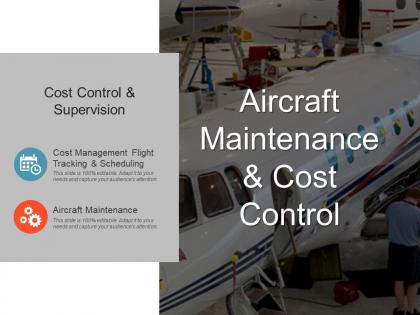
Introduce a vibrant dimension to your PowerPoint presentations through our, aircraft maintenance and cost control PowerPoint ideas. Refresh your working routines and bring productive changes through new working procedures. We have shown the data PowerPoint layout for aircraft maintenance and cost control. A bright image of and aircraft with keyword aircraft maintenance and cost control is shown here on one side and two stages for cost supervision and control is shown. Cost management flight tracking and scheduling, aircraft maintenance are the two parameters shown here to cover up the major aspects in aircraft maintenance and cost control. Include your key points and get your ideas across through the help of a PowerPoint template by editing the text boxes shown here. Explain your agendas in accordance with the industry norms business activity and product or service. We have shown engaging color patterns and icons here to make this PPT design more interactive. Overview your patterns and download our, aircraft maintenance and cost control PowerPoint ideas for your best experience and achieve your goal. Discharge your responsibility with our Aircraft Maintenance And Cost Control Powerpoint Ideas. Match up to the expectations of you.
People who downloaded this PowerPoint presentation also viewed the following :
Aircraft maintenance and cost control powerpoint ideas with all 5 slides:
Instil a desire for discipline with our Aircraft Maintenance And Cost Control Powerpoint Ideas. Explain how following instructions benefits all.





FAQs for Aircraft maintenance and cost
So basically it comes down to how old your planes are, how much you're flying them, and what kind of maintenance approach you're taking. Older aircraft are obviously pricier to maintain, but weirdly enough, flying them more can actually lower your per-hour costs since you're spreading those fixed maintenance expenses across more flight time. Whether you go with scheduled or condition-based maintenance makes a massive difference in your budget. Parts and labor costs are all over the map depending on aircraft type and where you're operating. Don't underestimate weather impacts either - if you're doing coastal operations, you'll deal with way more corrosion headaches. I'd definitely track cost per flight hour by individual tail number so you can identify which planes are bleeding money.
Dude, predictive maintenance is a game changer for your budget. Basically you're using sensors to actually see what's happening with your aircraft parts instead of just guessing. No more replacing stuff "just because" it hit some arbitrary hour limit - honestly that old approach always seemed wasteful to me. You'll catch issues before they turn into massive expensive failures. Plus you avoid all that unplanned downtime that kills your schedule. Components last longer too since you're not swapping them out unnecessarily. Start with your priciest parts first - that's where you'll see the biggest savings right away.
Compliance costs are honestly what'll kill your budget if you don't plan for them. Can't skip mandatory inspections or swap in cheaper parts - trust me, I've seen people try. The frustrating part? You're stuck doing what they say, when they say it, regardless of cash flow. But good record-keeping actually pays off here. Stay on top of preventive scheduling and you'll dodge those brutal emergency groundings and rush fees. I learned this the hard way - better to bake these costs into your baseline from the start. Oh, and certified parts are expensive but there's literally no way around it.
Look, in-house teams cost about 20-30% more per hour with benefits and training factored in. But outsourced guys will absolutely nail you during peak seasons or emergencies - honestly, it's brutal what they charge then. Your own crew knows your planes backward and forward, so turnaround's way faster. Plus outsourcing companies sometimes lock you into minimum hours that jack up costs. Oh, and you get predictable budgeting with in-house staff instead of those surprise invoices. I'd crunch the numbers based on your actual maintenance needs - if you've got steady work, keeping it in-house usually pays off better long-term.
Yeah, seasonal swings will totally wreck your maintenance budget if you don't plan ahead. Peak season is the worst - more flights means everything wears out faster and your maintenance cycles get compressed. Winter's rough too with all the de-icing costs and cold weather checks. Here's the thing though, you can't just push everything to the slow months since some maintenance is time-based no matter what. I learned this the hard way last year. Build in extra cushion during busy periods, like 15-20% more. Forecast those patterns early and you'll save yourself major headaches.
Start with ABC analysis - group your parts by how critical and expensive they are. Stock up on the high-value stuff that'll kill you if it breaks. Everything else? Just order as needed. Pooling deals with other operators are honestly a game changer for pricey rotables, cuts your carrying costs way down. Get a solid inventory system that tracks usage and auto-reorders. Oh, and definitely audit what you actually have first - your system's probably lying to you about half your stock anyway. Focus your budget where it really matters.
Honestly, once you start digging into your maintenance data, you'll be amazed at what jumps out. I'm talking about spotting which parts constantly break down, figuring out when stuff's gonna need replacing before it actually does. You can track cost patterns across different planes or routes too - sounds nerdy but it's actually super useful. The coolest part? Moving from just fixing things when they break to knowing what's coming next. Just throw your old maintenance records into some kind of dashboard first. Even basic stuff will show you where you're bleeding money that you didn't even realize.
Honestly, the worst thing is getting blindsided by random breakdowns. You plan for oil changes and inspections, then boom - engine trouble or some avionics thing dies on you. Parts take forever too, so you're paying hangar fees while waiting around. Don't just use those industry averages either, that's useless. Check your specific plane's history instead. Labor costs keep going up, and new regs pop up all the time. I always pad my budget by 15-20% because something will go wrong - it always does.
Ditch the rigid manufacturer schedules and use your actual aircraft data to predict when stuff really needs work. Bundle tasks by location so you're not tearing into the same panels over and over - huge time saver there. Track which scheduled items keep coming back totally clean, then push those intervals out longer. Smart forecasting lets you negotiate better bulk deals with suppliers too. Honestly, most shops treat this like checking boxes instead of thinking strategically. It's more like inventory management than anything else. Start small with the predictive stuff though - don't try to overhaul everything at once.
So airlines are finally getting smart with predictive maintenance - tons of IoT sensors and AI catching problems before planes break down. Way better than those old rigid schedules they used to follow. Digital twins are everywhere now, basically simulating how aircraft perform and predicting component failures. 3D printing is huge for spare parts too, saves them crazy money on inventory. Oh and the results are actually impressive - like 30% less unplanned downtime and major cost cuts. Honestly just start with sensors on your most critical stuff and see how it goes.
Your maintenance costs are gonna skyrocket after year 15-20. Think exponential growth, not gradual increases. More surprise repairs, longer ground time, and parts get stupid expensive since they're harder to find. Regulatory stuff becomes a nightmare too with older birds. It's basically like that old car your uncle keeps fixing - except each repair costs tens of thousands instead of hundreds. Track your cost-per-flight-hour religiously so you'll know when to cut your losses. Better to plan fleet replacement than get stuck with aircraft that drain your budget faster than you can feed them.
Dude, these IoT sensors are game-changers. They track engine temps, vibrations, all that stuff in real-time so you can spot problems before things go sideways. No more emergency repairs at 2am, you know? The predictive analytics are honestly pretty crazy accurate now - way better than I expected when this tech first came out. You'll catch issues during planned maintenance instead of dealing with expensive AOG situations. Plus you can actually plan your parts inventory since you know when stuff needs replacing. I'd start with your most critical systems first, then build from there.
Oh man, unscheduled maintenance is brutal - costs can hit 3-5x more than planned stuff because suddenly everything's an emergency. You're stuck paying rush fees for parts, overtime for mechanics, plus your plane's just sitting there making zero money. The domino effect is honestly the worst part though - delayed flights mean passenger compensation, rebooking headaches, crew scheduling chaos. All that adds up fast. Really, predictive maintenance programs are worth every penny upfront. Way better than getting smacked with a surprise $50K repair bill when you least expect it.
Look, maintenance contracts usually eat up about 10-15% of your operating costs, so yeah, they matter. Instead of getting hit with random $50k surprise repairs, you get predictable monthly bills. Sure, you'll pay extra for that peace of mind, but honestly? The cash flow predictability is worth it for most operations. Try negotiating performance guarantees - tie those payments to actual aircraft availability if you can. I'd crunch numbers on both fixed contracts vs pay-as-you-go before deciding. Really depends on how much you're flying though.
Check out what manufacturing and auto companies do with IoT sensors for predictive maintenance - they're killing it. Instead of waiting for stuff to break, they schedule fixes during downtime. Smart move. Shipping companies standardize parts across their whole fleet, which cuts inventory costs big time. Oil and gas folks (who basically throw money at equipment problems) focus on risk-based strategies that tackle critical systems first. I'd start by comparing your current process to theirs - bet you'll find some obvious wins with scheduling and parts management. Those industries figured this out the hard way.
-
Innovative and attractive designs.
-
Easily Editable.