


Amazon Company Profile Powerpoint Presentation Slides CP CD





Try Before you Buy Download Free Sample Product
 Impress Your
 Audience
 100%
100% Editable
 Save Hours
 of Time


Amazon began as an online bookstore but has become a giant in e commerce, cloud computing AWS, and streaming, earning the nickname The Everything Store. Check out our insightfully crafted PowerPoint Presentation titled, Amazon Company Profile. This e commerce company profile provides details about the executive summary which includes legal name, headquarters, year of foundation, founders, stock symbol, and product service offerings. It also outlines details related to business operations which are mission and core values, facts and statistics, unique selling points, and business model. Furthermore, the Technology PPT showcases global presence, history, awards and achievements, employee count, and workforce diversity. Moreover, the Cloud Computing presentation shows the competitive landscape of the company. It also includes yearly comparisons of monthly active customers, trips, and gross bookings. Lastly, our Digital Streaming Module presents business combinations, SWOT analysis, organizational structure, future strategy and goals, future expansion plans, SWOT analysis, and CSR goals and initiatives. Get access now.
People who downloaded this PowerPoint presentation also viewed the following :
Content of this Powerpoint Presentation
Slide 1: This slide introduces Amazon Company Profile. State Your Company Name and begin.
Slide 2: This slide shows a Table of Contents for the presentation.
Slide 3: This slide is in continuation with the previous slide.
Slide 4: The slide showcases the executive summary to provide brief insights of company.
Slide 5: This slide shows company introduction which includes founded year, website contact number, email, founder, headquarters and employee count.
Slide 6: This slide highlights the mission and vision of Amazon corporation along with its core values.
Slide 7: This slide presents recent awards and recognition received by business for work done on the behalf of its customers, employees and community across world.
Slide 8: This slide represents the Amazon company journey from 1994 to 2022, which showcases information of foundation of business, going public, expansions, acquisitions, launchers, new market entry, etc.
Slide 9: This slide outlines the Amazon company journey from 1994 to 2022.
Slide 10: This slide describes the Amazon company presence of international offices across all the continents.
Slide 11: This slide depicts various brands which Amazon has established long term strategic partnerships,
Slide 12: This slide focuses on major customers of our company on the basis of industry.
Slide 13: This slide is in continuation with the previous slide.
Slide 14: This slide mentions the key members of management board with their designation roles.
Slide 15: This slide contains the organization structure of Amazon company.
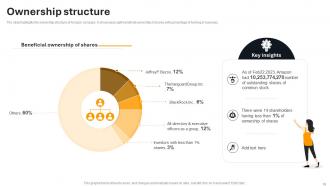
Slide 16: This slide highlights the ownership structure of Amazon company.
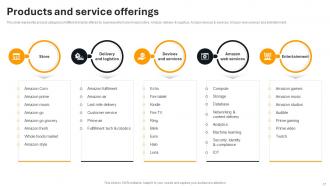
Slide 17: This slide represents product categories of different brands offered by business.
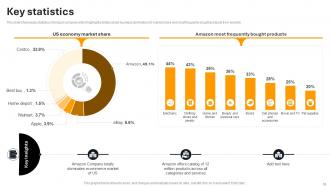
Slide 18: This slide showcases statistics of amazon company which highlights details about business dominates US market share.
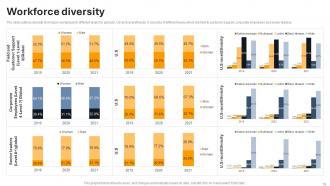
Slide 19: The slide outlines diversity at Amazon workplace for different levels for globally, US and race/ethnicity.
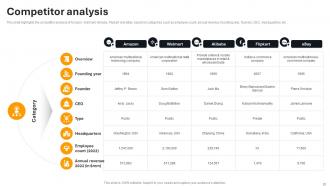
Slide 20: This slide highlights the competitor analysis of Amazon, Walmart, Alibaba, Flipkart and eBay based on categories.
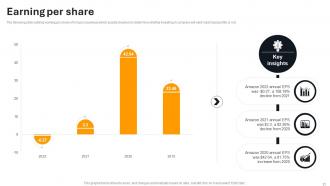
Slide 21: This slide puts earning per share of Amazon business which assists investors to determine whether investing in company will yield maximized profits or not.
Slide 22: This slide showcases the suitable graph/chart.
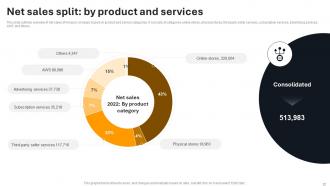
Slide 23: This slide outlines overview of net sales of Amazon company based on regional distribution.
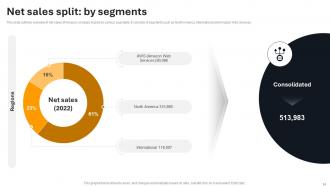
Slide 24: This slide entails an overview of net sales of Amazon company based on various segments.
Slide 25: This slide contains overview of net sales and operating profit or loss of North America segment of Amazon company.
Slide 26: This slide marks an overview of net sales and operating profit or loss of international segment of Amazon company.
Slide 27: This slide shows an overview of net sales and operating profit or loss of Amazon Web Services segment of Amazon company.
Slide 28: This slide projects a performance of Amazon stock price.
Slide 29: This slide pertains to Amazon business value proposition for customers and sellers.
Slide 30: This slide focuses on strengths, weakness, opportunities and threats to evaluate competitive position of company.
Slide 31: This slide focuses on business model of Amazon.
Slide 32: This slide elaborates on notable acquisitions and subsidiaries of Amazon company with year and value.
Slide 33: This slide puts various brands that is privately owned by Amazon company with product offered.
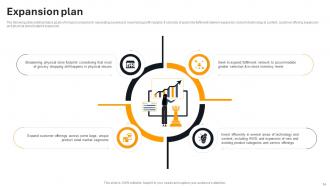
Slide 34: This slide mentions future goals of Amazon company for expanding business to maximizing profit margins.
Slide 35: This slide represents the client testimonials post using products and services offered by Amazon company.
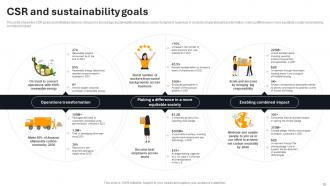
Slide 36: This slide shows the CSR goals and initiatives taken by Amazon to encourage sustainability and reduce carbon footprint of business.
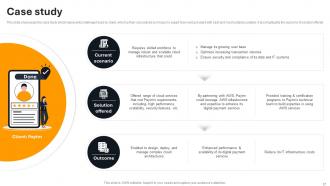
Slide 37: This slide mentions the case study which represents challenge faced by client.
Slide 38: This slide highlights the various platforms to follow and contact Amazon Incorporation.
Slide 39: This slide shows all the icons included in the presentation.
Slide 40: This slide is titled Additional Slides for moving forward.
Slide 41: This slide is an Idea Generation slide to state a new idea or highlight information, specifications, etc.
Slide 42: This slide is Our Target slide. State your targets here.
Slide 43: This slide is a Timeline slide. Show data related to time intervals here.
Slide 44: This slide shows Post-It Notes. Post your important notes here.
Slide 45: This slide depicts a Venn diagram with text boxes.
Slide 46: This slide is a financial slide. Show your finance-related stuff here.
Slide 47: This slide is a thank-you slide with address, contact numbers, and email address.
Amazon Company Profile Powerpoint Presentation Slides CP CD with all 55 slides:
Use our Amazon Company Profile Powerpoint Presentation Slides CP CD to effectively help you save your valuable time. They are readymade to fit into any presentation structure.
-

Amazon Company Profile
-
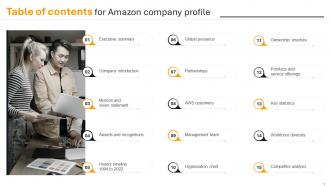
Table of contents for Amazon company profile
-
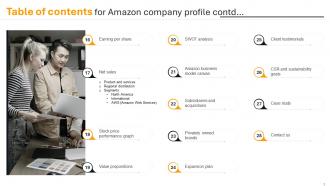
Table of contents for Amazon company profile contd
-
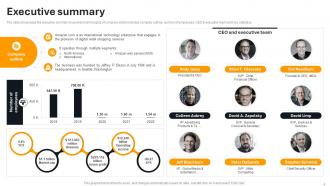
Executive summary
-
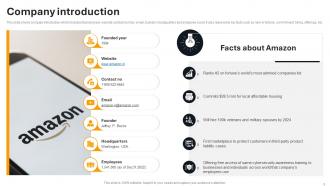
Company introduction
-
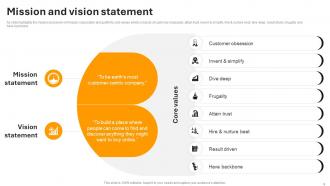
Mission and vision statement
-

Awards and recognitions
-
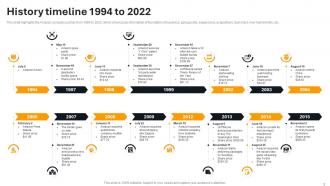
History timeline 1994 to 2022
-
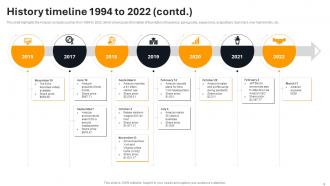
History timeline 1994 to 2022 contd
-

Global presence
-
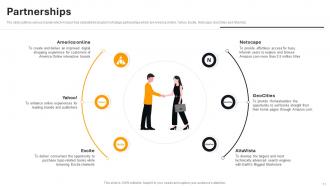
Partnerships
-
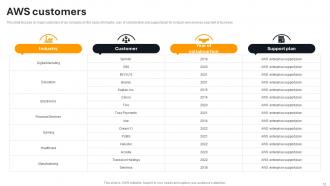
AWS customers
-
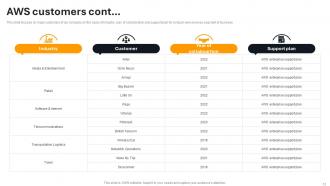
AWS customers cont
-
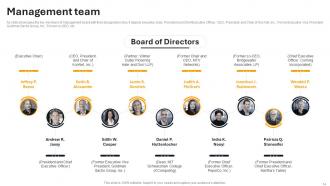
Management team
-
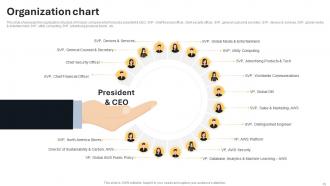
Organization chart
-
Ownership structure
-
Products and service offerings
-
Key statistics
-
Workforce diversity
-
Competitor analysis
-
Earning per share
-
Net sales split by product and services
-

Net sales split by regional distribution
-
Net sales split by segments
-
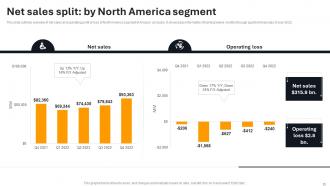
Net sales split by North America segment
-
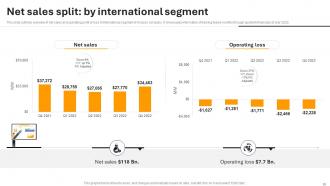
Net sales split by international segment
-
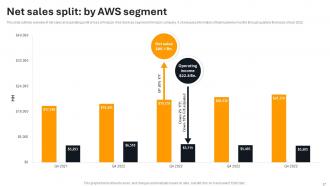
Net sales split by AWS segment
-

Stock price performance graph
-
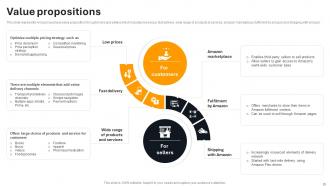
Value propositions
-
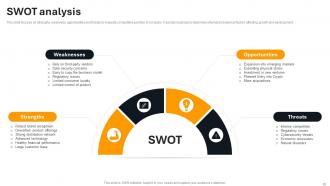
SWOT analysis
-
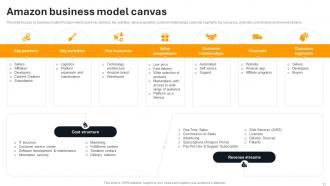
Amazon business model canvas
-
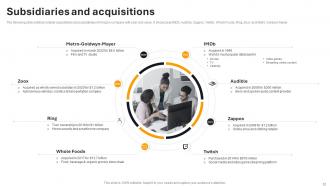
Subsidiaries and acquisitions
-
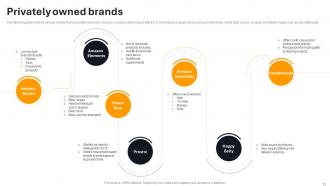
Privately owned brands
-
Expansion plan
-

Client testimonials
-
CSR and sustainability goals
-
Case study
-

Contact us
-
Icons slide for Amazon company profile
-

Additional slides
-
Idea generation
-

Target
-

Timeline
-
Post it notes
-
Venn diagram
-

Financial
-

Thanks for watching
-

-

-

-

-

-

-

-

FAQs for Amazon Company Profile Powerpoint Presentation
So Amazon basically started in '94 when Bezos was selling books out of his garage - pretty wild origin story. They went public in '97, then started selling literally everything. Prime launched in 2005 (that was smart), followed by AWS in 2006 which honestly makes them way more money than the retail side. Kindle came out in '07, then Alexa in 2014. Bezos handed things over to Andy Jassy in 2021. The crazy thing is how they kept reinvesting everything instead of just taking profits - that's probably why they're so huge now.
Amazon's crazy when you think about it - started selling books in '94 and now they're everywhere. They expanded into general retail, then AWS cloud services became this massive money maker. Prime membership was genius too. Third-party sellers, ads, streaming, even bought Whole Foods at some point. What gets me is how they'll take profits from one thing and just dump it into something totally different. Their whole strategy is playing the long game instead of chasing quick profits. That patience is probably why they dominate so many markets now.
Dude, AWS is literally Amazon's money printer. Most people think Amazon's all about retail, but AWS generates like 70% of their actual profits. That's how they can sell stuff at basically no margin - the cloud business pays for everything else. Plus it gives them this insane infrastructure advantage since they're running on their own tech stack. Honestly, whenever I'm looking at Amazon's financials, I skip straight to the AWS numbers because that's where the real action is. The whole company's basically transformed into a tech infrastructure play rather than just selling books and random stuff online.
So Amazon's basically put AI everywhere - Alexa's voice stuff, those "you might also like" suggestions when you're shopping. Their warehouses have AI robots doing inventory, plus they use it to figure out the fastest delivery routes. AWS sells a ton of AI tools to other companies (smart money move, honestly). They've got machine learning doing fraud detection and pricing, and it's what makes those Amazon Go stores work without cashiers. Oh, and if you want to see how they actually do this stuff, their AWS case studies are pretty detailed - I was reading through some the other day and they're way more transparent than I expected.
Prime totally changed shopping psychology. People check Amazon first now before even thinking about other stores. Two-day shipping spoiled everyone - honestly I get annoyed waiting longer than that myself. Members buy way more stuff because there's no shipping fee holding them back. Smart bundling too - you're not just canceling shipping, you're losing your shows and music. It's like breaking up with three services at once. Really shows how removing small barriers can create massive loyalty. Other businesses should study this playbook.
Yeah, Amazon's pushing hard on their Climate Pledge thing - net-zero by 2040. Pretty wild goal for a company shipping that much stuff daily. They're dumping money into electric delivery trucks and renewable energy for data centers. Plus sustainable packaging, though honestly the results feel kinda mixed so far. There's also this $10 billion fund they set up for clean tech companies. Scale is crazy though. Just heads up - if you're dealing with them as a vendor, they're getting pickier about sustainability requirements from suppliers now too.
Honestly, Amazon nailed it with three big moves. First, they built warehouses everywhere so your order ships from like 20 miles away instead of across the country. Prime was brilliant too - getting people to pay upfront for "free" shipping while Amazon uses that money to build more infrastructure. The scary part is how they predict what you want before you do, moving products closer based on data patterns. My friend's startup struggled until they focused on faster delivery and started tracking customer buying habits better. Short delivery times and good data analytics - that's where you gotta start if you're doing e-commerce.
Amazon started selling books back in '94, but damn, look at them now. They sell literally everything - groceries, electronics, random stuff you didn't know you needed. AWS is their real money maker though, which is kinda crazy when you think about it. A bookstore now runs half the internet's infrastructure. They've got Prime Video, Alexa, bought Whole Foods... honestly it's wild how they just kept expanding into whatever made sense. Perfect example of how to grow way beyond where you started.
Yeah, Amazon's in hot water with regulators right now - mainly antitrust stuff. They're getting called out for boosting their own products in search results and supposedly using seller data against competitors. The EU's been going hard on them with investigations and fines. Competition's heating up too. Shopify's helping brands skip Amazon entirely, and TikTok Shop is weirdly changing how people find stuff to buy. The whole landscape flipped pretty fast, honestly. If you're doing business with them, just watch how these regulatory changes might mess with their policies down the road.
Amazon basically stalks your every move to personalize everything. Your browsing history, what you buy, even how long you stare at something - they're watching it all. Those "customers who bought this" suggestions? Scary accurate because of all that data. They use it to tweak your search results and show you specific reviews first. Plus machine learning helps them predict what you'll want and get it to you faster. Oh, and prices change in real-time based on the analytics too. It's kind of creepy but honestly works really well.
Dude, Amazon's acquisition strategy is honestly genius but also kinda terrifying. They bought Whole Foods, AWS companies, logistics firms - not just to grow bigger, but to create this web where everything connects. Each purchase either kills competition or feeds data back into their system. So now they can lose money in one area while making bank in another, which lets them undercut competitors who only do one thing. Like, good luck competing against that flywheel effect. If you're looking at any retail or cloud company, don't just compare them to Amazon's individual businesses - you're really going up against this whole interconnected beast.
So Amazon basically changes everything depending on where they're going. Europe gets the full Prime treatment with crazy fast shipping since people there expect it. India? Totally different - they went mobile-heavy and added cash payments because that's just how Indians shop. China was honestly a disaster for them against Alibaba. Latin America's tricky with all the regulations, so they're partnering locally instead of going solo. Oh and they're super cautious there too. For your expansion, just copy what they do - figure out how people actually pay and shop in each place. Don't try forcing your usual approach everywhere.
Dude, Amazon's warehouse game is insane - those robot fulfillment centers cut picking time by 75%. They've got predictive analytics that somehow know what you want before you do, which honestly feels a little creepy but whatever. One-day shipping used to be impossible, now it's standard because of their logistics network. Machine learning handles demand forecasting across millions of products. The drone delivery thing is still rolling out, but their real-time route optimization already works crazy well. Seriously though, if you're trying to fix supply chain issues, just copy what they're doing. Their automation strategies are next level.
So Amazon basically does both - they buy directly from manufacturers for some stuff, but they also let third-party sellers use their warehouses through FBA. Their inventory system is wild though, like they've got these algorithms predicting what people will buy and auto-ordering more stock. Pretty smart way to avoid being stuck with too much crap sitting around. Most of the inventory headache actually gets pushed onto the sellers anyway - you ship your products to their warehouses and they handle shipping to customers. Just heads up, their payment terms can be brutal if you don't follow their rules exactly.
So Amazon's obsessed with their 14 Leadership Principles - stuff like "Customer Obsession" and "Ownership." Honestly, they take it pretty seriously. You'll hear people quoting them in random meetings all the time. They also do this thing called "Working Backwards" where they write fake press releases before building anything (kinda weird but it works). The culture's intense, not gonna lie. But it keeps everyone on the same page across like a million employees. If you're interviewing, definitely study those principles and think of real examples. They WILL ask about them.
-
Informative design.
-
Nice and innovative design.