

Alibaba Company Profile Powerpoint Presentation Slides CP CD





Try Before you Buy Download Free Sample Product
 Impress Your
Audience
 100%
Editable
 Save Hours
of Time


A company profile provides an overview of the most critical points about an organization which helps the investors and stakeholders to evaluate the business value and performance. Check out our professionally designed Alibaba Company Profile PowerPoint presentation. Firstly, the profile covers the executive summary, company introduction, business model, global presence, product portfolio, and employee base. partners and alliances. Also, this profile shows the Board of Directors, key stats and and figures, and revenue growth from 2018 to 2022. Moreover, this PowerPoint outlines business finances such as revenue by segment and by region. It also outlines the total deals done and deal value. Finally, this ppt illustrated business performance evaluation with competitor analysis and SWOT analysis. It further outlines plans and SWOT analysis. Lastly, it shows CSR activities. Download our 100 percentage editable and customizable template, which is also compatible with Google Slides.
People who downloaded this PowerPoint presentation also viewed the following :
Content of this Powerpoint Presentation
Slide 1: This slide showcase the title Alibaba Company Profile.
Slide 2: This slide exhibit Table of Content.
Slide 3: The slide showcases the executive summary to provide brief insights of company.
Slide 4: The slide showcases the overview of the company. It includes elements such as type, founding year, industry type, employees strength, stock symbol.
Slide 5: The slide showcases the mission and vision of the organization.
Slide 6: This slide showcases the key products of Alibaba. It includes product categories of core commerce.
Slide 7: This slide showcases the key products of Alibaba. It includes product categories.
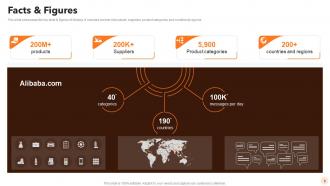
Slide 8: This slide showcases the key facts & figures of Alibaba. It includes number of products, suppliers, product categories and countries & regions.
Slide 9: This slide showcases the global presence of Alibaba. It includes countries such as UK, Germany, France, U.S, India, Italy, Taipei, Japan, Hong Kong.
Slide 10: This slide showcases the key members of management board with their designation roles.
Slide 11: This slide showcases the organization structure of Alibaba.
Slide 12: This slide showcases the Alibaba ecosystem. It includes segments such as China commerce, International commerce, Local consumer services.
Slide 13: This slide showcases the milestones achieved by Alibaba.
Slide 14: This slide showcases the combined shareholding pattern of Alibaba.
Slide 15: This slide showcases the number of employees on Alibaba.
Slide 16: This slide focuses on business model canvas of Alibaba. It covers key partners, key activities, value proposition, customer relationships, customer segments.
Slide 17: This slide showcases the Alibaba competitors. It includes companies such as aliexpress.com, JD.com, Flipkart, Amazon, Tencent and ebay.
Slide 18: This slide showcases the Alibaba competitors comparison. It includes key metrics such as number of employees, founding year, valuation, revenue, net income.
Slide 19: This slide showcases the key financial metrics of china commerce segment.
Slide 20: This slide showcases the key financial metrics of International commerce segment.
Slide 21: This slide showcases the key financial metrics of Local consumer services segment.
Slide 22: This slide showcases the key financial metrics of Logistics segment. It includes financial metrics such as revenue, Income, EBITDA and EBITDA margin.
Slide 23: This slide showcases the key financial metrics of Cloud commerce segment.
Slide 24: This slide showcases the key financial metrics of Digital media & entertainment commerce segment.
Slide 25: This slide showcases the key financial metrics of Innovative initiatives & others segment.
Slide 26: This slide showcases the Global statistical data of expenses of Alibaba.
Slide 27: This slide showcases the revenue of Alibaba. Total revenue is total amount of money that a company earns through the selling of its goods and services.
Slide 28: This slide showcases the net income of Alibaba. Net income is the money that's left over after paying operating expenses, administrative costs.
Slide 29: This slide represents the balance sheet financials (Assets) of Alibaba. It includes elements such as current assets and total assets.
Slide 30: This slide represents the balance sheet financials (Liabilities) of Alibaba. It includes elements such as current liabilities, shareholders equity.
Slide 31: This slide represents the cash flow statement of Alibaba. It includes elements such as operating activities, investing activities, finance activities.
Slide 32: This slide showcases the total number of deals done by Alibaba. It includes total number of deals in five years and also the total value of deals in every year.
Slide 33: This slide showcases the latest deals Alibaba. It includes deal type such venture financing and the partner/Issuer/target are Beijing Zhongce Zhihui Technology Co.
Slide 34: This slide showcases the key financial chart of Alibaba. It includes sales growth and net income growth of five years.
Slide 35: This slide showcases the merger and acquisition of Alibaba in different years.
Slide 36: This slide focuses on strengths to evaluate competitive position of company.
Slide 37: This slide focuses on weakness to evaluate competitive position of company.
Slide 38: This slide focuses on opportunities to evaluate competitive position of company.
Slide 39: This slide focuses on Threats to evaluate competitive position of company.
Slide 40: This slide showcases the glimpse of sustainability report of Alibaba.
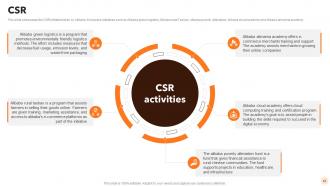
Slide 41: This slide showcases the CSR initiative taken by Alibaba.
Slide 42: The following slide highlights the various platforms to follow and contact Walmart.
Slide 43: This slide shows all the icons included in the presentation.
Slide 44: This slide is titled as Additional Slides for moving forward.
Slide 45: This slide shows Post It Notes for reminders and deadlines. Post your important notes here.
Slide 46: This slide showcases Magnifying Glass to highlight, minute details, information, specifications etc.
Slide 47: This is a Timeline slide. Show data related to time intervals here.
Slide 48: This slide depicts Venn diagram with text boxes.
Slide 49: This slide contains Puzzle with related icons and text.
Slide 50: This is a Thank You slide with address, contact numbers and email address.
Alibaba Company Profile Powerpoint Presentation Slides CP CD with all 58 slides:
Use our Alibaba Company Profile Powerpoint Presentation Slides CP CD to effectively help you save your valuable time. They are readymade to fit into any presentation structure.














FAQs for Alibaba Company Profile Powerpoint Presentation
Dude, Jack Ma was honestly a genius - he started Taobao in 2003 to take on eBay, then dropped Alipay the next year which basically invented digital payments in China. That $25 billion IPO in 2014? Still holds records I'm pretty sure. But here's the thing - Ma saw the potential way back in '99 when like nobody in China was even online yet. Smart move was building whole ecosystems instead of just single products. They didn't stop at e-commerce either, branching into cloud stuff, logistics, going global. That ecosystem approach is what really separated them from everyone else trying to compete.
So Alibaba's totally different from Amazon - they don't actually sell anything themselves. Think of it more like they're running this huge digital mall where other people set up shop. They just connect buyers and sellers, take their cut, then call it a day. Pretty smart if you ask me! Most of their money comes from ads, commissions, and subscription fees instead of marking up products. Since they're not dealing with warehouses and shipping headaches, their profit margins are way better than regular retailers. Oh and their overhead costs are way lower too, which probably explains why their stock does so well.
So Alibaba Cloud is basically their Amazon AWS move, right? They're trying to break out of just being a Chinese shopping site. Smart move honestly - that retail market's getting pretty crowded. The cloud stuff helps them make money from totally different sources, plus it runs all their other businesses like payments and shipping. Revenue-wise, it's growing super fast outside China. Oh and here's the thing - if you want to see whether Alibaba's actually transforming into something bigger, just watch their cloud numbers. That'll tell you everything about where they're headed long-term.
So Alibaba basically went global by buying up companies and making smart partnerships. They snagged Lazada in Southeast Asia, which was huge. AliExpress was their main play for international consumers - honestly worked way better than I expected. They dumped tons of money into logistics everywhere and built out cloud services too. Smart move focusing on emerging markets where they could copy what worked in China. Oh, and they partner with local companies to deal with all the regulatory headaches. If you're digging into this, definitely check out their Southeast Asia expansion first.
Dude, Alibaba's getting hit from all sides right now. Competition is brutal - ByteDance and Tencent keep stealing their customers, plus all these smaller companies popping up everywhere. The government stuff is probably worse though. They got slapped with huge antitrust fines and had to completely restructure their business. That whole crackdown was pretty intense. Chinese consumers aren't spending as much since COVID either, which obviously sucks for an e-commerce company. Tech giants there are having a rough time lately. If you're thinking about their stock or whatever, just watch how they handle all these new regulations first.
So Alibaba's whole thing is connecting small businesses to global buyers - pretty smart actually. Your clients can list on Alibaba.com or Taobao to reach millions of people worldwide. They handle logistics too, which is clutch since shipping internationally is such a pain. Plus they've got financing options (super helpful when cash is tight) and analytics to see what's actually selling. I mean, they basically made it possible for tiny companies to compete globally. Worth looking into their seller fees though - that stuff adds up quick. But yeah, their resources are solid if you're working with smaller businesses.
Dude, Alibaba's tech game is insane. They basically turned shopping into this AI-powered machine - everything from personalized recommendations to warehouses run by robots. Alipay completely killed cash in China (like, my friends there haven't touched paper money in years). Their cloud platform is massive too. What's really smart is how they blend online and offline stores using data analytics and IoT sensors. Oh, and their supply chain optimization is next level - machine learning handles most of it now. Honestly, if you're studying digital transformation, they're the perfect case study for integrating AI everywhere.
So Alibaba's logistics thing is pretty smart - they're not just a marketplace anymore. Through Cainiao, they control the whole delivery process, which means faster shipping and better customer experience. That's where the real money is tbh. Instead of relying on other companies for shipping, they own it all. Competitors can't really match their delivery speeds now, which is huge. I honestly think this logistics network is their biggest competitive advantage - way more defensible than just connecting buyers and sellers. It's like they've built this whole ecosystem that's really hard to compete against.
So Alibaba went all-in on digital stuff during COVID. They pushed their "New Retail" thing way harder - you know, mixing online and physical stores. Livestream shopping became huge for them (like QVC but actually fun to watch). Their grocery delivery through Freshippo stores exploded too. Cloud services was another big bet since everyone suddenly needed that infrastructure. Smart part? They didn't just react - they figured hybrid shopping and instant delivery weren't going anywhere. Now they're using AI to personalize everything, which honestly makes sense given all the data they have.
So basically Alibaba hoovers up tons of user data and has to share it with Beijing because of China's data laws. Their privacy policies are pretty vague about what they collect from buyers and sellers. Cross-border transfers get weird too - honestly half the time you can't tell where your info ends up or how long they keep it. I'd say their terms are deliberately confusing? Just make sure you're cool with whatever personal stuff you're handing over before you start using their platforms. Worth reading the fine print first.
Honestly, Alibaba's pretty smart about this whole Amazon thing. They're not trying to beat them everywhere - just focusing on what they're already crushing at. China's their playground, and they've built this crazy ecosystem where everything connects. You've got Alipay, cloud stuff, logistics, all wrapped up together. Amazon's more about going global fast, but Alibaba perfects their home base first. Then they slowly move into places like Southeast Asia. The wholesale thing is huge too - directly connecting manufacturers with buyers while Amazon's doing more retail stuff. It's actually kind of genius when you think about it.
So Singles' Day is Alibaba's huge shopping event every November 11th - think Black Friday but absolutely massive. We're talking tens of billions in sales in just 24 hours, which honestly blows my mind every time I see the numbers. It's way bigger than Black Friday and Cyber Monday put together at this point. For Alibaba, it's their biggest money maker and shows they can handle crazy traffic without crashing. If you're looking at e-commerce trends or thinking about the Chinese market, those Singles' Day numbers are pretty much the gold standard for measuring digital commerce scale.
Okay so Alibaba basically built social stuff right into their shopping apps instead of relying on outside platforms. Like on Taobao you've got livestreams, reviews, chat with sellers - all in one place. Smart move honestly, keeps people from bouncing around. They do use WeChat and influencers too, but the real win is when someone discovers something socially and can buy it instantly without leaving the app. I swear their livestream shopping thing is addictive lol. For you, maybe think less about traditional social ads and more about making the actual shopping experience feel social and interactive?
Alibaba's got some wild partnerships going on. Starbucks for digital stuff, Ford and GM for car tech. The luxury brand deals like Burberry are smart moves too. What's crazy is they're pushing hard into healthcare - partnering with Merck and others. Obviously there's the logistics side with Cainiao, plus tons of cloud deals. Honestly, it makes sense when you think about it - they're trying to get out of just being "China's Amazon" and diversify. These partnerships are basically their ticket to global expansion and new revenue streams beyond e-commerce.
Yeah, Alibaba got absolutely hammered by all the regulatory stuff. Billions in fines, forced to sell off parts of their business - it's been brutal for anyone holding the stock. Their whole expansion strategy basically got derailed and margins are still hurting from compliance costs. But they're pivoting hard into international markets and cloud services now, which honestly makes sense since there's way less regulatory drama there. I mean, they had to do something, right? If you're considering buying in, I'd probably wait another quarter or two to see if these compliance expenses level out first.
-
“Slides are formally built and the color theme is also very exciting. This went perfectly with my needs and saved a good amount of time.”
-
I am not the best at presentations but using SlideTeam’s PPT template made it easier for me. Thank you SlideTeam!