


AML Transaction Risks Monitoring Dashboard Ppt Powerpoint Presentation File Smartart




Try Before you Buy Download Free Sample Product
 Impress Your
 Audience
 100%
100% Editable
 Save Hours
 of Time


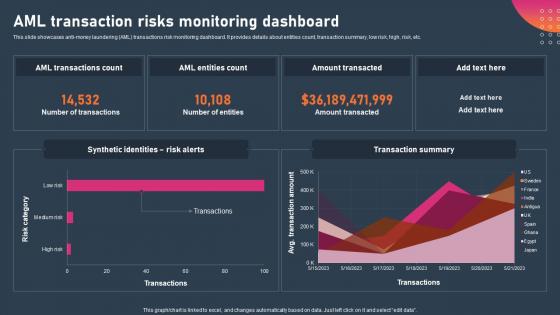
This slide showcases anti money laundering AML transactions risk monitoring dashboard. It provides details about entities count, transaction summary, low risk, high, risk, etc.
People who downloaded this PowerPoint presentation also viewed the following :
AML Transaction Risks Monitoring Dashboard Ppt Powerpoint Presentation File Smartart with all 7 slides:
Use our AML Transaction Risks Monitoring Dashboard Ppt Powerpoint Presentation File Smartart to effectively help you save your valuable time. They are readymade to fit into any presentation structure.






FAQs for AML Transaction Risks Monitoring Dashboard Ppt Powerpoint
Watch out for weird transaction stuff - like someone suddenly dumping huge cash deposits or moving money around really fast between accounts. Structuring is a big one too, where they keep amounts just under reporting limits. Geography matters a ton - transfers to sketchy countries or anywhere on sanctions lists. I'd also flag when customer behavior doesn't match their profile, you know? Like some tiny business suddenly wiring way more than usual, or personal accounts acting like commercial ones. Round numbers are pretty obvious red flags. Set up automatic monitoring for this stuff, but honestly you still gotta dig into the context behind each alert.
So ML is pretty game-changing for AML stuff. Your old rule-based system probably just flags anything over $10K, right? But machine learning looks at like hundreds of things at once - when transactions happen, what merchants, location patterns, how customer behavior shifts. It's wild how much it can process. The algorithms actually learn from mistakes too, so you get way fewer false positives cluttering your workload. Plus they catch the sneaky laundering schemes that slip past traditional systems. Honestly, I'd start small - maybe pilot it on your riskiest transaction types first and see how it goes.
So basically, transaction volume shows you when people are acting weird with their money. You gotta watch for sudden changes - like someone who usually moves $500 a month suddenly doing $50K transfers. That's sketchy as hell. The trick is figuring out what's "normal" for each customer first. Then when they go off-script, you'll catch it. Set your alerts based on their usual patterns and risk level. Honestly, it's one of the easier red flags to spot once you get the hang of it.
Honestly, you've gotta make AML training way more hands-on than those boring compliance manuals nobody reads. Use real case studies and role-play scenarios - that stuff actually sticks. Have your experienced people mentor the newbies during actual monitoring sessions. Mix in regular refreshers since regulations change constantly (which is annoying but whatever). The biggest thing though? Clear escalation procedures so when someone spots something fishy, they know exactly who to call and what steps to take. Interactive beats theoretical every single time.
Dude, don't mess around with this stuff. Missing suspicious transaction reports can totally destroy a bank - I'm talking huge fines, criminal charges for the big shots, and they'll literally revoke your license. Regulators treat it like you're helping launder money on purpose. Your institution gets hit with compliance violations costing millions, plus the reputation damage is brutal and takes forever to fix. Oh, and individual employees can get personally screwed too if there's criminal stuff going on. Honestly? Just file the SAR when you're unsure. Way better to report too much than miss something important.
Each country has totally different AML rules, so you'll have to tweak your monitoring thresholds for each one. The EU is super strict about beneficial ownership - way more due diligence required there. Singapore's really focused on cross-border wires specifically. Honestly, some places are just more chill about certain transaction types than others, depends on their risk appetite. Reporting deadlines are all over the map too - could be 24 hours or several days. Your system needs to handle the strictest requirements wherever you're operating, which can be a pain but that's compliance for you.
You'll want to look at machine learning first - it catches stuff that would fly right past manual reviews. Rule-based systems work too, but they're pretty inflexible once fraudsters change tactics. Graph analytics are actually really cool for this, they map out all the weird connections between accounts that shouldn't exist. Oh, and get something with real-time processing like Kafka so you're not finding out about problems three days late. Honestly though? Don't put all your eggs in one basket. I'd probably start with ML that builds on whatever rules you've got now.
So behavioral analytics build profiles of what's "normal" for each customer - transaction amounts, timing, who they send money to, all that stuff. When someone breaks their usual pattern, boom, it gets flagged. Like if your customer who always does tiny local transfers suddenly wires $50k overseas, the system's gonna catch that. Way smarter than those old static rules that fraudsters could game easily. Honestly, this context is gold when you're digging into alerts - you'll actually understand *why* something triggered instead of just seeing a random flag. Makes investigations way more efficient.
Honestly, cross-border AML is such a pain because every country has totally different rules and thresholds for what counts as "suspicious." Your monitoring system basically has to play by everyone's book at once. Different currencies, reporting deadlines across time zones, language issues when you're digging into alerts - it's a mess. The worst part? Data sharing restrictions mean sometimes you literally can't get the customer details needed to close a case. Super frustrating. I'd start by mapping out requirements for your main corridors, then just build everything around whoever has the strictest rules. Way easier than trying to customize for each jurisdiction.
Honestly, smart segmentation is where you'll see the biggest wins. Let your low-risk customers breeze through while flagging the sketchy stuff for review. Machine learning helps cut down false positives - there's nothing worse than getting your card rejected at Target because the system had a meltdown. I'd tune those thresholds based on how your actual customers behave and their transaction patterns. Speed matters too when you do catch something suspicious. Nobody should wait around for days to prove they really did buy that coffee maker.
So blockchain gives you this permanent record that can't be changed after it's written - super helpful for AML compliance. You can trace the whole transaction history and spot weird patterns that might flag suspicious stuff. Public blockchains are totally transparent, but honestly privacy coins are kind of a nightmare for this work. The cool part is seeing how money flows between different addresses. You should check out some blockchain analytics tools - they're pretty solid for tracking transactions and catching red flags. Way better than trying to piece things together manually.
Yeah, false positives are the worst. Your analysts end up drowning in alerts for totally normal transactions while the real sketchy stuff sits in a backlog somewhere. I've seen teams burn out so fast from this - it's honestly depressing. What kills me is you're paying people to chase ghosts instead of catching actual money laundering. Short sentences here really help: tune your rules constantly. Even tweaking thresholds by small amounts can save hours each week. The math works out crazy fast when you multiply saved time across your whole team.
First thing I'd do is ditch those generic alert thresholds and tune them based on what actually looks suspicious in your data. Customer segmentation makes a huge difference too - like you said, 10k hits way different depending on who's moving it. Run some backtesting on cases you already know were dirty to see what your current setup missed. Machine learning definitely helps cut down false positives, but honestly it's a pain to set up right initially. Keep tweaking your rules as new schemes pop up and investigators give you feedback. Oh, and threshold optimization is probably your easiest quick win to start with.
Look at your detection rates first - are you catching suspicious stuff or missing things regulators find later? False positives matter too since your analysts will go crazy with useless alerts. How long do investigations take? That's huge. Training completion rates, escalation numbers to law enforcement, exam findings from regulators - all good indicators. Honestly, enforcement actions are the scariest metric but they tell you everything about gaps. Oh, and focus on trends over months, not just snapshots. You'll spot patterns that way.
So basically you want everyone feeling ownership over this, not just dumping it on compliance folks. Skip those soul-crushing hour-long training sessions - nobody retains that garbage anyway. Get leadership actually talking about it regularly, not just paying lip service. Clear escalation paths are huge so people aren't like "um, who do I even tell about this sketchy transaction?" Here's the thing though - you've gotta celebrate the people who speak up, even when it turns out to be nothing. Monthly team chats about real scenarios work well too. People need to understand why they're doing this stuff beyond just "because regulations."
-
A library of engaging, customizable and content-ready templates.
-
Incredibly beautiful designs that will help you get noticed! These eye-catching templates are perfect for corporate presentations that can be altered to fit any occasion or taste.