


Analyzing Cloud Based Service Cloud Services Offered By Amazon Web Services




Try Before you Buy Download Free Sample Product
 Impress Your
 Audience
 100%
100% Editable
 Save Hours
 of Time


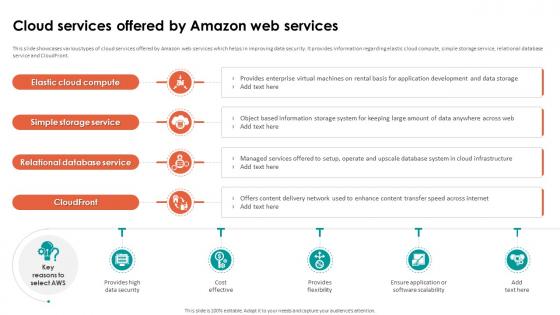
This slide showcases various types of cloud services offered by Amazon web services which helps in improving data security. It provides information regarding elastic cloud compute, simple storage service, relational database service and CloudFront.
People who downloaded this PowerPoint presentation also viewed the following :
Analyzing Cloud Based Service Cloud Services Offered By Amazon Web Services with all 9 slides:
Use our Analyzing Cloud Based Service Cloud Services Offered By Amazon Web Services to effectively help you save your valuable time. They are readymade to fit into any presentation structure.








FAQs for Analyzing Cloud Based Service Cloud Services Offered By
AWS Cloud Services deliver cost efficiency, scalability, enhanced security, operational flexibility, and global accessibility, enabling businesses to reduce infrastructure investments while maintaining enterprise-grade capabilities. From startups leveraging pay-as-you-scale models to Fortune 500 companies optimizing global operations, organizations streamline resource allocation, accelerate innovation cycles, and enhance competitive positioning through reliable, on-demand computing power.
AWS ensures data security through multi-layered encryption, identity access management, network security controls, continuous monitoring, and compliance certifications like SOC, ISO, and HIPAA. These security frameworks enable organizations across healthcare, finance, and government sectors to maintain regulatory compliance while leveraging cloud scalability, ultimately delivering enhanced data protection and operational efficiency.
AWS EC2 provides virtual servers with full control over operating systems, configurations, and persistent infrastructure, while Lambda offers serverless computing that automatically executes code without server management. EC2 suits applications requiring continuous operation and custom environments, whereas Lambda excels for event-driven tasks, microservices, and periodic functions, with organizations finding that Lambda significantly reduces operational overhead and costs for intermittent workloads.
AWS pricing operates on a pay-as-you-use model, charging for compute time, storage capacity, data transfer, and specific services consumed. Businesses optimize costs through reserved instances, auto-scaling, resource tagging, and regular usage audits, with many organizations finding that strategic resource allocation and automated scaling reduce expenses by 20-40% while maintaining performance.
AWS S3 serves diverse use cases including data backup and archiving, content distribution, data lakes for analytics, static website hosting, and disaster recovery across industries like media, healthcare, and e-commerce. Unlike traditional storage solutions, S3 delivers virtually unlimited scalability, pay-as-you-use pricing, and global accessibility, with many organizations finding significant cost reductions and enhanced operational efficiency.
Organizations can leverage AWS for disaster recovery through automated backup services, cross-region data replication, scalable storage solutions, and rapid failover capabilities that minimize downtime. AWS enables businesses to create cost-effective DR strategies by storing critical data across multiple availability zones, with many financial institutions and healthcare organizations finding that cloud-based recovery reduces costs while delivering faster restoration times and enhanced operational resilience.
AWS CloudFormation enables organizations to define, deploy, and manage cloud infrastructure through code templates, automating resource provisioning while ensuring consistency and repeatability across environments. This infrastructure-as-code approach streamlines operations by eliminating manual configurations, reducing deployment errors, and enabling version control, with many enterprises finding that CloudFormation significantly accelerates scaling while maintaining governance and cost optimization across their AWS environments.
AWS enables businesses to integrate machine learning through services like Amazon SageMaker, Rekognition, Comprehend, Polly, and Lex, which streamline model development, deployment, and management. These cloud-based tools help organizations automate processes, enhance customer experiences, and gain predictive insights without extensive ML expertise, ultimately delivering faster innovation and competitive advantage across industries.
Best practices for monitoring AWS applications include implementing CloudWatch metrics and alarms, utilizing AWS X-Ray for distributed tracing, establishing centralized logging with CloudWatch Logs, configuring automated scaling policies, and deploying comprehensive health checks across services. These practices enable organizations to proactively identify performance bottlenecks, reduce downtime, and optimize resource costs, with many enterprises finding that strategic monitoring delivers enhanced application reliability and improved user experiences.
AWS facilitates hybrid cloud solutions through services like AWS Direct Connect, AWS Outposts, and AWS Storage Gateway, enabling seamless integration between on-premises infrastructure and cloud resources. These technologies streamline data synchronization, application portability, and workload management, with many financial institutions and healthcare organizations finding that hybrid approaches deliver enhanced security, regulatory compliance, and operational flexibility.
AWS provides comprehensive big data analytics tools including Amazon Redshift for data warehousing, EMR for processing, Kinesis for real-time streaming, Glue for ETL operations, and QuickSight for visualization. These services compete effectively through deep integration capabilities, extensive machine learning features, and scalable pricing models, with many enterprises finding that AWS's mature ecosystem and broad partner network deliver faster implementation timelines and enhanced operational efficiency compared to alternative cloud platforms.
AWS's serverless architecture enables developers to build applications without managing infrastructure, utilizing services like Lambda, API Gateway, DynamoDB, and S3 for automatic scaling and resource management. This approach streamlines development cycles by reducing operational overhead, accelerating deployment processes, and minimizing costs through pay-per-use models, with many organizations finding enhanced agility and faster time-to-market.
AWS Global Accelerator delivers improved application performance through reduced latency, enhanced availability, simplified traffic management, automatic failover capabilities, and optimized routing via AWS's global network infrastructure. By directing traffic through AWS edge locations and utilizing anycast IP addresses, organizations experience faster user connections, seamless geographic distribution, and enhanced reliability, ultimately delivering superior customer experiences across global markets.
AWS IAM features control user permissions through role-based access controls, multi-factor authentication, policy management, and granular permission settings. These security mechanisms enable organizations to streamline access governance by defining specific user roles, automating permission workflows, and monitoring access patterns, ultimately delivering enhanced security compliance and operational efficiency across cloud environments.
Emerging cloud computing trends include edge computing, serverless architectures, AI/ML integration, multi-cloud strategies, and enhanced security frameworks. AWS leads these developments through services like Lambda Edge, SageMaker, and GuardDuty, enabling organizations to streamline operations, reduce infrastructure costs, and accelerate digital transformation, with many enterprises finding these technologies deliver significant competitive advantages.
-
It is my first time working with them and that too on a friend's recommendation. I would say, I am not expecting such a worldly service at this low price.
-
Editable templates with innovative design and color combination.