


Android RPA Powerpoint Ppt Template Bundles





Try Before you Buy Download Free Sample Product
 Impress Your
 Audience
 100%
100% Editable
 Save Hours
 of Time


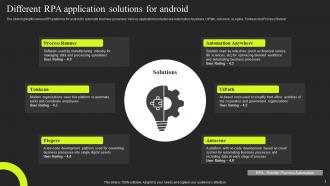
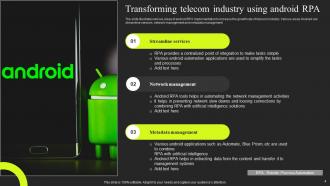
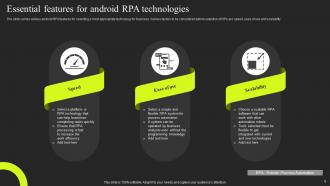
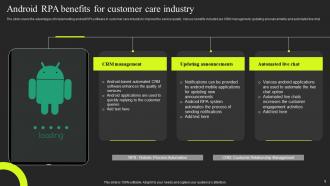
Introducing our cutting-edge Android RPA PowerPoint Presentation PPT, a comprehensive guide to leveraging Robotic Process Automation RPA tools on the Android platform. This engaging presentation explores the applications of Android RPA in streamlining processes, enhancing productivity, and optimizing workflows. We delve into the top RPA tools compatible with Android through detailed comparative analysis, highlighting their unique features and functionalities. Our RPA PPT further equips you with insights on seamless implementation strategies, empowering your organization to harness the full potential of Android RPA.
People who downloaded this PowerPoint presentation also viewed the following :
Android RPA Powerpoint Ppt Template Bundles with all 17 slides:
Use our Android RPA Powerpoint Ppt Template Bundles to effectively help you save your valuable time. They are readymade to fit into any presentation structure.











FAQs for Android RPA Powerpoint
Android RPA integration delivers enhanced operational efficiency, streamlined mobile-first processes, reduced manual errors, improved customer response times, and seamless cross-platform automation capabilities. Through automated mobile workflows, organizations in retail, banking, and logistics achieve faster customer service delivery, lower operational costs, and improved data accuracy, ultimately gaining competitive advantage in increasingly mobile-driven business environments.
Android RPA enhances mobile development by automating testing processes, streamlining deployment workflows, and accelerating quality assurance cycles across different device configurations. Through intelligent automation, development teams reduce manual testing time, minimize human errors, and deliver consistent user experiences, with many mobile-first companies finding that automated workflows significantly improve app reliability and faster release cycles.
Organizations face challenges including device fragmentation across Android versions, complex integration with existing enterprise systems, security concerns around automated access, skill gaps in RPA development, and scalability issues. While these present implementation hurdles, many enterprises find that strategic planning, phased rollouts, and comprehensive training programs enable successful Android RPA adoption, ultimately delivering streamlined mobile operations and enhanced productivity.
Android RPA improves data accuracy by automating data entry, validation, and transfer processes, eliminating manual transcription errors and inconsistencies. Through automated workflows on mobile devices, businesses streamline inventory management, customer data updates, and field reporting, with many retail and logistics companies finding significantly reduced error rates and enhanced operational efficiency.
Healthcare, banking, retail, logistics, and manufacturing are experiencing transformative results from Android RPA implementation, with mobile-first operations driving adoption. These sectors leverage Android automation for patient check-ins, mobile banking processes, inventory management, and field service operations, ultimately delivering faster customer experiences, reduced operational costs, and enhanced service accessibility across distributed mobile workforces.
Android RPA offers greater flexibility than traditional solutions by enabling automation across mobile environments, cloud-based deployments, and diverse device ecosystems, while typically requiring lower infrastructure investments. Unlike desktop-bound traditional RPA, Android RPA scales seamlessly across organizations without expensive server setups, with many businesses finding significantly reduced implementation costs and enhanced operational agility.
Android RPA development relies on tools like UiAutomator, Appium, Robotium, Espresso, and MonkeyRunner for automated testing and interaction. These technologies streamline mobile app automation by enabling cross-platform compatibility, robust element identification, and seamless integration with CI/CD pipelines, with many enterprises finding significant efficiency gains in mobile testing workflows.
Businesses measure Android RPA ROI by calculating cost savings from reduced manual labor, faster processing times, and decreased error rates against implementation costs. Organizations typically track metrics like transaction processing speed, employee productivity gains, and customer satisfaction improvements, with many finding that Android RPA delivers measurable returns within six to twelve months through streamlined mobile workflows.
AI enhances Android RPA by enabling intelligent decision-making, natural language processing, computer vision, and adaptive learning capabilities that go beyond simple rule-based automation. Through machine learning algorithms, Android RPA systems can handle complex scenarios, recognize patterns in mobile interfaces, and optimize workflows dynamically, ultimately delivering more sophisticated automation and reducing manual intervention requirements.
Android RPA supports real-time data processing by continuously capturing, extracting, and analyzing data from mobile applications, APIs, and user interactions without manual intervention. These automated systems streamline data workflows, enable instant decision-making, and deliver immediate insights across industries like banking, retail, and healthcare, ultimately enhancing operational efficiency and competitive advantage.
Best practices for scaling Android RPA solutions include establishing standardized development frameworks, implementing centralized governance models, creating reusable automation templates, ensuring robust security protocols, and developing comprehensive training programs. These approaches streamline deployment by minimizing development time, maintaining consistency across departments, and reducing operational risks, with many organizations finding that strategic scaling ultimately delivers faster ROI and enhanced competitive advantage.
Security and compliance concerns significantly impact Android RPA deployment by requiring robust authentication protocols, encrypted data transmission, and adherence to regulatory frameworks like GDPR and HIPAA. Organizations must implement comprehensive access controls, audit trails, and vulnerability assessments, with many financial institutions and healthcare providers finding that strategic security planning ultimately enables faster, more trusted automation while maintaining regulatory compliance.
Essential skills for Android RPA developers include mobile automation frameworks, Android SDK proficiency, Java/Kotlin programming, UI testing tools like Espresso, and understanding of device fragmentation challenges. These technical competencies enable developers to create robust automation solutions across diverse Android environments, with many organizations finding that combining mobile development expertise with RPA knowledge delivers significantly faster app testing, streamlined deployment processes, and enhanced user experience validation.
Organizations ensure successful Android RPA integration with legacy systems through comprehensive API mapping, middleware solutions, and phased deployment strategies that minimize operational disruption. By conducting thorough system audits, establishing robust data validation protocols, and implementing fallback mechanisms, companies in manufacturing, healthcare, and financial services streamline workflows while maintaining system stability and regulatory compliance.
Future trends in Android RPA include enhanced AI integration, cloud-based deployment models, low-code development platforms, cross-platform compatibility, and advanced analytics capabilities. These developments streamline mobile automation by reducing implementation complexity, enabling faster deployment, and delivering sophisticated process intelligence, with many organizations finding that strategic Android RPA adoption ultimately provides significant competitive advantage in increasingly mobile-centric business environments.
-
“Detailed and great to save your time.”
-
It saves your time and decrease your efforts in half.