

Rpa powerpoint presentation slides






Try Before you Buy Download Free Sample Product
 Impress Your
 Audience
 100%
100% Editable
 Save Hours
 of Time


Complete tasks on time and with efficiency using content-ready RPA PowerPoint presentation Slides. Incorporate professionally designed robotic process automation PPT templates to handle high volume tasks. From queries to calculations, rpa PPT slides calculate and maintain the records, data and transactions. IT firms can implement the technology efficiently using rpa PowerPoint presentation slideshow. Without changing the infrastructure and system, companies can enhance technologies advancement. This rpa PowerPoint complete presentation comprises of templates such as rpa steps, rpa drivers, rpa spectrum, rpa journey, rpa cycle, etc. Also known as software robot or bot, these templates are completely customizable. Change color, text, icon and font size as per your need. Add ore remove the content from the presentation, if needed. Grab this ready-made rpa PowerPoint presentation templates to bring a successful digital transformation. Let your processes be completed rapidly and efficiently, create cost savings for manual, enable employees to be more productive, etc, with the help of rpa PPT slides. Experience the comfort our Rpa Powerpoint Presentation Slides bring. It eliminates a lot of hassles.
People who downloaded this PowerPoint presentation also viewed the following :
Content of this Powerpoint Presentation
Robotic Process Automation (RPA) is a new concept that has won plaudits and business backing due to the speed and efficiency it brings to the table. The RPA technology automates and increases the pace at which businesses can handle repetitive and tedious activities. It is akin to designing a process that ensures tedium-filled activities do not have to be repeated manually by humans, something we find very difficult.
RPA is growing at a rapid pace due to the fact that it saves time and labor for businesses.
Our RPA PPT templates are designed to improve your technological transitions for maximum optimization and smoothing of business workflows. This 100% editable and customizable set includes slides on RPA steps, drivers, spectrum, journey, and cycle — each ready for you to adjust to your company's branding with editable colors, text, and icons.
Use these ready-to-use templates to spearhead your company's digital initiatives to save costs, increase efficiency, and boost productivity. Above all the modern technologies being used, our RPA Slides ensure that in your corporate presentations, simplicity and convenience are delivered for getting the work done quickly by process automation or optimization. Experience the comfort and clarity our RPA PowerPoint Presentation Slides provide, and start on the road to an easy automation journey.
Upgrade your financial services with our "Fraud Detection Automation Roadmap in RPA Cognitive Automation" slide. Download now and start on the way to an automated, self-improving business process.
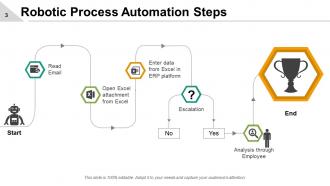
Template 1: Robotic Process Automation Steps

Knowing workflows is important, and this PPT Slide illustrates how RPA improves and automates tasks where email and data management become critical. The flowchart here moves from 'Start,' to 'Read Email,', showing the automation's ability to handle emails. Open Excel attachment from Excel is the next step, where the system works with data from Excel files. After that, data is 'Entered from Excel in ERP platform,' showing RPA's smooth data transfer abilities. An important 'Escalation' decision point checks if human analysis is needed; if yes, it goes to 'Analysis through Employee’. The workflow ends with an 'End' trophy icon, marking the successful finish of the process. This changeable slide is made to draw in audiences, giving a clear visual guide of RPA steps in business presentations and creates a balanced mix of automated systems and human input.
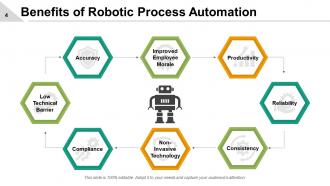
Template 2: Benefits of Robotic Process Automation

In a unique design, this PPT Template showcases the advantages of RPA with a central robot icon surrounded by seven hexagons, each showing a different benefit. The first of these is "accuracy," for the precision of automated processes; "Improved Employee Morale," for the better well-being of staff; "Productivity," for increased work efficiency; "Reliability," for consistent performance; "Consistency," for standard output; "Low Technical Barrier," for easy adoption; and "Non-Invasive Technology," for compatibility with existing systems.
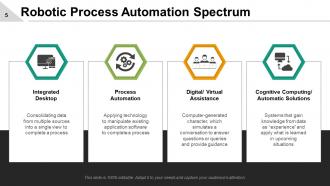
Template 3: Robotic Process Automation Spectrum
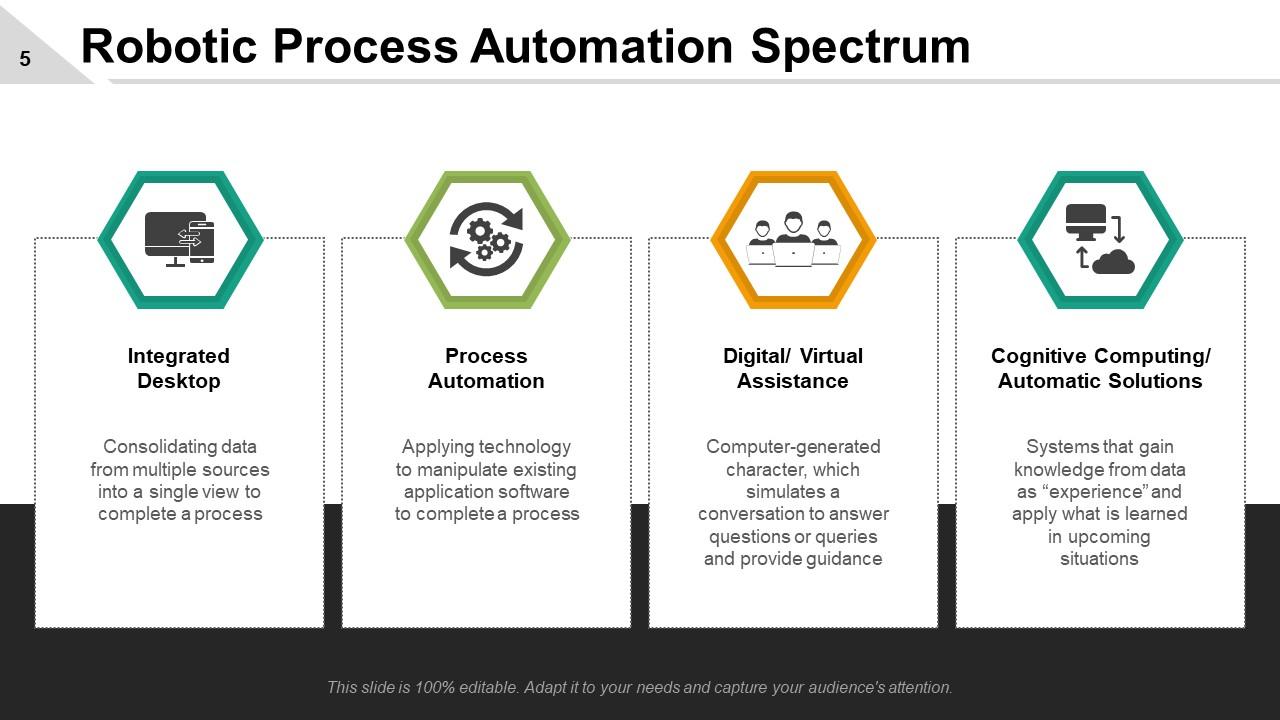
This visual guide showcases the stages of automation technologies, split into four main groups. Starting with the "Integrated Desktop," which makes it easier to carry out tasks by bringing together data from sources into one interface, it moves on to "Process Automation," where technology is used to improve existing software. The journey continues with "Digital/Virtual Assistance," which shows computer-made characters that can talk to people. In the final stage, "Cognitive Computing/Automatic Solutions," we refer to systems that can learn from data and use that knowledge for tasks. This template is a thorough way to teach audiences about the range and possibilities of RPA in today's business world.
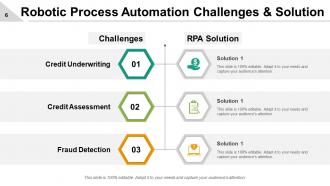
Template 4: Robotic Process Automation Challenges & Solution
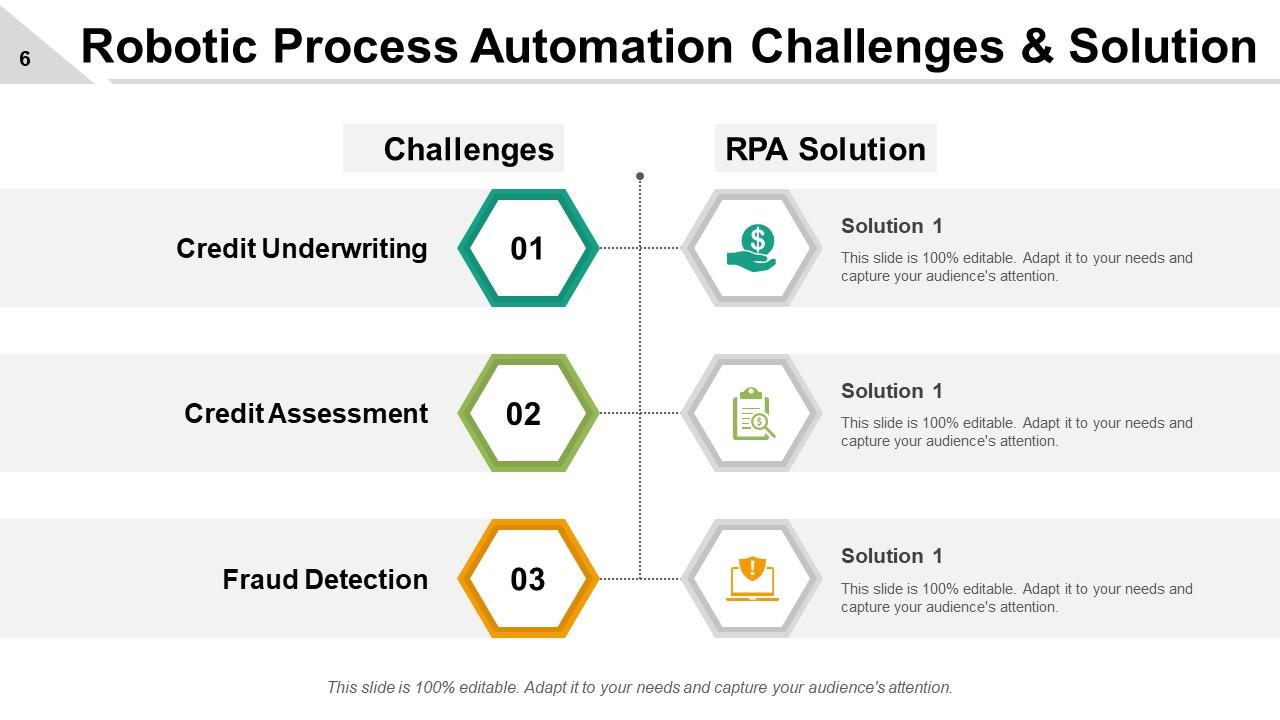
RPA is like a match made in heaven for certain tasks like the underwriting of credit, credit assessment and fraud detection. This PPT Template acts as the perfect solution to ensure businesses understand and implement RPA in these tasks and more. The color-coded design offers solutions and connects the remedy to the problem. Financial institutions find this slide effective in depicting how RPA works in making processes simpler, and ensuring they can always find a better way to do things.
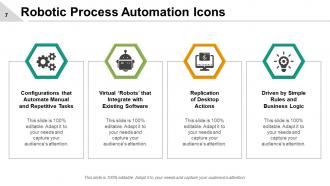
Template 5: Robotic Process Automation Icons

This template explains the main functions of RPA using four icons. It begins with settings that make manual and repetitive tasks more efficient, showing RPA's ability to make time-consuming processes quicker. Next, virtual robots show how RPA can easily work with existing software, depicting how things run without needing big changes to the system. Then, the slide shows how RPA can copy actions done on a computer, demonstrating that software robots can act like humans when using applications. Lastly, the template highlights that RPA works based on clear rules and business logic that guide how tasks are done. Maximize your business's potential with RPA! Check out our Core Capabilities of RPA Center of Excellence Operating Framework slides to make your processes more efficient. Download now to improve your operations!
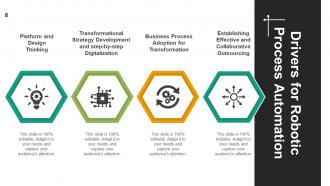
Template 6: Drivers for Robotic Process Automation

Use this PPT Template to depict important parts needed for the successful use of RPA in a company. It includes four main parts: 'Platform and Design Thinking' to encourage new ideas, 'Transformational Strategy Development' for step-by-step digital change, 'Business Process Adoption' to make RPA a part of daily work, and 'Effective and Collaborative Outsourcing' to make the most of working with outside partners. The icons are self-explanatory, adding to the appeal of the process; the slide also explains how to operationalize it.
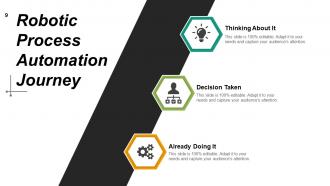
Template 7: Robotic Process Automation Journey
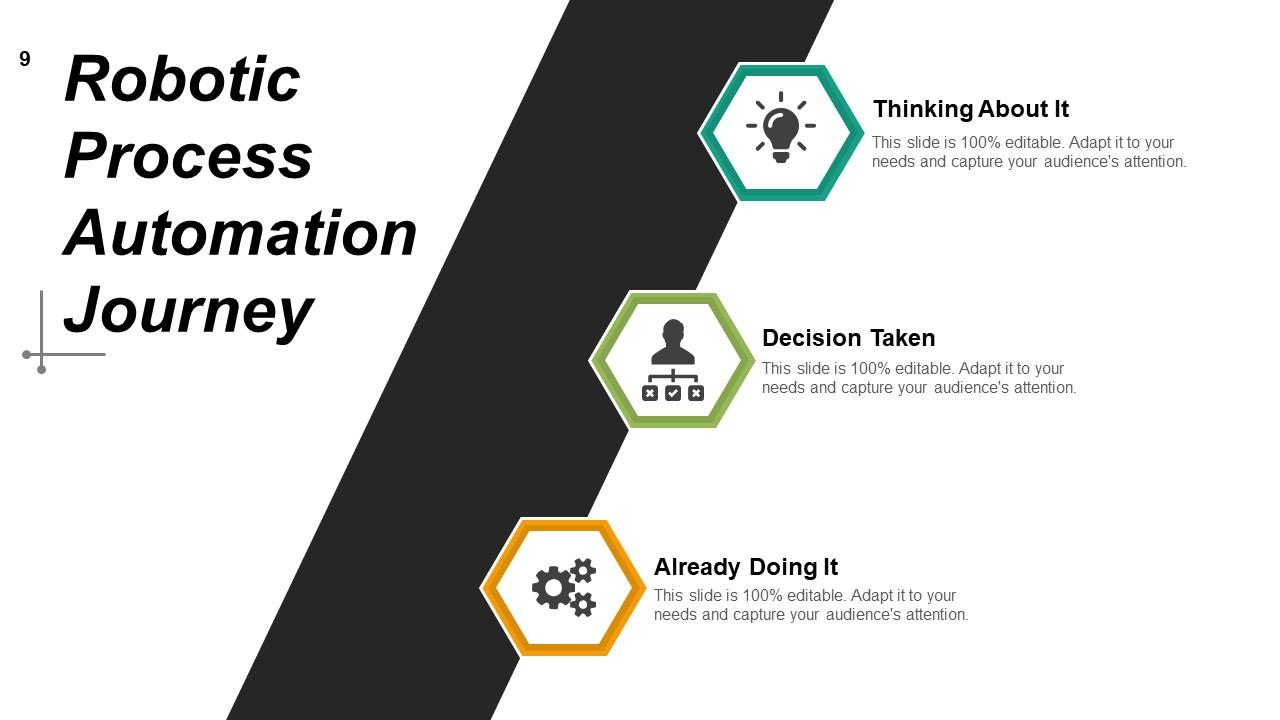
Showcase how companies must use the RPA to ensure they are able to make a real difference to efficiency, say of the order of 100 of times, rather than any incremental improvement. In the thinking about it phase, the inference is that RPA is the start of a new idea or a project. Then, the slide depicts the decision-taken stage, shown by a person’s outline with check marks, meaning the company has decided to go ahead. The journey ends with the "Already Doing It" stage, where a gear icon shows that the company is actively using RPA technologies.
Template 8: Robotic Process Automation Cycle
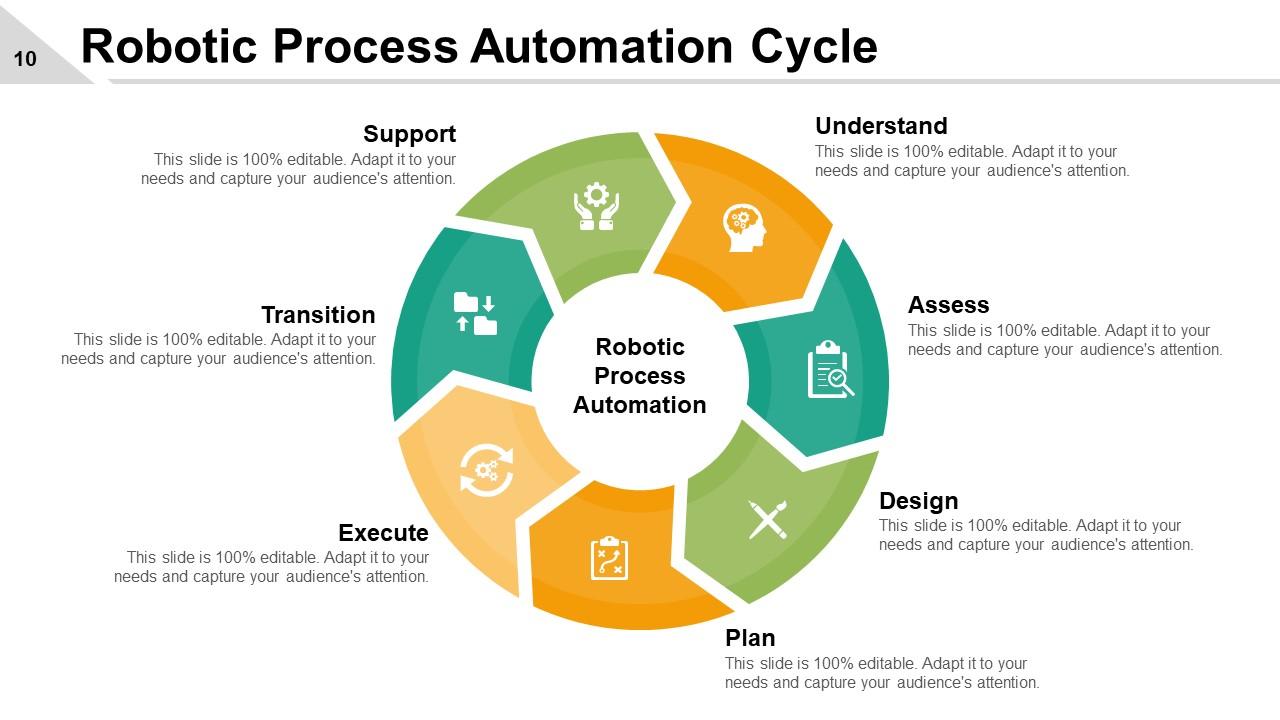
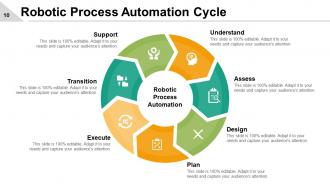
This slide highlights the RPA lifecycle in six main steps: Understanding, Assessing, Designing, Executing, Supporting, and Transitioning. Each part has a unique symbol that shows its function—from thinking and analyzing to planning, acting, helping, and moving data, showing the ongoing movement and connected nature of RPA tasks. The diagram’s focus on the circular aspects highlights how to operationalize the ongoing and repetitive process of getting the RPA started.
*****
Powering the Future: Move Your Business Forward with RPA
SlideTeam’s Templates on automation are a step towards improving how things work across industries. From explaining the important steps of Robotic Process Automation to covering its range, these slides are carefully made to lead your audience through every part of this important technology. The flexibility of our RPA templates, from showing the benefits and addressing challenges to highlighting the key factors and the journey of RPA, is unmatched. By giving your team these ready-to-use, fully editable slides, you're not just providing them with a tool but also giving them knowledge—to improve your company's use of technology and to increase efficiency, productivity, and satisfaction within your workforce. Download now to make Robotic Process Automation a key part of your company's success.
Ready to make your business processes smoother with advanced technology? Check out our Robotic Process Automation (RPA) Architecture Analysis template now!
Rpa powerpoint presentation slides with all 21 slides:
Get folks to act according to your advice with our Rpa Powerpoint Presentation Slides. Be able to bring your influence to bear.




FAQs for Rpa
Honestly, RPA is pretty great for cutting costs and getting rid of those mind-numbing tasks everyone hates. Data entry, invoices, reports - all that stuff can run automatically now. Your team gets freed up for actual interesting work instead. Error rates drop like crazy since bots don't get tired or have Monday morning brain fog. They work 24/7 too, no overtime needed. Most companies see payback within a year, which isn't bad at all. I'd start by looking at whatever eats up the most time - just make sure it follows clear rules that you can actually map out.
RPA is so much less invasive than old-school automation. You don't have to tear apart existing systems or rewrite a bunch of code. The bots literally just copy what humans do - clicking buttons, typing stuff, moving through your current apps. It's actually kind of mesmerizing to watch them go. Traditional automation? That usually means your IT team has to build these complex system connections that take forever and cost way too much. RPA gets things automated in weeks instead of months. Oh, and start with your most mind-numbing, repetitive tasks - those work perfectly for this kind of thing.
Dude, banking and finance are killing it with RPA - loan processing, account stuff, all that tedious crap nobody wants to do. Healthcare's massive too, especially claims and data entry. Insurance companies eat this up for underwriting and policies. Oh, and manufacturing uses it everywhere for supply chain tracking. Basically any industry buried in paperwork is perfect for this. My buddy's company started with their most boring, repetitive tasks first - that's where you'll see the biggest wins. Just map out whatever processes make your team want to bang their heads against the wall. Those are your goldmines.
Track your hard savings first - labor costs, fewer errors, faster processing times. Don't forget the soft stuff though, it's actually where you see big wins. Employee happiness goes up when they're not doing mind-numbing work all day. Customer response times improve too. For ROI, it's pretty straightforward: (total benefits minus costs) divided by costs, times 100. Most places I've seen hit 200-300% in year one, which is solid. Your costs include licenses, development, training - the whole package. Oh, and set up dashboards so you can show leadership actual numbers. They love that stuff.
Honestly, the worst headaches come from picking processes that are way too complicated or still changing all the time. Employees freak out thinking they'll lose their jobs, which makes everything harder. Legacy systems are a pain to integrate with too - they weren't designed for this stuff. Oh, and governance gets messy super quick when different teams start building bots without talking to each other. It's like herding cats sometimes. Start with boring, repetitive tasks that actually work and get people on board early. Tell them upfront how it'll make their jobs less mind-numbing.
So RPA basically plugs into whatever you're already using - APIs, databases, even just the regular user interface. The cool thing is it won't break your existing setup. Your bots can work with old legacy systems by literally clicking and typing like a person would. Pretty wild when you think about it. It just sits on top of everything instead of requiring you to rebuild stuff. I'd start with processes that already run smoothly when done manually - those translate to automation really well and you'll see results fast.
So basically AI turns your RPA bots from mindless button-clickers into something that can actually think. Your bots can suddenly handle weird exceptions, read messy documents, and figure out what to do when stuff goes sideways. Like OCR for invoices or processing random email formats - things that'd normally crash traditional RPA completely. Honestly, the combo is pretty sweet because you get RPA's reliability but with actual brain power behind it. My advice? Start small with one process where you're always fixing exceptions manually. Way easier than trying to revolutionize everything at once.
Yeah, they actually work really well together! RPA handles all the boring stuff - clicking buttons, moving data around. Then AI jumps in for the tricky parts like reading messy documents or figuring out what to do next. Machine learning makes your bots smarter over time too, which is pretty cool. Honestly, I'd start with basic RPA first since it's easier to wrap your head around. Once that's running smooth, you can add the AI pieces where you actually need them. Way better combo than trying to do everything with just one or the other.
Build a Center of Excellence first - trust me on this one. Otherwise every team will create their own chaotic automation mess. Pick high-volume, repetitive tasks that span multiple departments for your initial focus. Train business users early since they actually understand the workflows, but loop IT in for technical stuff. Change management is huge here because people freak out about bots replacing them. Honestly, broken bots at scale will ruin your day fast, so set up monitoring from the start. Begin small, show some wins, then grow from there.
RPA gets rid of all that soul-crushing busy work nobody wants to do. Your people won't have to copy data between systems or churn out the same weekly reports anymore. They can actually solve problems and think creatively instead. Honestly, I've seen teams transform when they're not stuck doing mindless tasks all day. People feel way more engaged when their work matters. You'll cut down on those annoying mistakes too – you know how it is when someone's basically sleepwalking through repetitive stuff. Just ask your team what tasks make them want to scream. Start there.
Hey! So for RPA you definitely need some programming basics - loops, logic, that kind of stuff. But honestly, you don't need to be some coding genius. UiPath and Blue Prism are super visual anyway, lots of drag-and-drop. Process mapping is probably the biggest thing since you're breaking down workflows. Oh and learn some database stuff and APIs too. The weird thing is soft skills matter just as much - maybe more? You'll be explaining tech stuff to business people who have no clue what you're talking about. I'd start with getting certified in one platform first, then build from there.
Honestly, RPA is a game-changer for compliance stuff. Bots do the same steps every time - no human screw-ups. They automatically handle reports, validate data, and never miss deadlines (unlike Jerry from accounting, lol). Everything gets logged too, so when auditors show up you're not digging through random files. Banking and healthcare companies love it because there's zero room for "oops I forgot." My advice? Start with whatever process causes you the most headaches first. You'll see results pretty fast.
Credential management is your biggest headache - bots need privileged access, so if someone gets those credentials, you're screwed. They also handle sensitive data across tons of systems without human oversight, which is risky as hell. Authentication matters too. I've seen companies where bots just run around with zero logging - nightmare fuel honestly. You'll want strong encryption and regular access reviews. Oh, and audit trails for everything the bots touch. Start with a security assessment first though, before deploying anything.
Dude, seriously map out everything you're doing now before you automate anything. I can't stress this enough - it'll save you so much pain later. Document every single step and find where things get stuck. Time how long stuff takes, count errors, the whole deal. Different people probably do the same task differently, right? Fix that first because automation needs everything consistent. Actually talk to whoever's doing this work daily - they know exactly what sucks about it. Here's the thing though: optimize the messy manual process first, THEN automate the clean version. Don't just turn garbage into digital garbage.
So basically RPA is getting way smarter by teaming up with AI and machine learning. Instead of just doing the same boring clicks over and over, it can actually make decisions now. Hyperautomation is the buzzword everyone's throwing around - it's like RPA on steroids, combining it with process mining and analytics to automate whole workflows. Most platforms are moving to the cloud because scaling is a nightmare otherwise. The coolest part? Low-code tools mean your business team can build their own bots without bugging IT constantly. Honestly, start mapping out which processes you could automate end-to-end.
No Reviews