

Process automation powerpoint presentation slides




Try Before you Buy Download Free Sample Product
 Impress Your
 Audience
 100%
100% Editable
 Save Hours
 of Time


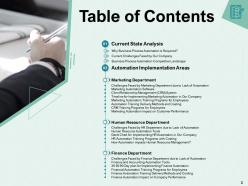
Identify and eliminate the repetitive processes and decrease manual work by using our visually appealing Process Automation PowerPoint Presentation Slides. Our business process automation PPT visuals, help you to automate the processes and use secured software to perform the different tasks. The Robotic Process Automation slide deck contains current state analysis, automation implementation areas, such as the market department, human resource department, finance department, etc. Discuss the challenges faced by the company which arises the need for automation by using business process reengineering PPT slideshow. Showcase different business automation processes such as file transfer, report generation, order entry, spreadsheets, etc. After that, describe automation implementation areas, including marketing, human resourcing, finance, and accounting. The presentation also provides the details of marketing automation software, CRM system, the timeline for implementing marketing automation in the company. Details like challenges faced by the HR department due to lack of automation, impact of automation on HR management can be presented with company automation PPT layouts. Download our ready-to-use business automation PPT slide deck and overcome the gap between business and technology by offering automated solutions.
People who downloaded this PowerPoint presentation also viewed the following :
Content of this Powerpoint Presentation
It's proven that automation is helping and will help various individuals and organizations make regular operations and processes easier and more self-stimulating, but this may come with a substantial price.
The prices and setup pattern of automation may overshadow its perks in the eyes of management, thus making them reluctant to proceed with process automation in the business. But what if we offer you something that can help you make your case for process automation and, therefore, change the management's perception to employ automation?
SlideTeam’s 100% customizable process automation template will allow you to showcase that automation has far more benefits than negatives. Using the template, you can provide all the required details of process automation, including the areas of application, the relevance of different automation software and platforms for different tasks, and every other aspect related to the automation domain.
So, let’s get cracking and see what this template offers below.
If you are looking for a product lifecycle marketing model, the smart one offered here is worth a look.
Template 1: Objectives of Business Process Automation

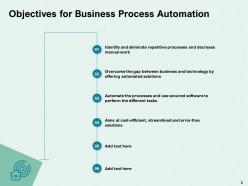
It would benefit your cause if you immediately enlist the main objectives of the business process automation. This slide allows you to do the same by showcasing that automation will help in figuring out the repetitive tasks in the organization and reduce the amount of manual work the employees undergo. Similarly, automation will help fill the gap between operations and technology in multiple tasks.
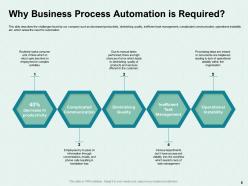
Template 2: Why Business Process Automation is Required?
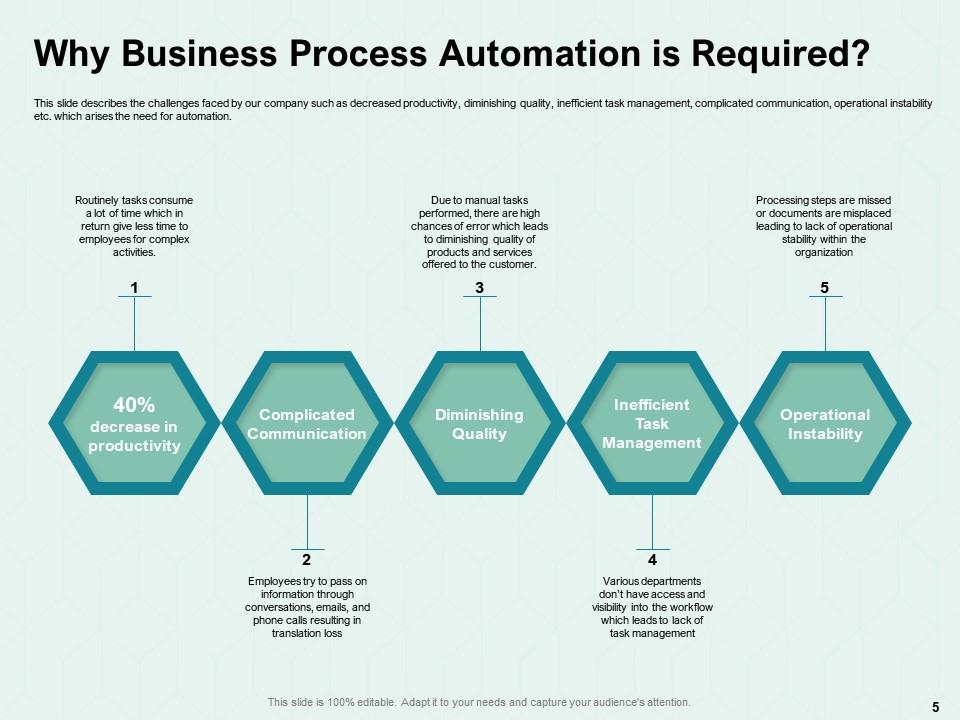
As stated, this slide will help answer the big question of why. This PPT Template showcases the drawbacks of the manual approach. You can use pointers as an infographic and list the shortcomings, such as productivity decreases, communication getting complicated, the quality of operations deteriorating, task management becoming ineffective, and overall operations becoming unstable.
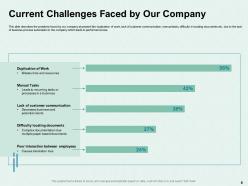
Template 3: Current Challenges Faced by Our Company
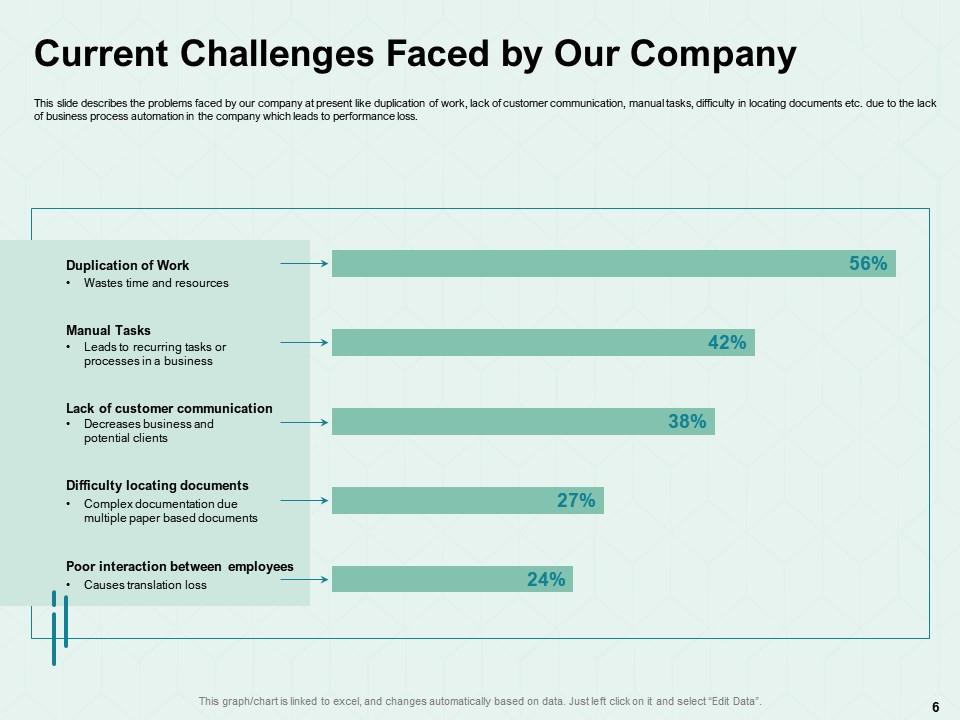
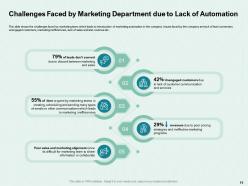
If you pin out all the challenges your organization faces because of the manual approach to operations, it can help you compel your case for process automation. Use this slide to showcase the problems your employees face in the form of a bar chart. You can include facts like the duplicity of work, which wastes valuable time for employees, and other facts.
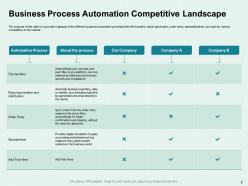
Template 4: Business Process Automation Competitive Landscape
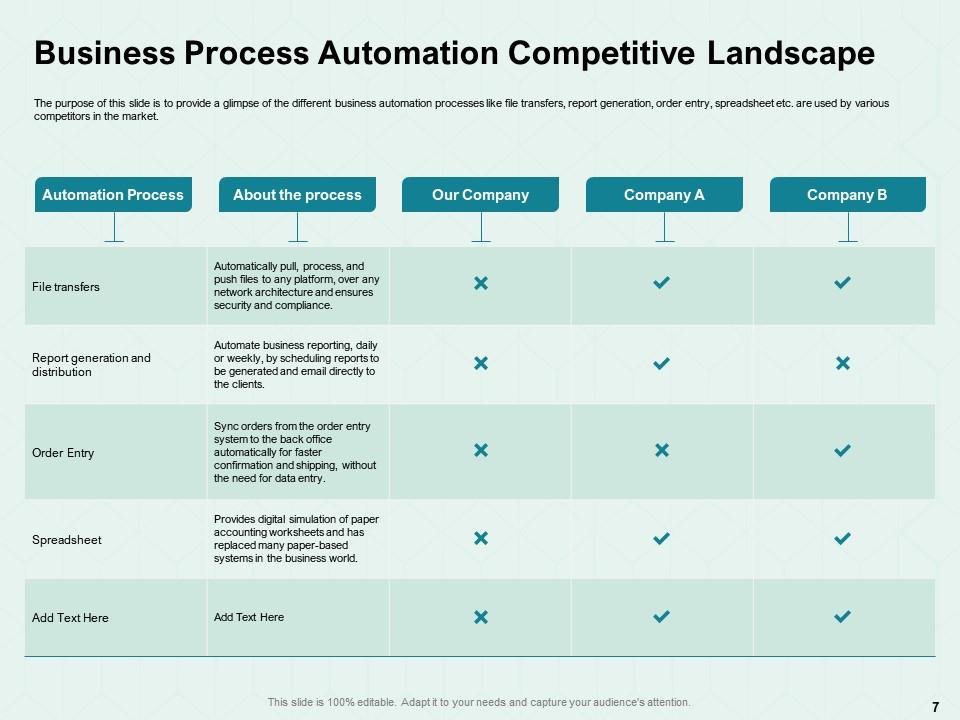
This slide will help showcase how your main competitors use automation for better productivity. You can create a checklist that includes the area of operations, the usage of automation in your company, and other competitions. Add pointers and processes like file transfers, report generation, order entry, spreadsheet updation, and other processes as required.
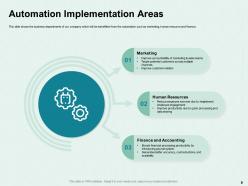
Template 5: Automation Implementation Areas
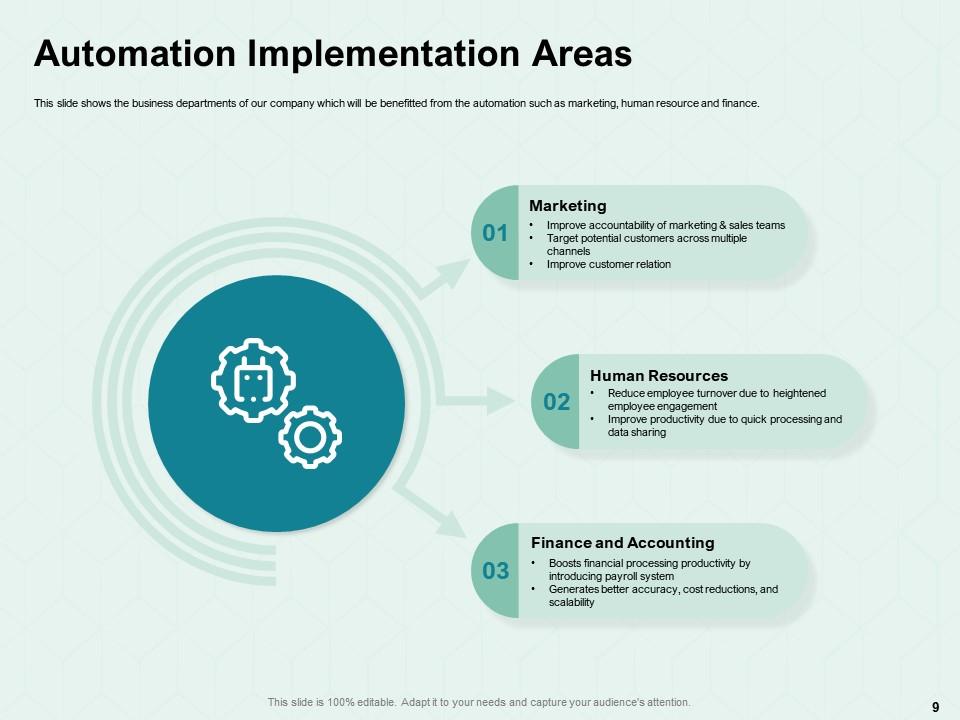
Use this PowerPoint Template to explain all the implementation areas for process automation. You can add processes related to Marketing, Human Resources, Finance/Accounting, and others as necessary. To make your case, you can add supportive text about how automation will help in each aspect right beneath the area title but within its bubble.
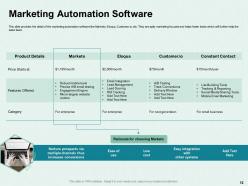
Template 6: Marketing Automation Software
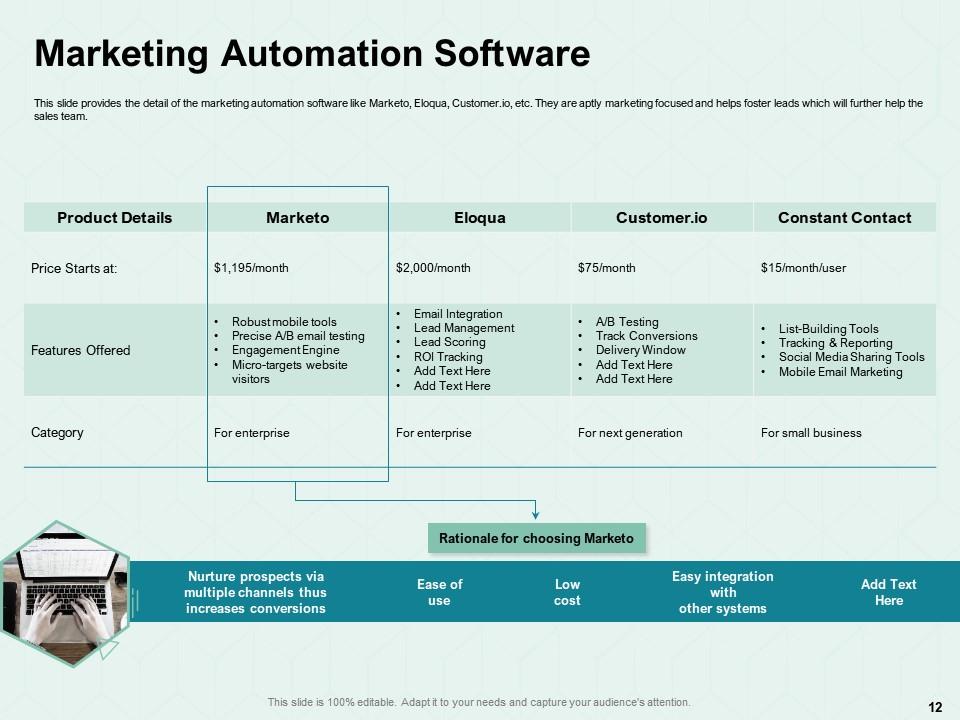
This PowerPoint Slide explains the software used for process automation in the marketing department. Add the names of various competitive software available in the market and compare them with respect to their prices, the scope of services offered to you, and the category of users the software companies cater to the most. The management can easily make the required decision.
Template 7: Client Relationship Management (CRM) System

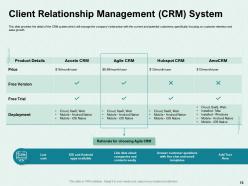
Employing a client relationship management system or CRM system will help manage the actual and potential clientele of the business. Use this to compare different CRM system alternatives available to the business. You can enlist software like Accelo CRM, Agile CRM, Hubspot CRM, and AmoCRM in terms of pricing, free versions, and more. You can box your favorite choice in the slide if you want to represent your preferences.
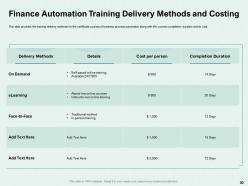
Template 8: Automation Training Delivery Methods and Costing
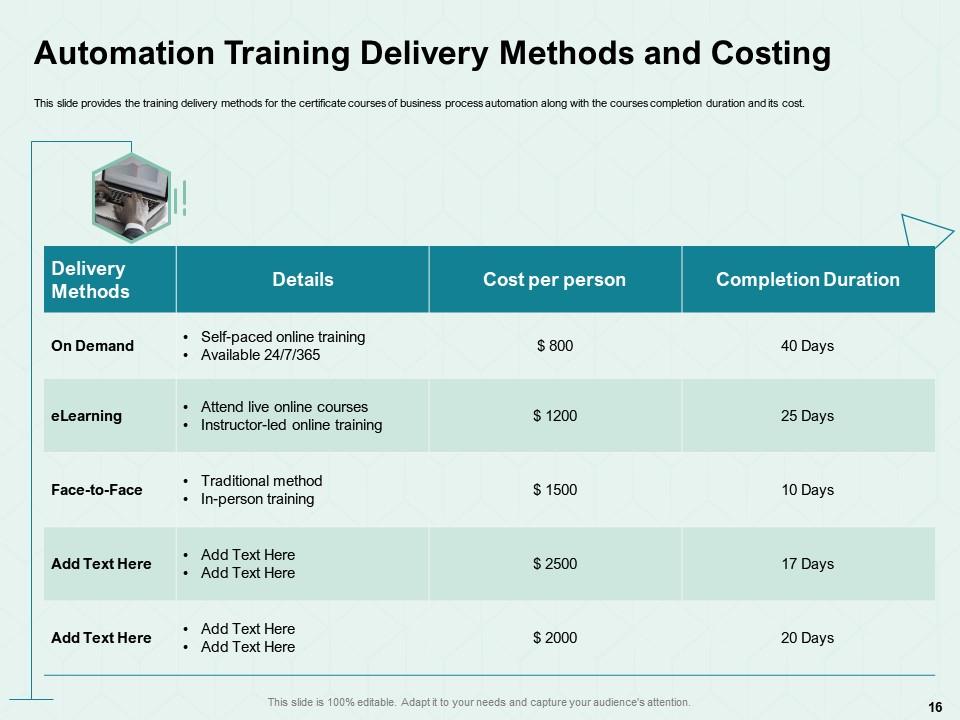
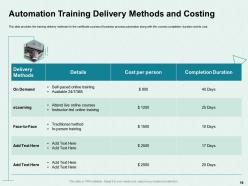
If management permits automation, then training the employees on how to use automation is required. You should also enlighten them about the training methods available to the business, along with the prices and tenure. Use this tabular slide to showcase 5 different ways, including on-demand, eLearning, and Face-to-Face techniques, to mark the costs and tenure of each technique right next to the name.
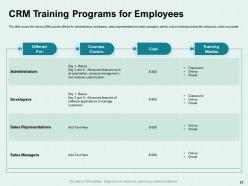
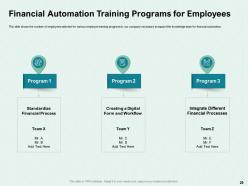
Template 9: CRM Training Program for Employees
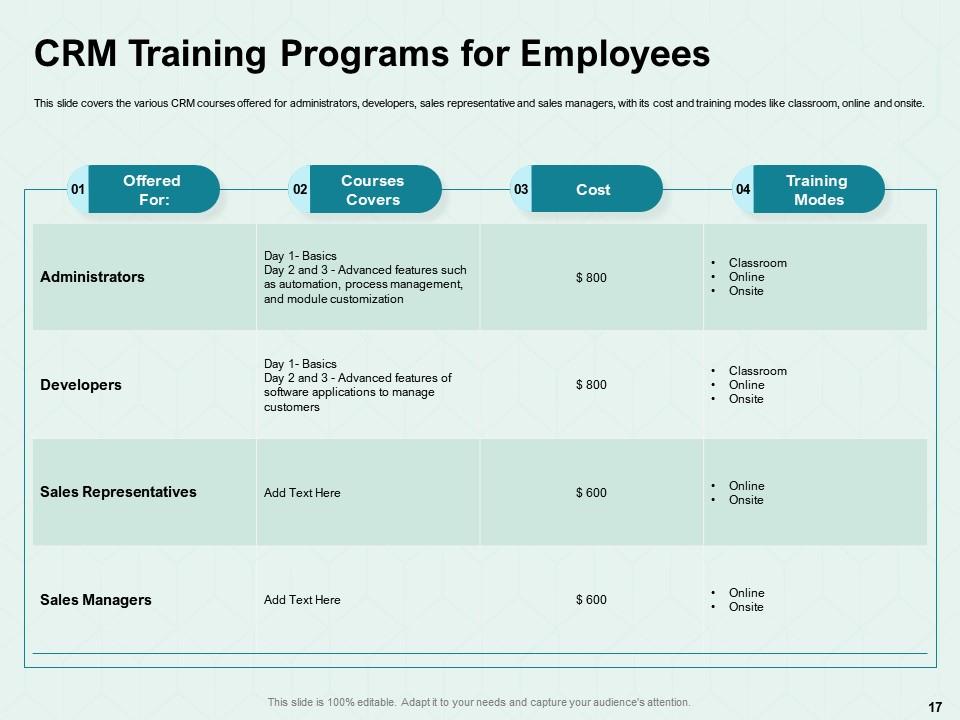
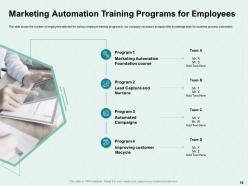
Use this PPT Slide to understand the cost and tenure of CRM training. The table shows that the administrators, developers, sub-developers, and sales managers would need the training, and each would cost $800, $800, $600, and $600, respectively. This tool is also perfect for showing the training methods.
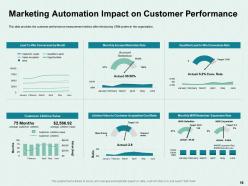
Template 10: Marketing Automation Impact on Customer Performance

This presentation allows us to understand the overall impact of marketing automation on the business and its employees' performance. Each chart represents the Lead-to-Win Conversion by Month, Monthly Account Retention Rate, Qualified Win Conversion Rate, Customer Lifetime Value, Lifetime Value to Customer Acquisition Cost Ratio, and Monthly MMR Retention/Expansion Rate, respectively.
Here’s a challenge vs solution template to help you showcase the common challenges faced with revenue generation along with the solutions.
Undergo Operations Easily with Process Automation
The process automation template offered above offers everything you may need to convince management to approve the use of automation in your business. All you need to do is edit and prepare the template smartly, and victory will be yours.
Check out this one-pager strategic planning framework template to help you showcase your strategic vision, mission, goals, fountain, and more.
Process automation powerpoint presentation slides with all 41 slides:
Use our Process Automation Powerpoint Presentation Slides to effectively help you save your valuable time. They are readymade to fit into any presentation structure.


FAQs for Process automation
Honestly, automation is a game changer. You'll cut way down on errors and save tons of time - your team can finally work on stuff that actually matters instead of boring repetitive tasks. The money savings are real too. What I love is that automated processes just keep running, even at 3am when everyone's sleeping. Data stays consistent, customers get faster responses. Yeah, setting it up is kinda annoying at first, but most companies break even within like 6-12 months. I'd start by looking at whatever manual process eats up most of your day.
Honestly, automation just handles all the boring stuff nobody wants to do anyway. Data entry, processing invoices, that whole customer onboarding nightmare - you automate those and your team can actually work on things that matter. Works everywhere too. Hospitals do it for scheduling patients, factories use it for quality checks, finance teams automate their compliance reports (lucky them). The trick is starting small though. Just pick whatever process makes everyone groan and fix that first. You'll see results fast, plus way fewer stupid mistakes.
UiPath or Automation Anywhere are solid picks for the main automation stuff. Honestly though, map out your processes first with something like Lucidchart - I learned this the hard way when I skipped ahead and had to backtrack. Zapier's perfect if you hate coding, and Power Automate integrates nicely with Microsoft stuff. You'll also want something to monitor how things are running. Process Street works well for that. Oh, and start with just one tool! Master it before you go crazy adding more. Way easier to figure out what you actually need that way.
Go for the boring stuff first - data entry, invoice processing, anything super repetitive that follows clear rules. Basically if you can write down "when X happens, do Y" then it's probably worth automating. I'd focus on whatever's costing you the most time or money when people mess it up. Map out your current process (sounds tedious but trust me) and find the biggest pain points. High-volume tasks are goldmines too since even small time savings add up fast. Don't bother with anything that needs creativity or complex judgment calls though. Save those for actual humans.
So AI takes your basic automation and makes it actually smart. Your regular automation just follows scripts - if this, then that. But AI can make real decisions and learn from what's happening. Like, those chatbots that actually get what you're asking instead of giving you five irrelevant options? That's the difference. Plus AI spots patterns humans miss - predicting machine failures before they happen is honestly pretty cool. The biggest win though? Your systems get better over time instead of doing the exact same thing forever. I'd look at where your current automation constantly breaks or needs someone to babysit it. Those pain points are perfect for adding AI.
Three main things to nail down: access controls, monitoring, and regular security audits. First, set up role-based permissions so only the right people can mess with your automated workflows. Real-time monitoring is huge here - catches sketchy activity before it becomes a problem. Most teams totally whiff on this part because they assume automation just runs itself. Wrong move. Also gotta review those automation rules regularly, especially when people quit or switch departments. My biggest rec? Build a monthly security checklist your team actually uses. Sounds boring but it'll save your ass when something goes sideways.
Honestly, the hardest part is dealing with scared employees who think they're getting replaced. Plus the upfront costs hit hard - both money and time to get everything working right. Integration is where things get messy though. Your new tools probably won't talk to your old software without some serious tweaking. Finding people who get both the tech stuff AND your actual business? Good luck with that one. Start with just one process, something simple where you can show quick wins. And yeah, be super transparent with your team about how this actually makes their jobs easier, not obsolete.
Look, automation isn't going to wipe out your team - that's mostly fear-mongering. What happens is the boring, repetitive stuff gets handled automatically. Your people end up doing way cooler work like analyzing data and solving complex problems instead of just entering it all day. Sure, some job descriptions will change and you might combine certain roles. The trick is getting everyone involved early so they don't freak out about it. Honestly, most employees are pretty relieved once they realize they're moving up to more strategic work rather than getting replaced entirely.
Track a few key things - time savings, error rates, cost reduction, and how your team actually feels about it. Nobody wants to deal with automation that sucks to work with. Oh, and throughput if you're processing lots of stuff. Here's the thing though - you gotta measure before you start automating or you'll have no clue if it's actually helping. Don't go crazy trying to track everything at once. Pick 3-4 metrics that actually matter for what you're doing. Way easier to focus on what counts rather than drowning in data you don't need.
So basically, automation tools connect to your current software through APIs and webhooks - they don't replace everything, which is nice. Most platforms already have connectors built for stuff like Salesforce and Excel. Pretty cool how many they support now, honestly. If you're using something weird or niche, you can usually build custom connections too. Here's what I'd do: map out where your data moves between systems and find those annoying repetitive handoffs. That's where automation shines. Don't go crazy though - pick one workflow that's driving everyone nuts and start there. You'll learn a ton from that first one.
Dude, the whole "robots taking over overnight" thing is total BS - it doesn't happen that fast. Start small instead of trying to automate everything at once, trust me on this. Smaller companies can definitely afford automation tools too, despite what people think. You'll still need someone keeping an eye on things though, because automation isn't perfect (learned that one the hard way). Oh, and focus on those boring, repetitive tasks first - like data entry or whatever's driving your team crazy. Those are usually the easiest wins anyway.
Get your team involved right from the start - seriously, people hate changes they had no say in. Explain WHY you're doing this and how it'll actually help them, not replace them. I've watched so many managers just drop these bombshells without any context and it goes horribly. Train people properly and show some quick wins early. Be upfront about concerns and timelines. Oh, and find those few people who are excited about it - they'll do half your convincing for you when the skeptics see their coworkers actually benefiting from the changes.
AI's getting scary good at making actual decisions now, not just following basic scripts. Low-code platforms are everywhere too - my cousin who can barely use Excel built this whole workflow thing last month, which is honestly kind of nuts. Edge computing means you can automate stuff right where it happens instead of waiting for everything to ping back to some server. Oh, and companies are finally connecting all their automated systems instead of having these random isolated processes. You should mess around with some AI tools in whatever you're already doing. Even tiny tests will help you figure out where this is all headed.
Look, automate the boring stuff but don't go crazy with it. Start small with low-risk tasks that follow clear rules. When weird situations pop up, make sure there's a way for your team to jump in and handle it manually. I've watched companies automate everything then totally panic when something unexpected happens - honestly such a mess to watch. Keep doing regular check-ups on how it's working. The whole point is giving your people time for the important decisions, not cutting them out completely. Oh and always build in that manual override option, trust me on this one.
Honestly, automation usually helps the environment more than it hurts. Machines are way better at not wasting energy and materials - they're just more precise than humans, you know? Yeah, building all those sensors creates some pollution upfront, but that gets offset pretty fast. The cool part is automated systems can watch emissions constantly and tweak things to stay compliant. Oh, and if you're thinking about automation projects, definitely track the environmental benefits from the start. Makes your pitch way stronger and helps you choose the most sustainable options. Win-win situation really.
-
The content is very helpful from business point of view.
-
Nice and innovative design.
-
Great quality product.
-
Great quality slides in rapid time.
-
Great designs, really helpful.
-
The content is very helpful from business point of view.