


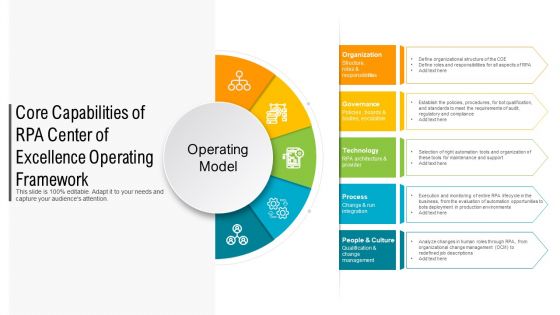
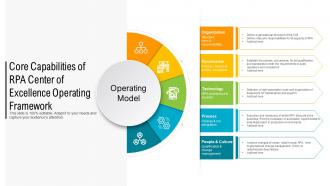
Core capabilities of rpa center of excellence operating framework





Try Before you Buy Download Free Sample Product
 Impress Your
 Audience
 100%
100% Editable
 Save Hours
 of Time


Our Core Capabilities Of RPA Center Of Excellence Operating Framework are explicit and effective. They combine clarity and concise expression.
People who downloaded this PowerPoint presentation also viewed the following :
Core capabilities of rpa center of excellence operating framework with all 2 slides:
Give your audience a fulfilling experience. They will find our Core Capabilities Of RPA Center Of Excellence Operating Framework elevating.
FAQs for Core capabilities of rpa center of
So you'll need five main things for your RPA CoE setup. Governance comes first - basically your rules and standards (most people skip this and regret it later). Then pipeline management for finding good automation opportunities. You need a solid technical team who can actually build the bots. Change management is huge because people hate when their processes get switched up. Oh, and don't forget tracking your ROI with good metrics. Communication strategy keeps everyone in the loop too. Honestly, nail down governance before you do anything else or you'll be scrambling to catch up later.
So your RPA CoE is basically the control center for all your automation stuff. Right now you probably have different teams just doing whatever with their bots, which honestly gets chaotic pretty quick. The CoE fixes that by standardizing everything so it actually ties into your bigger digital transformation goals - better data flows, customer experience, operational stuff. Make sure CoE leadership talks regularly with your digital transformation people. Otherwise you'll end up automating random processes that don't really move the needle. I'd start by looking at what automation you've got now and see how it maps to your digital roadmap. That'll show you where the gaps are.
So you need a CoE Lead first - they handle strategy and take the heat when stuff breaks. Get some Process Analysts to hunt down automation opportunities. RPA Developers obviously build the actual bots. Don't skip Infrastructure/Security people or you'll regret it later. Business Stakeholders are crucial since they know if your automation actually works in the real world. Oh, and maybe throw in Change Management specialists if people are being weird about the changes. Honestly, start simple with these roles then add more as you figure out what you actually need.
Track the obvious stuff first - hours saved, costs cut, fewer errors. But honestly? The soft metrics matter just as much. Employee happiness usually shoots up when people aren't doing mindless tasks anymore. Also watch compliance improvements and how quickly other departments want in on automation. ROI calculation is pretty straightforward - just compare what you spent vs what you're getting back. I'd set up a monthly dashboard (nothing fancy) and actually share it with people regularly. Keeps everyone bought in, you know?
So you'll want three main things set up for your RPA CoE. Get a steering committee going with both business and IT folks - they handle the big decisions and what gets priority. Then you need a technical review board (this one's huge honestly) to check bot designs and security stuff before anything goes live. Regular governance meetings are the third piece - track how things are performing, deal with any issues that pop up. Oh and definitely nail down who makes what decisions early on. Otherwise you get that whole "everyone's in charge so nobody's in charge" mess and projects just sit there forever.
Get C-level backing first - seriously, without executive sponsorship you're dead in the water. Build a small, skilled team to start. I've watched way too many CoEs crash and burn because they tried scaling before proving anything worked. Create standard processes for development, testing, deployment. Build reusable components your teams can actually use (not just theoretical stuff). Here's the thing though - measuring ROI isn't optional. You need to track wins and shout about them to stakeholders constantly. Oh, and resist the urge to go big immediately. Prove value first, then expand.
Honestly, just bake experimentation into how your CoE works day-to-day. Run innovation challenges where teams pitch wild automation ideas. Create space for "intelligent failures" - let people experiment without fear of getting roasted when stuff doesn't pan out. Build communities where bot developers actually share what they've learned (not just the wins). Track metrics that celebrate trying new approaches, not just efficiency bumps. Oh, and give your team real time to explore - maybe 10-15% of their week? I've watched CoEs become way too buttoned-up and basically suffocate themselves. Don't be that team.
So for your RPA CoE tech stack, you're looking at three main things: development platforms (UiPath, Automation Anywhere, Blue Prism), monitoring tools to track how your bots are doing, and governance stuff to manage everything. Vendor selection is honestly such a pain - I'd focus on what plays nice with your current systems. Process mining tools like Celonis help spot automation opportunities. Oh, and don't skimp on security. My advice? Pick one main RPA platform first and grow from there. I've seen too many teams try to boil the ocean right away and it never ends well.
Honestly, getting buy-in is like 80% of the battle with RPA stuff. Show them what they'll get out of it first - less boring tasks, quicker turnarounds, fewer mistakes. Monthly demos work great because watching bots do actual work is weirdly mesmerizing (I swear people get addicted to it). Set up ways for them to pitch new automation ideas so they feel ownership. But here's the real trick - train a couple people in each department to be your cheerleaders. They'll convince their coworkers way better than any presentation you could give. Oh, and keep talking to them throughout the whole thing, not just at the beginning.
Your RPA team needs both technical and people skills. Get them certified in the main platforms - UiPath, Automation Anywhere, Blue Prism. Python or .NET basics help too. Process mining is huge but weirdly underrated at first. Business analysis training matters since they'll need to understand workflows. Oh, and change management workshops are clutch because you're basically selling automation to skeptical people all day. Agile methodology keeps projects moving. I'd map out a learning path with cert milestones, then do monthly lunch sessions to stay sharp.
Banks are absolutely dominating with RPA right now. Insurance and healthcare aren't far behind though. Manufacturing too - they're getting crazy ROI on quality control stuff. Here's the thing - it's not really about your industry. What matters is having those mind-numbing, repetitive processes that follow the same rules every time. Loan apps, insurance claims, data entry... you know the drill. I'd honestly just start by writing down your most boring, repetitive tasks first. Those are your goldmine. The standardized processes practically automate themselves once you map them out properly.
So your RPA CoE handles change management by setting up communication plans and getting stakeholders bought in early. They'll run training sessions and create user guides - pretty standard stuff. The hard part? People freaking out about robots stealing their jobs. Honestly, that fear never gets old. Good CoEs run workshops showing how automation actually lets people do more interesting work instead of mind-numbing tasks. They should have rollback plans too if something breaks. Oh, and make sure they're tracking adoption metrics so you know if people are actually using the bots.
Track both the technical stuff and business impact - you'll need both. Bot uptime and deployment speed matter, but honestly executives only care about cost savings and ROI numbers. Those employee hours you're freeing up? That's gold for budget conversations. Developer satisfaction is weirdly important too since unhappy devs kill projects faster than bad metrics. I'd grab 3-4 key numbers from each bucket and throw them on a monthly dashboard. Makes it way easier to catch problems early. The adoption rates from business stakeholders tell you if you're actually solving real problems or just playing with cool tech.
Bake compliance into your CoE from the start - you'll thank yourself later. Set up standard dev templates and security reviews that catch problems early. Also build approval workflows before bots go live. A central registry with access controls is clutch when auditors show up (and they will). Regular health checks plus rollback procedures are non-negotiable. The trick? Don't make it feel like bureaucratic BS. If the process is too clunky, devs will just find workarounds. Keep it smooth so people actually follow it instead of dodging the whole system.
Resource constraints will kill you every time - plus getting executives to actually care about your CoE. Teams love staying in their little bubbles too instead of working together. And honestly? Half the departments just want to automate random stuff because it sounds cool. Get your governance sorted from the start. Build processes people will actually use, not perfect ones they'll ignore. Show leadership the money you're saving constantly. Your CoE needs real dedicated people, not Karen from accounting doing bot work between her regular job. Pick some quick wins first to prove you're not wasting their budget, then expand from there.
No Reviews