


Strategic RPA Process Assessment Checklist




Try Before you Buy Download Free Sample Product
 Impress Your
Audience
 100%
Editable
 Save Hours
of Time


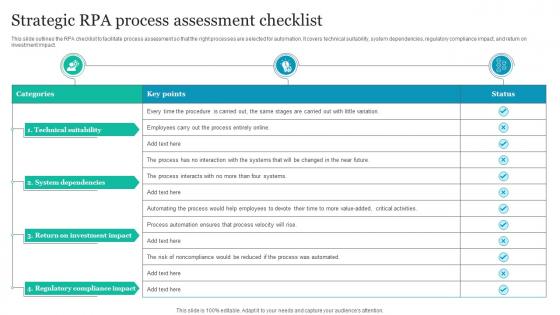
This slide outlines the RPA checklist to facilitate process assessment so that the right processes are selected for automation.It covers technical suitability, system dependencies, regulatory compliance impact, and return on investment impact.
People who downloaded this PowerPoint presentation also viewed the following :
Strategic RPA Process Assessment Checklist with all 6 slides:
Use our Strategic RPA Process Assessment Checklist to effectively help you save your valuable time. They are readymade to fit into any presentation structure.






FAQs for Strategic RPA
So there's basically five things to check before diving into RPA. Your processes need to be repetitive and rule-based - otherwise you're just wasting money on fancy software. Data quality matters a ton too, plus your systems can't be constantly crashing. Get leadership on board early because trust me, you'll need their support when things get messy. Someone has to actually run this thing once it's built. Oh, and prep your team for the whole "robots are taking our jobs" drama that always happens. Pick something simple but high-volume for your first attempt. Don't be that person who tries automating everything day one.
First, figure out which processes get hit with the most transactions daily. Those standardized workflows that multiple departments already use? Pure gold for RPA scaling. Test if your legacy systems can actually handle more volume though - some of those older platforms throw tantrums under pressure, honestly. Document the manual stuff and weird edge cases now because they'll bite you later when you're trying to scale up. Focus on high-volume processes that work the same way across different teams. That's where you'll see the biggest returns without wanting to pull your hair out.
Track the obvious stuff first - time saved, costs cut, fewer errors, faster processing. Those numbers will make your boss happy. But here's what people miss: measure how much happier your team is now that they're not doing soul-crushing manual work all day. Employee satisfaction matters way more than most companies realize. Also grab baseline numbers before you start, otherwise you're just guessing at ROI later. Set up monthly tracking for process compliance and any customer improvements too. Oh, and definitely build a dashboard - makes reporting so much easier.
Honestly, start with the boring stuff that makes you want to bang your head against your desk - data entry, processing invoices, generating those weekly reports nobody reads but everyone needs. You'll want things that follow super clear rules without needing actual thinking. Skip anything messy or unstructured for now, trust me on that one. Map out what's eating up hours of your day that a robot could basically handle. The magic happens when you find processes that take forever manually but could zip by in minutes automated. Go for the obvious wins first - high volume, repetitive tasks where you're just following the same steps over and over.
So here's the thing - your employees are actually the key to good RPA assessment. They know their workflows inside and out, way better than any consultant ever will. Get them documenting their current processes and pointing out what sucks. Train a small group first, maybe your process champions or whoever's most into this stuff. People freak out thinking automation means layoffs, so address that head-on. The tricky part is teaching them to spot what's truly repetitive vs what needs human brain power. Honestly, skip the big company-wide rollout and start small - it's less chaos that way.
Before you deploy those bots, do a solid risk assessment covering tech, operations, and compliance stuff. Check your current processes for security holes, data issues, and anything that could break. Change management's huge too - people hate when their jobs get automated (can't blame them honestly). If you're dealing with sensitive data, regulatory compliance becomes a nightmare real quick. Make a risk matrix ranking everything by how likely it is and how bad the impact would be. Get IT, compliance, and business teams involved early. Trust me, catching problems now beats fixing expensive disasters later.
Honestly, I'd start simple and just map out 2-3 of your busiest, most repetitive processes by hand first. UiPath has some really good task mining tools that'll help you spot automation opportunities you might miss otherwise. Microsoft's Power Platform is decent too if you're already in their ecosystem. Blue Prism and Automation Anywhere have their own assessment kits, though I haven't used those as much. The RPA Center of Excellence framework is solid but wow, it can be a lot to digest at first. Once you've got your manual mapping done, use these tools to double-check your work and catch any complexity you didn't see coming.
Dude, compliance stuff will totally derail your RPA project if you're not careful. Map out early which processes touch regulated data - GDPR, SOX, HIPAA, whatever applies to you. I learned this the hard way when a "perfect" automation candidate got scrapped because it needed human oversight for audit trails. Some processes look amazing for bots until you hit those data handling rules. You'll need extra logging and controls built in. Honestly, it's such a pain but way better than finding out months into development. Trust me on this one.
Honestly, RPA ROI is trickier than most people think. You've got your obvious savings - less manual work, fewer screw-ups, faster turnaround times. Those are the easy ones to calculate. Then there's the fuzzy stuff like happier employees and better compliance that's harder to put numbers on but still counts. Here's what'll bite you though - implementation costs are brutal. Licensing fees, development work, ongoing maintenance. My buddy's team totally underestimated the support costs and it killed their first-year ROI. Timeline matters too. How long until you actually see the money? Start small with a pilot project first. Get some real data before you go all-in on automation across the board.
First thing - make a simple spreadsheet of all your key systems and figure out which ones have APIs or play nice with RPA tools. Your network setup and security stuff matters too. Legacy systems can be absolute hell to automate, honestly some aren't worth the headache. Data quality is huge since bots need clean info to actually work. I'd start small though - pick the easiest systems first and see how it goes. Also check if your older applications can even handle bot interactions without breaking. Makes the whole process way smoother when you know what you're working with upfront.
Get your people involved right from the start - have them point out which tasks are mind-numbing and broken. They know way better than management what actually sucks about their day-to-day work. Be upfront about how this changes their roles instead of axing them completely. Honestly, I've watched resistance disappear once folks realize they won't be doing data entry all day anymore. Run small group meetings to tackle concerns head-on. Share some quick wins from your pilot tests too. Find those natural advocates in each department who can sell this thing from the inside - makes a huge difference.
Build a scoring matrix - business impact vs how hard it'll be to implement. Finance and HR usually win big here since they handle tons of repetitive stuff with major time savings potential. Don't pick based on who's yelling the loudest (we've all made that mistake lol). Technical feasibility matters too, plus whether the department's actually ready for change. Start with your best ROI bet that's also low-risk. Honestly, getting that first win is everything - then you can ride that momentum to tackle other areas. Available resources obviously play into this whole equation.
Don't pick tools before you map out your actual processes first - you'll just automate broken workflows. Big mistake I see everywhere. Get your business people involved early, not just IT folks, or you'll miss tons of important details. Those flashy software demos are tempting but honestly? Simple tools often work way better than complex platforms. Change management is huge too - your team needs real training and has to actually want this thing to work. Oh, and start with one small pilot project instead of trying to fix everything at once.
Honestly, getting stakeholders involved can totally make or break your RPA assessment. Business users and IT folks have all the juicy details about what's actually broken in your processes - stuff you'd never figure out on your own. When they feel heard from day one, they're way more likely to back your recommendations later. Skip this step and you'll get pushback when it's time to implement. I learned this the hard way on a project last year. My take? Get those interviews scheduled ASAP. Their buy-in isn't just nice to have - it's everything.
Track your automation rate first - like how many processes you've actually automated vs what you could automate. ROI should hit around 200-300% in 18 months if you're doing it right. Deloitte and PwC drop these annual RPA studies that are actually pretty useful for seeing how you stack up by industry. Bot utilization rates matter too, plus error reduction and whether your team actually likes the changes (that last one's huge). Honestly though? Pick maybe 3-4 metrics that fit your goals and just track them quarterly. The trends matter way more than hitting some magic number.
-
Wow, never been this impressed with any online service provider. Really appreciate the customer support all along from the navigation to purchasing the right products.
-
I've been looking for a good template source for some time. I'm happy that I discovered SlideTeam. Excellent presentations must try!