

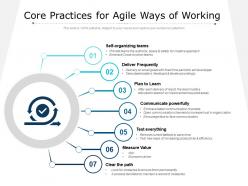
Core practices for agile ways of working





Try Before you Buy Download Free Sample Product
 Impress Your
 Audience
 100%
100% Editable
 Save Hours
 of Time


Our Core Practices For Agile Ways Of Working are topically designed to provide an attractive backdrop to any subject. Use them to look like a presentation pro.
People who downloaded this PowerPoint presentation also viewed the following :
Core practices for agile ways of working with all 2 slides:
Use our Core Practices For Agile Ways Of Working to effectively help you save your valuable time. They are readymade to fit into any presentation structure.
FAQs for Core practices for agile
So basically, Agile is all about putting people first instead of getting bogged down in processes and paperwork. You work in these short bursts called sprints and constantly check in with customers rather than planning everything upfront. Way less stressful honestly! Plus you're shipping working software regularly instead of waiting forever for some "perfect" version. The biggest thing? You've gotta be cool with change - requirements will shift and that's just how it goes. Oh, and definitely get your customers involved way more throughout. Short planning cycles are your friend here.
Daily standups are where the magic happens - get people talking through blockers instead of just rattling off status updates. Sprint planning works way better when the whole team estimates together rather than you or the PM just deciding what fits. Don't skip retros even when everything feels smooth (learned that one the hard way). Make sprint reviews demo-focused so stakeholders actually see progress, not death by PowerPoint. Keep standups under 15 minutes and you'll be shocked how much more engaged everyone gets. Oh, and keep ceremonies short but consistent - that's honestly the secret sauce.
Your Product Owner is basically the middleman keeping everyone sane. They handle the product backlog, write user stories, and decide what gets built first when stakeholders are all yelling different things. Trust me, I've seen terrible POs completely wreck good dev teams - it's painful to watch. During sprints, they need to actually be around to answer questions and sign off on finished work. Without someone clearly owning the "what" and "why," you'll end up perfectly building something nobody wanted. Just make sure they can actually make decisions and aren't some powerless messenger boy.
Honestly, just keep your teams small - like 8-10 people tops. Use SAFe or Scrum of Scrums to connect everything without turning into a nightmare. Don't let the corporate BS creep back in when you scale up, that's where most places screw it up. Short feedback loops are everything. Get everyone aligned on the same goals instead of obsessing over perfect processes. I'd start with whatever product area matters most, nail it there first, then spread out. Oh and actually DO something with your retrospectives - can't tell you how many teams just talk and never change anything. The bureaucracy will try to sneak back in, trust me.
Track velocity first - story points your team knocks out each sprint. Cycle time's clutch too, shows how long features actually take start to finish. Burndown charts help you see if you're gonna hit sprint goals or if you're screwed. Lead time is honestly my go-to metric because it captures the whole customer experience. Don't sleep on the softer stuff either - team happiness through retros, defect rates, deployment frequency. Here's the thing though: pick like 3-4 metrics max. I've seen teams drown in dashboards they never look at. Start simple with velocity and cycle time, then add whatever fixes your actual problems.
So basically, Agile treats scope changes like they're totally normal - because they are. Your team can actually pivot when you get new feedback or realize something's not working. Waterfall? That's the opposite. Everything gets locked down from day one, and changing anything later feels like pulling teeth with all the paperwork. Once you try Agile, it's honestly pretty freeing. You're reviewing your backlog every sprint anyway, so you end up working on whatever's actually important right now instead of stuff you decided on months ago. My advice? Try it on your next project and see how it feels.
Honestly, most failures come down to three things: people hate change, zero training budget, and trying to flip everything overnight. Waterfall folks are stubborn - I get it, it's what they know. Pick one small team to test with first. Get a decent Scrum Master who actually knows their stuff. Retrospectives are clutch, don't blow them off. Your C-suite will want results yesterday, but reality check - you need 3-6 months minimum. Focus on nailing standups and sprint planning before you get fancy. Trust me, crawl before you run or you'll face-plant hard.
Honestly, Agile just forces people to actually talk to each other. Daily standups mean no more hiding behind endless email threads (thank god). Everyone knows what's going on, what's stuck, where help's needed. Sprint reviews and retrospectives? Game changers. You get this safe space to call out problems before they blow up into drama. Teams start figuring things out on their own when transparency becomes the norm. My advice? Just try 15-minute daily standups first. Don't overthink it. You'll notice the shift pretty fast - people actually start caring about each other's work instead of working in silos.
So here's the thing - Agile works because you're not trying to build everything at once. Break stuff into 1-2 week chunks and actually ship features people can use. Problems get caught early instead of becoming massive headaches later. Daily check-ins keep everyone on the same page, and honestly, blockers get solved way faster when you're talking every day. The best part? You're getting real feedback from users, so you don't waste months building something nobody wants. Automated testing makes deploying less scary too. Try shorter sprints first - you'll see results pretty quick.
Dude, retros live or die by psychological safety - no blame game allowed or people clam up. Pull actual numbers like cycle time and bug counts, not just the usual feelings chat. Here's what really works: pick ONE or two concrete things to fix next sprint. Don't make some giant wishlist that'll gather dust. Someone needs to own each action item (learned this the hard way). Keep it time-boxed because honestly, people's attention spans are terrible. The data part is huge - way better than just going "hmm things felt chaotic." Check back on your improvements too, otherwise what's the point?
MoSCoW method is probably the easiest place to start - just bucket everything into Must have, Should have, Could have, Won't have. Value vs Effort matrices are clutch for finding quick wins too. Story mapping is where it gets interesting though, you can actually see the whole user journey laid out. Kano model helps with customer satisfaction stuff, and weighted scoring lets you juggle multiple factors like business value and risk at once. Honestly just pick whichever one clicks with your team first. You can always try the others later once you get the hang of it.
So basically, you're shipping working software every few weeks instead of waiting months for some "perfect" final product. Customers can actually see what you're building and tell you if you're on the right track. Way better than the old waterfall days - honestly, those were brutal. When priorities change (which, let's be real, happens constantly), you can pivot without scrapping everything. Each sprint lets you focus on what users really care about, not your assumptions. My advice? Start small and just try shortening your release cycles. Even going from quarterly to monthly releases will make customers way happier because they'll see you're actually listening to their feedback.
Jira's pretty much the standard for issue tracking, plus Confluence for docs. Most teams use Slack or Teams for chat. Project management wise, Trello's great if you like visual stuff, or there's Azure DevOps and Monday.com. Honestly though? I've watched so many teams obsess over which tools to pick when a basic Kanban board would've done the job perfectly. Your team's gotta actually want to use whatever you choose, or it's pointless. Maybe start with just Jira and Slack - you can always add more later once you figure out what you actually need. Don't go crazy with features right away.
Honestly, story mapping sessions are where it's at - way more useful than people think. Get your whole team together with a product vision that actually makes sense (skip the corporate fluff). Daily standups and sprint planning help, but you've gotta make alignment ongoing, not just a checkbox thing. Crystal clear acceptance criteria are huge. Have stakeholders review them regularly so everyone's on the same page. I'd also do weekly check-ins with key people to catch any weirdness early. The trick is constant touchpoints and shared docs that people actually reference. Oh, and make sure your vision isn't some forgettable mission statement nobody cares about.
Honestly, combining DevOps with Agile is pretty genius. You'll get way faster deployments and fewer headaches between your dev and ops people. Automated testing becomes your best friend - seriously cuts down on those 3am panic calls. The feedback loop gets so much tighter too, which means you can actually see how users respond to changes and pivot quickly. Plus your team spots production issues before customers start complaining. I'd say start with basic test automation first, then gradually work toward full continuous deployment. It's one of those things that sounds overwhelming but pays off huge once you get rolling.
No Reviews