


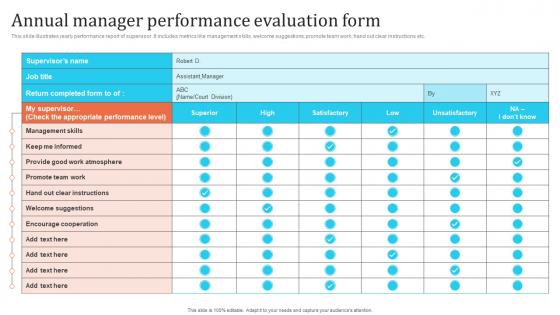
Annual Manager Performance Evaluation Form




Try Before you Buy Download Free Sample Product
 Impress Your
 Audience
 100%
100% Editable
 Save Hours
 of Time


This slide illustrates yearly performance report of supervisor. It includes metrics like management skills, welcome suggestions, promote team work, hand out clear instructions etc.
People who downloaded this PowerPoint presentation also viewed the following :
Annual Manager Performance Evaluation Form with all 6 slides:
Use our Annual Manager Performance Evaluation Form to effectively help you save your valuable time. They are readymade to fit into any presentation structure.





FAQs for Annual Manager
Honestly depends on what field you're in. Sales people track revenue, conversion rates, customer acquisition costs - the usual suspects. If you're in tech, focus on project timelines, code quality, system uptime. Healthcare's totally different though - patient outcomes and safety scores matter way more than anything else. Manufacturing cares about productivity and quality control. Retail looks at sales per square foot and inventory turnover. Don't overcomplicate it - pick like 3 or 4 metrics that actually move the needle for your role. I've seen people track a million things and it just becomes noise. Figure out what "winning" looks like in your position first, then work backwards from there.
Your performance metrics have to actually connect to what the company's trying to accomplish. Break down those big strategic goals into specific things employees can control and measure. Like if customer retention is the priority, track response times and satisfaction scores instead of vague "teamwork" stuff. Most places completely whiff on this connection - they end up with meaningless evaluations that don't change anything. Also, don't forget to update your framework yearly since priorities always shift. Otherwise you'll be measuring last year's goals while chasing this year's targets.
Dude, you've gotta get their input first. Most people actually want to be asked what they think instead of just getting lectured at. Ask them about their goals and what's bugging them before you even start the formal review stuff. Here's the thing - when employees feel heard, they'll actually care about whatever development plan you come up with together. You'll catch things you totally missed otherwise. It's like... why wouldn't you want their perspective? Makes the whole thing way less awkward and more productive.
So instead of trying to remember what everyone did months ago (impossible, honestly), you can use performance management software that tracks everything in real-time. AI tools are actually pretty good at catching bias in reviews and keeping things consistent across teams. 360-degree feedback platforms make collecting input from different people way less of a headache too. The trick is finding something that works with what you're already doing - nobody needs another system that makes everything harder. Oh, and the automated data collection thing? Total game changer for cutting down on all that manual work.
Ugh, performance reviews are such a minefield! Watch out for recency bias - you'll only remember what happened last month instead of the whole year. Then there's the halo effect where one amazing project makes you forget all their other work. I'm guilty of affinity bias too, favoring people who remind me of myself. The horns effect is brutal - one screw-up and suddenly everything they did looks terrible. Confirmation bias sneaks in when you cherry-pick examples that match your gut feeling. Honestly? Write down specific examples from the entire period beforehand. Maybe run it by another manager if you can.
Talk about what they DID, not who they are as a person. Like "your presentation jumped around too much - maybe try an outline next time" vs calling them scattered. I honestly think that sandwich method thing is kinda overdone, but you still gotta mention what's going well if you mean it. Ask stuff like "what do you need from me to fix this?" - turns it into problem-solving instead of just pointing out flaws. Oh and don't save it all for reviews. Make it feel more like you're helping them get better, not tearing them down.
Honestly, there's a bunch of ways to do this without traditional reviews. 360-degree feedback is solid - everyone evaluates each other. Customer satisfaction scores are clutch if your team deals with clients. I'm obsessed with team retrospectives though - they're basically casual sessions where people reflect on what bombed and what didn't. You could also track stuff like project completion rates or watch how they interact in meetings (sounds creepy but it's not lol). Peer reviews focusing on collaboration work well too. Mix the hard data with gut feelings and you'll get a real sense of how they're actually working together.
So basically, junior people get judged on whether they're learning and following the process you've set up. Can they take feedback? Are they hitting the basic requirements? Honestly, half the battle at that level is just showing up ready to work. Senior folks though - totally different game. You're looking at leadership stuff, strategic thinking, how they're mentoring others. Are they solving complex problems without you holding their hand? The key is matching your evaluation criteria to what actually matters for each role. Sounds obvious but you'd be surprised how many managers mess this up!
Honestly, performance reviews can either pump people up or totally crush their spirit. The difference? How you actually run them. Good ones with real feedback and clear growth paths make employees feel valued and motivated. But if you're just checking boxes or being harsh without offering solutions, morale tanks hard. I've watched whole teams get demoralized for months after terrible review cycles - it's painful to see. The trick is treating these like actual development conversations, not just pointing out what's wrong. Give specific examples, sure, but always pair criticism with actionable steps they can take.
Give them 1-2 weeks to fill it out before your meeting. But here's the thing - don't just ask "how'd you do?" Give them actual prompts about goals and what they want to work on. I always use their responses as talking points during the review. It's honestly pretty eye-opening when you realize how differently you both see their performance. Sometimes they're way harder on themselves than I'd be. The whole point is making it feel like you're figuring things out together, not quizzing them on the "right" answers. Let their input drive where the conversation goes.
Honestly, don't try cramming performance reviews into your regular team calls - it never works well. Set up separate video sessions just for reviews. Send materials beforehand so they can actually prep. Remote reviews get weird and one-sided super easily, so I ask way more open-ended questions than I would face-to-face. Body language is basically impossible to read through a screen anyway. Break longer reviews into chunks because Zoom fatigue is real and nobody's paying attention after 45 minutes. Oh, and send a written recap within a day while you both remember what was discussed.
Honestly, I'd go with quarterly check-ins. Annual reviews are such a waste - by the time you sit down, half the stuff that happened is ancient history. Monthly feels excessive unless someone's brand new or really struggling. Four times a year gives you enough runway to actually see how things are going without being annoying about it. Plus you can always grab coffee and chat informally if something comes up between meetings. Oh, and pick whatever schedule works but then actually stick to it. People hate surprises with this stuff.
Okay so the main thing is you can't just collect feedback and then do nothing with it - that's where most places mess up. Make actual development plans for people based on what you learned. Help them work on specific skills they're struggling with. Also watch for patterns that keep showing up across different teams. Like if everyone's confused about expectations, that's probably a management problem, not an employee problem. The follow-up part is huge though - check in regularly to see how they're doing. Don't make it one of those annual review things that everyone forgets about until next year.
Yeah, you definitely gotta adapt those frameworks by region. Americans love individual metrics and direct feedback - classic us, right? But try that in Japan and you'll tank morale since nobody wants to stand out from the group. Team evaluations work way better there. Scandinavian offices prefer peer reviews while Eastern Europeans expect more formal structure. Some cultures care more about relationships than hitting quarterly numbers too. Honestly, just ask your local HR folks what actually works before you mess it up with some generic approach.
Unconscious bias training is huge - that's what screws up most people doing evaluations. Legal compliance stuff is boring as hell but you really can't skip it or you'll run into discrimination problems. Your company will probably make you learn their rating system too, plus those calibration sessions where everyone practices scoring together (actually pretty helpful tbh). Oh and the feedback conversation part - don't just read about it, you need to actually practice having those awkward talks. Setting measurable goals and proper documentation are key too. Most places make you do refreshers every year since you forget this stuff fast.
-
The content is very helpful from business point of view.
-
Great product with highly impressive and engaging designs.