

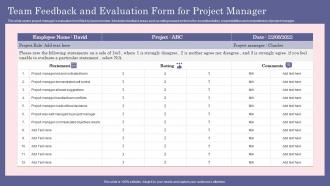
Team Feedback And Evaluation Form For Project Manager





Try Before you Buy Download Free Sample Product
 Impress Your
Audience
 100%
Editable
 Save Hours
of Time


This slide covers project managers evaluation form filled by team member. It includes feedback areas such as ratings based on the list for essential duties, responsibilities and competencies of project manager.
People who downloaded this PowerPoint presentation also viewed the following :
Team Feedback And Evaluation Form For Project Manager with all 6 slides:
Use our Team Feedback And Evaluation Form For Project Manager to effectively help you save your valuable time. They are readymade to fit into any presentation structure.





FAQs for Team Feedback And Evaluation Form
Definitely include performance metrics and how well they work with the team. Goal tracking is huge too. Add peer feedback sections - honestly, coworkers see stuff managers totally miss. Self-reflection questions work great for this. Mix in communication skills evaluation and ask about obstacles they're facing. Oh, and resources needed! That's always revealing. Don't just do ratings though. Get specific examples of both wins and areas to improve. Balance the number scores with actual written feedback. I'd test it with maybe 3-4 people first before sending it to everyone - you'll catch weird wording that way.
Honestly, just make it feel like a normal conversation instead of some corporate survey. Start with easy questions to get people going, then mix in rating scales and multiple choice stuff. Maybe one open-ended question max - nobody wants to write essays. Progress bars are clutch because people need to know what they're getting into. Oh, and definitely tell them upfront what you're actually gonna do with their answers. Clean design helps too, don't cram everything together. The biggest thing? Skip the business-y language completely. Write like you're talking to a friend.
Anonymous feedback is gold - people actually spill the truth when their name's not on it. Google Forms or SurveyMonkey work great for this, though honestly paper surveys can work too if you're going old school. Just make sure you can't trace responses back through writing style or specific details. Get enough responses so individual voices blur together, then share the results in chunks rather than one by one. Oh, and this is crucial - you've got to actually do something with the feedback or people will just stop bothering to respond.
Ditch the open-ended stuff - it never works. Instead of "what went wrong?" try "what's one thing we'd do differently next time?" Way better responses. I've filled out so many surveys that just ask "any feedback?" and honestly, they're pointless. You want specifics. Ask for examples, solutions, or have people rate actual behaviors. Oh, and make it anonymous if you can - people get weirdly honest when they're not worried about office drama. Focus on "what" and "how" questions that force real answers instead of just letting people complain.
Here's what I'd do - throw some open-ended questions right after each rating section. Like if someone gives communication a 3/5, ask "what communication improvements would help most?" Then add a few big-picture reflection questions at the end (honestly those usually give the best insights even when people groan about them). Oh and maybe grab key team members for quick verbal follow-ups since some folks are way better at talking than writing. The trick is making your qualitative stuff feel tied to the numbers, not like random extra work nobody wants to do.
Quarterly is the way to go, honestly. Monthly burns people out - I've watched whole teams just check out when there's constant feedback cycles. Once a year? Way too slow if you actually want to fix things. Four times a year hits that sweet spot where people can make real changes between sessions. Plus you start seeing actual patterns in what comes up. The consistency helps too - your team knows what to expect. Oh, and seriously put it on the calendar now or you'll blink and suddenly it's been eight months.
Track how fast people respond to messages and whether they actually show up to meetings. Also look at info sharing between projects - that's huge. I'd measure if conflicts get resolved well and honestly, the biggest one is follow-through on commitments. Like, do people actually do what they said they'd do? That tells you everything about real teamwork. Oh and feedback frequency too - how often teammates give each other useful input. Cross-department communication matters if that applies to your situation. Just pick 3-4 of these to start though, don't go crazy measuring everything.
Oh definitely focus on the communication stuff - like how people respond in Slack, whether their emails actually make sense, and if they speak up in video calls. Remote people get forgotten about way too easily, so ask about that inclusion piece. Also timezone handoffs are huge - nothing worse than waiting 8 hours for someone to pick up where you left off. Honestly, most feedback forms are still stuck in the office mindset. You want questions that actually match how your team collaborates now, whether someone's working from their kitchen table or the conference room.
Definitely cast a wider net when you're collecting feedback - hit up people across different levels and backgrounds, not just the usual suspects who always talk in meetings. Some folks are way more comfortable sharing privately, so mix it up with anonymous surveys, one-on-ones, maybe small group chats. Oh and ask specific questions about belonging and inclusivity instead of just the standard "how's work going" stuff. The whole point is making people feel safe enough to actually be honest with you. Then obviously you gotta follow through on what they tell you, otherwise what's the point?
Okay so feedback forms are actually super useful for finding skill gaps - you just gotta read them properly. Multiple people saying Sarah can't present or the team needs better project tools? That's a red flag right there. Most managers probably just stick these in a folder somewhere (honestly such a waste). What I'd do is make a basic spreadsheet tracking the same issues popping up everywhere. Focus on gaps that really mess with performance first. Then have actual conversations with people - like one-on-ones where you dig into what they're really struggling with. Way more helpful than just the surface-level stuff.
Honestly, forms just give you a snapshot of one moment. People tend to write what sounds "professional" instead of being real with you. Some folks are way better writers too, so their feedback always looks more polished. The real problem? You're missing all the actual human stuff - tone, body language, the whole vibe of how someone acts day-to-day. Like, someone might seem great on paper but be totally different in meetings. Forms are fine for getting baseline info, but you really need those one-on-ones and just paying attention to how people actually interact. That's where the truth is.
Skip the generic "rate this person 1-10" stuff - that's useless. Ask for specific examples instead, like "Tell me about a time they actually helped solve something." Make it anonymous too, because honestly, nobody wants their name attached to real feedback. Mix up your question types - some multiple choice, some where people can actually write stuff out. Oh, and maybe throw in a quick section asking people to check their own biases first? The whole point is creating a space where people feel safe being honest instead of just saying nice things to avoid drama.
For collecting feedback, I'd go with Typeform or Google Forms - both are super straightforward. Analysis-wise, Tableau and Power BI are solid choices, though honestly Excel works fine if you're not dealing with massive amounts of data. Text feedback is where it gets interesting - MonkeyLearn does great sentiment analysis, or Microsoft Forms has built-in features that'll sort comments into positive/negative buckets automatically. Oh, and if your team's already on Slack, feedback bots can save you tons of time. My advice? Start with something simple that does collection and basic analysis, then add more tools later.
Yeah, feedback forms are super flexible - just swap out sections based on your team type. Cross-functional teams need questions about department collaboration and who's doing what. Project teams should focus more on deliverables and timelines. Remote work? Add communication stuff because those gaps will bite you later, trust me. Creative projects need innovation questions, while tech teams want problem-solving and quality metrics. Honestly, I'd just grab a basic template and replace 2-3 sections that actually fit your situation. Way easier than starting from scratch.
Just carve out like 10-15 minutes in your regular meetings for quick feedback rounds. Have people share what's going well and what's not. Rotate who goes first so it doesn't get stale - honestly, nobody wants to always be the person starting these things. "Start, stop, continue" works great, or just go around the table. Don't make it feel like some huge formal review. Set basic rules about being specific instead of vague. Maybe try every other week first? Once people get used to it, the whole thing becomes way less awkward.
-
Definitely recommend SlideTeam to all who need help with PowerPoint presentations. Their design team can create anything you need.
-
“I required a slide for a board meeting and was so satisfied with the final result !! So much went into designing the slide and the communication was amazing! Can’t wait to have my next slide!”