


Peer Rating And Team Review Feedback Form




Try Before you Buy Download Free Sample Product
 Impress Your
 Audience
 100%
100% Editable
 Save Hours
 of Time


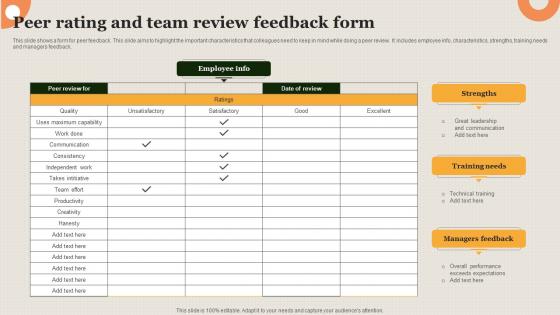
This slide shows a form for peer feedback. This slide aims to highlight the important characteristics that colleagues need to keep in mind while doing a peer review. It includes employee info, characteristics, strengths, training needs and managers feedback.
People who downloaded this PowerPoint presentation also viewed the following :
Peer Rating And Team Review Feedback Form with all 9 slides:
Use our Peer Rating And Team Review Feedback Form to effectively help you save your valuable time. They are readymade to fit into any presentation structure.








FAQs for Peer Rating And Team
Effective peer feedback forms include presentation clarity, content organization, delivery techniques, visual aid effectiveness, and audience engagement metrics. These elements streamline evaluation processes by capturing both strengths and improvement areas, enabling presenters to enhance their communication skills while providing structured assessment frameworks, with many organizations finding that comprehensive feedback forms ultimately deliver improved presentation quality and stronger team collaboration.
A peer feedback form can be structured with specific prompts for strengths, improvement areas, actionable suggestions, and goal-setting sections, while incorporating rating scales and open-ended questions. This strategic combination enables organizations to foster transparent communication, enhance team collaboration, and accelerate professional development, with many companies finding that structured feedback ultimately delivers stronger performance outcomes and workplace relationships.
Anonymity enables peers to provide candid, constructive feedback without fear of personal repercussions, workplace tensions, or damaged relationships. This approach encourages honest assessments of performance gaps, behavioral concerns, and improvement opportunities that colleagues might otherwise avoid discussing, ultimately delivering more accurate evaluations and fostering professional development across teams.
Balanced feedback requires structured guidelines that encourage specific, actionable observations while discouraging vague generalizations or extreme judgments. Effective peer feedback forms incorporate rating scales with descriptive criteria, prompt for both strengths and improvement areas, and include examples from successful organizations like consulting firms and healthcare institutions, ultimately delivering more credible assessments and meaningful professional development.
Peer feedback forms for presentations should assess content quality, delivery effectiveness, visual aid design, organization and structure, and audience engagement techniques. These criteria enable comprehensive evaluation by examining message clarity, speaker confidence, slide readability, logical flow, and interaction skills, with many organizations finding that structured peer assessment ultimately enhances presentation standards and professional development outcomes.
Peer feedback forms can be customized by adjusting evaluation criteria, question formats, and focus areas to match specific audiences, presentation contexts, and assessment goals. For academic presentations, forms emphasize research methodology and analytical depth, while business pitches prioritize market viability and strategic clarity, with many organizations finding that tailored feedback mechanisms deliver more actionable insights and enhanced presenter development.
Common pitfalls include overly complex questions, vague rating scales, lack of anonymity options, insufficient space for constructive comments, and focusing solely on weaknesses rather than balanced evaluation. These design flaws can discourage honest responses and reduce participation rates, with many organizations finding that streamlined, user-friendly forms ultimately deliver more meaningful insights and higher engagement levels.
Incorporate quantitative feedback through rating scales, numerical scores, performance metrics, and frequency measurements, while including qualitative elements like open-ended comment sections, specific example requests, and improvement suggestion boxes. This strategic combination enables comprehensive peer evaluation by capturing measurable data alongside detailed insights, with many organizations finding that balanced forms deliver more actionable feedback and enhance professional development outcomes.
Training peers to give effective feedback requires structured approaches including feedback frameworks like SBI (Situation-Behavior-Impact), active listening workshops, role-playing exercises, and peer observation sessions. These strategies enhance communication skills by teaching specificity, focusing on behaviors rather than personality traits, and emphasizing constructive dialogue, with many organizations finding that regular practice sessions and feedback coaching ultimately deliver improved team collaboration and performance outcomes.
Visual elements like progress bars, rating scales, color-coded sections, icons, and clear typography enhance feedback form response quality by improving user engagement, reducing cognitive load, and providing intuitive navigation pathways. These design features streamline the feedback process, minimize completion time, and encourage more thoughtful responses, with many organizations finding that well-designed visual interfaces significantly increase both response rates and overall feedback quality.
Feedback collected through peer evaluation forms can be utilized by identifying recurring themes across multiple reviews, implementing specific suggestions for content organization and delivery techniques, and developing targeted improvement plans for future presentations. This systematic approach enables presenters to enhance their communication skills, refine their message clarity, and build more engaging presentations, ultimately delivering stronger audience connections and more impactful business outcomes.
Follow-up discussions ensure feedback translates into actionable improvements by clarifying expectations, addressing concerns, and creating accountability for development goals. These conversations enable managers and peers to track progress, provide ongoing support, and adjust strategies based on implementation challenges, ultimately strengthening professional relationships and accelerating skill development across teams.
Technology streamlines peer feedback through automated distribution systems, real-time collaboration platforms, AI-powered sentiment analysis, and integrated performance dashboards. These digital solutions enhance efficiency by eliminating manual processes, providing instant feedback compilation, and delivering actionable insights, with many organizations finding that automated peer review systems reduce administrative time while improving feedback quality and employee engagement.
Open-ended questions in peer feedback forms enable deeper insights, personalized responses, constructive suggestions, specific examples, and actionable recommendations that closed questions cannot capture. These questions streamline feedback quality by encouraging detailed explanations, fostering meaningful dialogue, and ultimately delivering more valuable developmental insights, with many organizations finding that open-ended responses enhance professional growth significantly.
Peer feedback forms should be utilized at multiple stages throughout the presentation process, including during initial rehearsals, mid-development reviews, and final run-throughs before delivery. This strategic approach enables presenters to refine content, enhance delivery techniques, and build confidence incrementally, with many organizations finding that regular peer input ultimately delivers more polished presentations and improved audience engagement.
-
Nothing beats the well-formatted and professionally designed templates offered. Kudos to SlideTeam for their amazing collection of PPT slides.
-
The templates you provide are great! They have saved me tons of time and made my presentations come alive. Thank you for this awesome product. Keep up the good work!