


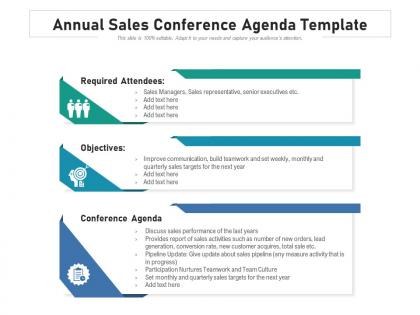
Annual sales conference agenda template




Try Before you Buy Download Free Sample Product
 Impress Your
 Audience
 100%
100% Editable
 Save Hours
 of Time


Our Annual Sales Conference Agenda Template are topically designed to provide an attractive backdrop to any subject. Use them to look like a presentation pro.
People who downloaded this PowerPoint presentation also viewed the following :
Annual sales conference agenda template with all 2 slides:
Use our Annual Sales Conference Agenda Template to effectively help you save your valuable time. They are readymade to fit into any presentation structure.
FAQs for Annual sales
So basically they want to pump everyone up and show off the Q2-Q4 product roadmap. There's CRM training too - hopefully it's better than last time. You'll sit through breakout sessions on closing deals and objections, which actually aren't terrible despite sounding super corporate. Leadership's gonna talk about new sales targets and territory shuffles. Definitely bring questions about your accounts since they always do manager one-on-ones. Oh and check your email for that prep stuff they sent - I think it was last week? The whole thing's really about getting everyone on the same page before the next quarter hits.
Definitely send out surveys afterward - ask about content quality, networking opportunities, that stuff. You want at least 60% of people responding or the data's kinda useless. Track your leads and see if deals actually close in the next few months. Social media buzz during the event is huge too, shows people are genuinely excited. Here's the real test though: are attendees asking about next year before this one's over? That tells you everything. I'd make a simple scorecard with maybe 4-5 metrics max so you're not drowning in data later.
Honestly, "Sales in the Age of AI" is pretty solid right now - everyone's buzzing about it anyway. I'm kind of obsessed with doing a "Sales Olympics" thing though. Different teams competing in challenges all day? Way less weird than forced networking. "Future-proofing Your Pipeline" covers more ground if you want broader appeal. "Breaking Barriers" hits hard for market expansion stuff. But here's the thing - don't just pick what sounds catchy. Figure out what you actually want people remembering when they leave, then work backwards from there. The theme should connect to real goals, not just look good on the banner.
Start with the basics, then build up to advanced stuff. That whole "tell them what you're going to tell them" thing actually works - newbies can prep mentally and the experienced people know what's ahead. Real examples are gold here. Everyone connects with good war stories, honestly. Maybe do breakout tracks by skill level? Oh, and define your jargon as you go. Won't bug the veterans but saves rookies from getting lost. I'd definitely run your content past people from different experience levels first - saves you from bombing later.
Honestly, just tell a story about the problem you're fixing and how it changes everything for them. Hook them right away, then hit maybe 3 solid benefits - that's it. Most decks are total disasters with random features nobody gives a shit about. Keep your slides super visual, barely any text. Practice those transitions until you're not stumbling around like an idiot. Always end with what you want them to do next - be specific. And seriously, bring a backup plan for when the projector inevitably breaks. Nothing's worse than standing there messing with cables while everyone checks their phones.
Try Mentimeter or Slido - seriously, people get weirdly excited about clicking buttons and watching results appear live. Set up a hashtag for the conference too. Oh, and those live Q&A platforms are gold since nobody wants to actually raise their hand anymore (totally get it). You could gamify things with a leaderboard if you're feeling ambitious. Even for in-person breakouts, throw in some virtual whiteboards or collaboration tools. The whole point is giving people different ways to jump in instead of just... sitting there zoning out.
Look, networking at these conferences is where the real money gets made. Skip some sessions if you have to - I'm serious about this. Those random conversations during coffee breaks? That's where million-dollar deals actually start. I watched a guy from our Phoenix office meet someone at the hotel bar and they ended up doing this massive partnership six months later. Crazy how that works. Don't pack your schedule too tight because you'll miss those moments when you're just chatting with someone and realize your clients would love what they're selling. Block out time to actually talk to people instead of running between presentations all day.
Dig up those feedback forms from last year's conference first - seriously, people forget about the goldmine sitting in there. Scan for complaint patterns about logistics, content, timing, whatever. Our catering was absolutely roasted in 2023 but honestly? Led to amazing food this year. Make a basic spreadsheet breaking issues into themes and impact levels. Share it with your committee, then hit the high-impact stuff that's actually easy to fix first. Don't go crazy trying to solve everything though. Pick maybe 3-4 key things to focus on so you'll actually nail them instead of half-assing ten different improvements.
Okay so definitely switch up your content every 20-30 minutes or people will zone out completely. Quick polls work great, or throw in some small group discussions. I always keep backup energizer activities ready because you never know when the room's gonna die. Stories beat data dumps every time - way more engaging. You could even gamify parts of it? Like team challenges or points systems, that stuff actually works. Oh and don't forget stretch breaks! Sounds silly but people get restless sitting there all day. Just watch for phone checking and be ready to pivot when needed.
Dude, success stories are like presentation gold - seriously the best way to grab people's attention. When you throw in real examples, the audience actually gets it instead of just staring at boring charts. I've watched talks go from mehh to amazing once someone drops a good customer win story. Just make sure you get approval first (learned that one the hard way). Don't dump them all at the end though. Sprinkle 2-3 throughout so people stay hooked. The data hits different when there's an actual story behind it, you know?
Oh man, venue capacity is always a nightmare - you think you have enough space then suddenly you don't. Catering headcounts are impossible to nail down too, I swear they're wrong every single time. A/V setup will definitely cause drama, and don't get me started on travel coordination when people cancel last minute. Room stuff like breakout spaces and parking becomes this whole thing. Also make sure people can actually hear what's going on (learned that one the hard way). Build in extra time for literally everything and have backups for your speakers and main tech. Trust me on this one.
Honestly, you've gotta start way earlier than you think - like 8-10 weeks out. Hit up email, your intranet, team meetings, Slack, whatever you've got. Here's the thing though - personal invites from managers absolutely crush those boring company-wide blasts. People actually open those. Focus on the good stuff: training sessions, networking, any cool speakers you snagged. Make registration super easy with one-click links because nobody has time for complicated forms. Then hit them with reminders at 4 weeks, 2 weeks, and 1 week out. Oh, and definitely track your open rates - that data's gold for planning next year's event.
Track your attendance rates and see who's actually engaging - are people asking questions, responding to polls, using that conference hashtag on social? The mobile app data is gold too. Check if attendees are downloading stuff, networking, browsing schedules. Honestly, the networking events matter more than most people think - mixers and breakouts are where the real magic happens. Survey folks during sessions for quick feedback on content. Oh, and definitely set up some kind of dashboard beforehand so you're not scrambling to pull numbers later.
Try breaking people into smaller groups - some folks are way more talkative when it's just 4-5 people instead of the whole room staring at them. Anonymous idea boxes work too, or those structured brainstorming things where everyone writes stuff down first. Walking meetings sound ridiculous but honestly they're pretty effective. Don't let the same people run every discussion either. You'll probably need to directly ask the quiet ones what they think - they're not gonna jump in on their own. The goal is just giving everyone different ways to contribute instead of hoping the loud people will somehow share the spotlight.
Dude, charts and infographics are your best friend here - way better than drowning people in text walls. Interactive stuff like polls or dashboards keeps everyone awake too. I'd focus on storytelling with your visuals - before/after shots, customer journeys, even basic icons work great. Nobody wants to sit through someone reading bullet points for 20 minutes (been there, it's painful). Start with your most confusing concepts and figure out how to show them visually first. Simple beats fancy every time - you want the info to actually stick, not just look pretty.
-
Graphics are very appealing to eyes.
-
Good research work and creative work done on every template.
-
Designs have enough space to add content.