


Application Of Wireless Sensor Networks In IoT




Try Before you Buy Download Free Sample Product
 Impress Your
 Audience
 100%
100% Editable
 Save Hours
 of Time


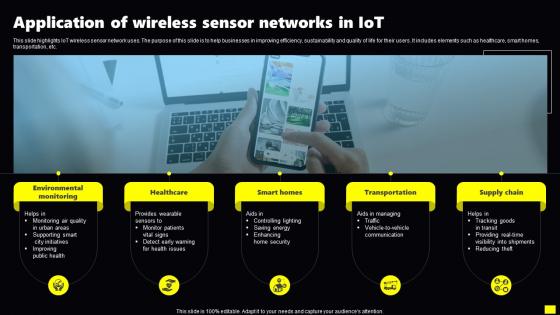
This slide highlights IoT wireless sensor network uses. The purpose of this slide is to help businesses in improving efficiency, sustainability and quality of life for their users. It includes elements such as healthcare, smart homes, transportation, etc.
People who downloaded this PowerPoint presentation also viewed the following :
Application Of Wireless Sensor Networks In IoT with all 9 slides:
Use our Application Of Wireless Sensor Networks In IoT to effectively help you save your valuable time. They are readymade to fit into any presentation structure.









FAQs for Application Of Wireless Sensor
The main components of a Wireless Sensor Network include sensor nodes, base stations, communication protocols, data processing units, and power management systems. These components work together by collecting environmental data, transmitting information wirelessly, and processing insights in real-time, with industries like manufacturing, agriculture, and healthcare finding that WSNs deliver enhanced monitoring capabilities, reduced operational costs, and improved decision-making efficiency.
WSN communication protocols prioritize energy efficiency, self-organization, and data aggregation, unlike traditional networks that focus on high throughput and reliability. These protocols use clustering, multi-hop routing, and sleep scheduling to minimize power consumption, with many industrial monitoring systems finding that specialized protocols like LEACH and ZigBee deliver significantly longer network lifespans.
Wireless Sensor Networks in smart cities include traffic management systems, environmental monitoring, energy grid optimization, waste management automation, and public safety surveillance. These interconnected sensors streamline urban operations by providing real-time data collection, predictive analytics capabilities, and automated response mechanisms, with many municipalities finding that integrated sensor deployment ultimately delivers reduced operational costs and enhanced citizen services.
Energy constraints fundamentally shape WSN design by requiring ultra-low-power components, efficient communication protocols, and strategic node placement to maximize battery life. These limitations drive innovations like sleep-wake cycling, data aggregation techniques, and energy harvesting solutions, with many industrial monitoring systems finding that optimized power management ultimately delivers years of autonomous operation while maintaining reliable data transmission across distributed networks.
Key security challenges in Wireless Sensor Networks include limited computational resources, vulnerable wireless communications, physical node tampering, energy constraints affecting encryption protocols, and scalable key management across distributed nodes. These constraints create unique vulnerabilities where traditional security measures often prove inadequate, with many organizations in healthcare, manufacturing, and smart city deployments finding that layered security approaches combining lightweight encryption, secure routing protocols, and physical protection ultimately deliver more robust network integrity.
Environmental factors significantly impact WSN sensor node performance through temperature variations affecting battery life and signal accuracy, humidity causing corrosion and connectivity issues, physical obstacles reducing transmission range, and weather conditions disrupting communication protocols. These challenges require robust deployment strategies, with industries like agriculture, manufacturing, and environmental monitoring finding that weatherproof enclosures, adaptive power management, and redundant network topologies ultimately deliver reliable data collection and operational efficiency.
Data aggregation optimizes WSN performance by reducing network traffic, minimizing energy consumption, extending battery life, and improving bandwidth efficiency through intelligent data processing at intermediate nodes. This approach enables healthcare monitoring systems, environmental sensors, and industrial automation networks to deliver faster response times, lower operational costs, and enhanced scalability, with many organizations finding that strategic aggregation ultimately delivers significant competitive advantages in data-driven operations.
Routing protocols in WSNs prioritize energy efficiency, data aggregation, and network lifetime over traditional metrics like throughput or delay, using cluster-based hierarchical structures and geographic positioning. Unlike conventional networks that focus on optimal path selection, WSN protocols employ duty cycling, multi-hop communication, and sensor fusion techniques, ultimately extending battery life while maintaining reliable data collection across distributed sensor deployments.
Technologies driving WSN scalability include mesh networking protocols, edge computing integration, 5G connectivity, AI-powered resource management, and energy harvesting solutions. These innovations enhance network capacity by enabling dynamic routing, distributed processing, and adaptive power management, with smart cities and industrial IoT deployments finding that strategic combinations ultimately deliver expanded coverage and operational efficiency.
Machine learning enhances Wireless Sensor Networks by optimizing energy consumption through predictive analytics, automating network topology management, and enabling intelligent data processing at sensor nodes. Through adaptive algorithms, organizations streamline battery life, reduce transmission overhead, and improve data accuracy, with applications in smart cities and industrial monitoring ultimately delivering cost-effective operations and extended network lifespans.
LoRaWAN offers significant benefits including long-range connectivity, low power consumption, cost-effective deployment, scalable network architecture, and robust security protocols for WSN applications. While it presents limitations like lower data rates and potential network congestion, many organizations in agriculture, smart cities, and industrial monitoring find that its ability to connect thousands of sensors across vast areas ultimately delivers enhanced operational efficiency and competitive advantage.
Wireless Sensor Networks serve as the foundational infrastructure for IoT ecosystems by providing distributed data collection, real-time monitoring capabilities, and seamless device connectivity across various environments. These networks enable organizations to gather comprehensive environmental data, automate decision-making processes, and create intelligent systems in smart cities, industrial facilities, and healthcare applications, ultimately delivering enhanced operational efficiency and data-driven insights.
Fault tolerance strategies for Wireless Sensor Networks include redundant sensor deployment, hierarchical clustering, dynamic routing protocols, data fusion techniques, and distributed consensus algorithms. These approaches enhance network reliability by automatically detecting failed nodes, rerouting data through alternative paths, and maintaining continuous monitoring capabilities, with many industrial and environmental monitoring systems finding that strategic redundancy ultimately delivers improved operational efficiency and reduced maintenance costs.
Different sensor types significantly impact data accuracy through varying precision levels, sampling rates, environmental tolerances, and calibration requirements, with temperature sensors offering high accuracy while motion sensors may provide broader ranges. Network functionality changes based on power consumption patterns, data transmission frequencies, and processing demands, with many IoT implementations finding that strategic sensor combinations deliver optimal performance while balancing accuracy, battery life, and operational efficiency.
Future trends in Wireless Sensor Network development include edge computing integration, AI-powered analytics, 5G connectivity, energy harvesting technologies, and blockchain security implementations. These advancements streamline data processing, enhance real-time decision-making, and minimize power consumption, with industries like smart manufacturing, healthcare monitoring, and environmental tracking finding that these innovations deliver faster insights, reduced operational costs, and significantly improved network reliability.
-
Great templates that you can use in your next keynote or conference. They are perfect for quick and visually-engaging delivery.
-
SlideTeam is my one-stop solution for all the presentation needs. Their templates have beautiful designs that are worth every penny!