

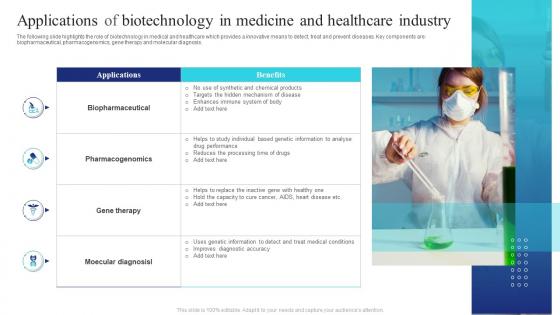
Applications Of Biotechnology In Medicine And Healthcare Industry




Try Before you Buy Download Free Sample Product
 Impress Your
 Audience
 100%
100% Editable
 Save Hours
 of Time


The following slide highlights the role of biotechnology in medical and healthcare which provides a innovative means to detect, treat and prevent diseases. Key components are biopharmaceutical, pharmacogenomics, gene therapy and molecular diagnosis.
People who downloaded this PowerPoint presentation also viewed the following :
Applications Of Biotechnology In Medicine And Healthcare Industry with all 6 slides:
Use our Applications Of Biotechnology In Medicine And Healthcare Industry to effectively help you save your valuable time. They are readymade to fit into any presentation structure.





FAQs for Applications Of Biotechnology In Medicine
Oh man, where do I even start? Recombinant DNA tech was huge - that's how we got insulin and growth hormones. Then monoclonal antibodies completely changed cancer treatment by targeting specific cells. PCR made diagnostics way better (literally saved us during COVID). CRISPR is the cool new kid that lets scientists edit genes super precisely. Now doctors can tailor cancer treatments based on your specific genetics, which is pretty wild. You should definitely look up CAR-T therapy - they're actually reprogramming people's immune cells to attack tumors. It's like science fiction but real.
So CRISPR is basically a game-changer because it makes gene editing super precise and way easier than before. Instead of just treating symptoms, you can actually fix genetic problems right at the DNA level. Wild stuff, honestly. They're already working on cures for things like sickle cell disease that we couldn't touch before. Plus it opens up personalized medicine - like, treatments designed specifically for your genetic makeup instead of generic drugs everyone gets. My cousin's doing research on this actually, says it's moving crazy fast. We're talking about medicine that's actually tailored to you as an individual.
So biologics are actually pretty amazing for chronic stuff like diabetes, MS, rheumatoid arthritis. Regular pills kinda blast your whole system, but these target the exact pathway that's broken. Monoclonal antibodies, insulin analogs - they work with your body instead of just masking symptoms. My aunt's been on one for her RA and it's been life-changing honestly. The downside? They're crazy expensive, which sucks. But if normal treatments aren't cutting it, definitely worth asking your doctor about. Sometimes insurance covers more than you'd expect too.
So biotech completely changed the vaccine game - instead of the old method of growing weakened viruses, scientists can now design them at the genetic level. mRNA vaccines got developed in weeks, not years (still crazy to think about). Genetic sequencing helps spot new variants fast, then vaccines get adapted quickly. The cool part? Multiple candidates can be tested at once using computer models and synthetic biology. Oh and pro tip - next pandemic, check WHO and CDC variant pages since they track everything with these biotech systems. It's honestly impressive how much faster everything moves now.
Oh man, this stuff keeps me up at night sometimes. Future generations can't exactly sign off on genetic changes we make today - that's terrifying when you think about it. Rich people will get all the fancy treatments while everyone else gets left behind, making inequality even worse. We're still figuring out what happens years down the road with off-target effects. The whole "designer baby" thing? Feels way too close to eugenics territory for my comfort. If you're diving into this field, just make sure there's solid ethical oversight and people are thinking beyond just fixing immediate problems.
So basically, biotech lets doctors customize treatments based on your exact DNA and how your body works. No more guessing games with meds! They can test which antidepressants will actually work for you instead of that awful trial-and-error thing. Cancer treatments are getting crazy precise too - they target your specific tumor mutations rather than just nuking everything. Honestly, the coolest part is predicting what'll work before you even try it. If you're dealing with patients, pharmacogenomic testing is everywhere now. Makes such a difference.
Dude, biotech has completely changed how we find new drugs. You can actually pinpoint exactly what's going wrong at the molecular level instead of just throwing random chemicals around hoping something works. Tools like CRISPR and genomic screening let you design drugs that target specific disease pathways. Way more efficient than the old days. Testing happens faster too with better lab models and imaging tech. Honestly, the AI-driven screening stuff is pretty wild - that's where companies are seeing huge speed improvements. Worth looking into if you're curious about this field.
Oh man, recombinant DNA totally changed everything for making medicines. So basically we stick human genes into bacteria or yeast, and they pump out proteins for us. Way better than the old days when scientists had to extract tiny amounts from dead bodies - yikes, right? Now we get tons of insulin, growth hormone, all that stuff. The cool part is these proteins are exactly like what your body makes naturally, so fewer weird reactions. Most protein drugs you see today? They're made this way. It's pretty much become the go-to method.
So researchers are using CRISPR and other biotech tools to basically program stem cells - telling them exactly where to go and what to become. They're 3D printing tissue structures and using growth factors as like cellular GPS. Pretty crazy that we can now control stem cell behavior so precisely. Early trials are showing promise for spinal injuries and heart disease, plus they're actually growing organs in labs now (though that still feels sci-fi to me). Clinical trials are where the real action is if you want to see what's moving beyond just lab experiments.
Dude, biotech is rough. FDA approval alone takes years and costs insane money - like millions just for trials. Patent stuff gets messy fast, plus you're always racing competitors. The worst part? Your drug can totally bomb in Phase III after you've already burned through everyone's cash. Regulations keep shifting too, which is annoying but whatever. Insurance companies are another headache with reimbursement fights. Honestly, if you're thinking about investing, stick with companies that have multiple drugs in their pipeline and decent cash reserves. They'll survive the inevitable disasters better.
So basically, biotech has made medical tests crazy precise now. They can spot diseases by looking at your actual genes, proteins, and tiny pathogens - like how COVID tests use PCR technology. The cool part? Doctors can catch stuff way before you feel sick. Some tests even predict how you'll respond to specific treatments based on your DNA, which honestly blows my mind. If certain diseases run in your family, definitely ask your doctor about the newer screening options. Way better than waiting around for symptoms to show up.
So there's actually some cool stuff happening with biotech and antibiotic resistance. Phage therapy is probably the most interesting - basically using viruses to kill specific resistant bacteria. Sounds crazy but it works. AI is speeding up drug discovery too, finding new compounds way faster than before. CRISPR can mess with the resistance mechanisms directly. Oh, and they're doing personalized treatment now - sequencing your infection to pick the right antibiotic. Combination therapies are showing the best results in trials right now though, so I'd focus there if you're looking into this stuff.
Dude, the coolest stuff happening right now is personalized medicine - they're literally tailoring treatments to your specific DNA. AI can already catch diseases super early, way before doctors spot them. CRISPR gene editing is wild too, actually fixing problems at the source instead of just managing symptoms. Those microscopic robots delivering cancer drugs directly to tumors? That's not even future tech anymore, it's happening. Honestly, the whole one-size-fits-all medicine thing is about to be toast. You should check out what Moderna and 23andMe are up to if you want to see where this is all going.
So basically, bioinformatics lets you crunch huge datasets to find patterns in diseases that you'd never spot by hand. You can compare genetic sequences from thousands of patients and identify biomarkers. The computational power is honestly insane. It's perfect for complex diseases where normal methods just don't cut it - you know, the tricky multi-factor ones. Algorithms help connect dots between genomics, proteomics, and clinical data to show how diseases actually function at the molecular level. Check out NCBI databases or mess around with some basic sequence tools to get a feel for it.
So biotech is what makes biosensors actually work - it provides all the biological stuff that does the detecting. Think engineered enzymes, antibodies, DNA sequences that bind to specific things like glucose or hormones. The neat thing is we can tweak these biological parts to be way more stable than what you'd find in nature. Combine that with some electronics and you get real-time health data. Honestly, the hardest part is probably figuring out which biomarkers you actually care about measuring first. There's so many options it's kind of overwhelming.
-
Topic best represented with attractive design.
-
The Designed Graphic are very professional and classic.