


Artificial Intelligence In Telecommunication Industry Training Ppt





Try Before you Buy Download Free Sample Product
 Impress Your
 Audience
 100%
100% Editable
 Save Hours
 of Time


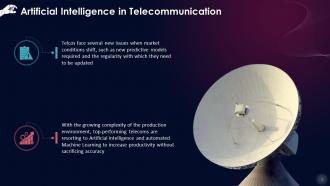
This slide discusses the importance of Artificial Intelligence in the telecommunications industry. Telcos face several new issues when market conditions shift, such as new predictive models required and the regularity with which they need to be updated. Hence, the adoption of AI technologies becomes important as they increase productivity without sacrificing accuracy.
People who downloaded this PowerPoint presentation also viewed the following :
Artificial Intelligence In Telecommunication Industry Training Ppt with all 17 slides:
Use our Artificial Intelligence In Telecommunication Industry Training Ppt to effectively help you save your valuable time. They are readymade to fit into any presentation structure.














FAQs for Artificial Intelligence In Telecommunication
AI optimizes telecommunications network performance through predictive maintenance, dynamic resource allocation, traffic routing optimization, anomaly detection, and automated network configuration adjustments. These technologies streamline operations by preventing outages before they occur, balancing loads across infrastructure, and enhancing signal quality, with many telecom providers finding that AI-driven optimization reduces operational costs while delivering faster, more reliable customer experiences.
Machine learning algorithms enhance predictive maintenance by analyzing equipment performance data, identifying failure patterns, and predicting potential breakdowns before they occur. Through IoT sensors and advanced analytics, telecom operators can reduce downtime by 30-50%, optimize maintenance schedules, and significantly lower operational costs, with many networks finding that predictive approaches deliver superior service reliability.
AI improves telecommunications customer service through intelligent chatbots, predictive analytics, automated troubleshooting, personalized recommendations, and real-time sentiment analysis. These technologies streamline operations by reducing wait times, resolving technical issues faster, and delivering proactive support, with many telecom providers finding that AI-driven solutions ultimately enhance customer satisfaction while significantly reducing operational costs.
Ethical considerations include data privacy protection, algorithmic bias prevention, transparency in automated decisions, customer consent protocols, and equitable service access across demographics. These challenges present opportunities for telecom companies to build trust through responsible AI governance, with many providers finding that ethical frameworks ultimately deliver stronger customer relationships and competitive differentiation.
AI strengthens telecommunications security by deploying machine learning algorithms for real-time threat detection, behavioral analysis for anomaly identification, and automated response systems for immediate threat mitigation. Through predictive analytics and pattern recognition, telecom providers can proactively identify vulnerabilities, minimize network breaches, and enhance customer data protection, ultimately delivering stronger cybersecurity frameworks and competitive operational resilience.
AI significantly reduces telecom operational costs through network optimization, predictive maintenance, automated customer service, and intelligent resource allocation. These technologies streamline operations by minimizing equipment downtime, reducing manual interventions, and optimizing bandwidth usage, with many telecom providers finding that AI-driven solutions deliver 20-30% cost savings while enhancing service quality and operational efficiency.
AI-driven analytics transforms telecom customer experience by enabling predictive service maintenance, personalized plan recommendations, real-time network optimization, and automated issue resolution. Through machine learning algorithms, telecom companies can anticipate network congestion, customize service offerings based on usage patterns, and deliver proactive support, ultimately reducing customer churn while enhancing satisfaction and operational efficiency.
Integrating AI into telecom systems presents challenges including legacy infrastructure compatibility, data quality and standardization issues, cybersecurity vulnerabilities, regulatory compliance complexity, and workforce skill gaps. While these obstacles require strategic planning and investment, many telecom operators find that phased implementation approaches, comprehensive staff training, and robust security frameworks ultimately deliver enhanced network efficiency, improved customer experiences, and significant competitive advantage.
AI facilitates 5G rollout by automating network optimization, predicting equipment failures, and streamlining resource allocation across cell towers and infrastructure. Through machine learning algorithms, telecommunications companies enhance signal quality, reduce latency, and deliver faster connectivity, while AI-powered analytics enable predictive maintenance and seamless user experiences, ultimately providing competitive advantage in increasingly connected markets.
AI assists in managing peak loads through predictive analytics, dynamic resource allocation, intelligent traffic routing, automated scaling protocols, and real-time network optimization. These technologies enable telecom operators to anticipate demand surges, redistribute network capacity seamlessly, and maintain service quality during high-traffic events, with many providers finding that AI-driven load management reduces network congestion by up to 40% while ensuring consistent customer experiences.
Successful AI implementations in telecommunications include Vodafone's predictive maintenance reducing network downtime, AT&T's AI-powered fraud detection systems, and Deutsche Telekom's chatbots handling customer inquiries. These strategic applications streamline operations by automating network optimization, enhancing security protocols, and improving customer experiences, with many telecom providers finding that AI delivers significant cost reductions and competitive advantages.
NLP revolutionizes telecom customer support by enabling automated chatbots, intelligent call routing, and real-time sentiment analysis during customer interactions. Through advanced language understanding, telecom companies streamline query resolution, reduce wait times, and enhance customer experiences, with many providers finding that NLP-powered systems deliver significantly faster service while minimizing operational costs.
AI-powered predictive analysis in telecommunications will increasingly enable operators to anticipate customer churn, optimize network resources, and personalize service offerings through advanced machine learning algorithms. These capabilities will revolutionize customer retention strategies, network planning, and revenue optimization, with telecommunications companies ultimately delivering more responsive services while significantly reducing operational costs and enhancing competitive positioning.
AI-driven automation transforms telecom workforce dynamics by eliminating routine tasks, creating demand for advanced technical skills, and enabling employees to focus on strategic initiatives like network optimization and customer relationship management. While some traditional roles become obsolete, many telecom companies find that automation generates new positions in AI management, data analytics, and service innovation, ultimately delivering enhanced operational efficiency and competitive advantage.
AI enhances voice and speech recognition in telecom through natural language processing, machine learning algorithms, deep neural networks, and acoustic modeling technologies. These systems streamline customer interactions by enabling accurate voice commands, real-time language translation, and automated call routing, with many telecom providers finding that AI-powered recognition delivers faster customer service, reduced operational costs, and significantly improved user experiences across voice-activated services.
-
I am really satisfied with their XYZ products. Used their slides for my business presentations and now I am taking their help for my son's high-school assignments. Super satisfied!!
-
“Excellent service from the customer support team when I wanted a slide that was a bit different from those on their standard menu. Super helpful.”